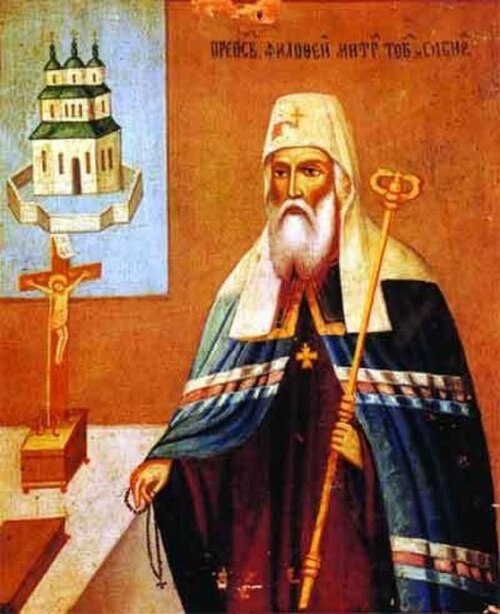
Saint
Philotheus of Tobolsk
Metropolitan of Siberia and Tobolsk
Metropolitan of Siberia and Tobolsk from 1702, died at Tyumen in 1727, honored among the Siberian saints.
Life
Saint Philotheus Leszczynski, the Hierarch (in the schema Theodore, about 1650 to 1727), was from 1702 metropolitan of Siberia and Tobolsk, sent by Tsar Peter I to govern a diocese stretching from the Urals to the Pacific Ocean. Born in Ukraine, he was an ascetic at the Kyiv Caves Lavra, then a pastor, missionary and builder of churches in Siberia. He fell asleep at Tyumen in 1727 and is venerated in the Synaxis of the Siberian Saints.
Origins and beginnings
Fyodor Leszczynski was born about 1650 at Krolevets, to a noble family of Little Russia. Some authors today give his parents as the grand treasurer and vice-chancellor of the crown, Bogusław Leszczyński, and Anna von Dönhoff, and his baptismal name as Raphael, but this is a mystification. The son of hereditary Catholics of the ruling elite of Poland could not have entered an Orthodox school and then served as an ordinary priest in an Orthodox parish, and in the Leszczyński genealogies no such person is noted.
He was educated at the Mohyla Academy in Kyiv. After his studies he married and for some years served as a parish priest, but, widowed, he entered the Kyiv Caves Lavra, where he was tonsured a monk. For his rare piety and his particular experience and competence in affairs he was, after a time, chosen steward of the Lavra. Later he was raised to the post of abbot of the Bryansk-Svensky monastery, with the rank, by some data, of archimandrite and by others of builder, without being relieved of his duties as steward of the Lavra.
Metropolitan of Siberia
In fulfilment of the decree of Tsar Peter I of 18 June 1700, he was consecrated metropolitan of Tobolsk and Siberia on 4 January 1702, at Novgorod, and sent to Tobolsk together with several learned monks. The consecration was performed by Metropolitan Stephen (Yavorsky), Saint Dimitry of Rostov and Metropolitan Parthenius Neboza of Laodicea.
The metropolia of Tobolsk then stretched from the Ural Mountains to the Pacific Ocean and from the Arctic Ocean to the Kirghiz steppes and Dauria, about ten thousand versts long and three thousand wide. A separate diocese for eastern Siberia was established only in 1721, after Philotheus's final retirement. He carried out all the work of governance personally, without assistants, except in the period 1707 to 1714.
In 1703 he obtained from Peter I permission to open at Tobolsk the first Slavonic-Russian parish school in Siberia, when such schools existed only in Kyiv, Moscow, Chernigov and Rostov. By 1704 he had enlarged the Saint Sophia Cathedral at Tobolsk and made in it a carved iconostasis, with a thousand roubles asked of Peter. In the same year he founded the first church choir, from Cossacks exiled to Siberia.
The missionary
From 1705 he began to spread Orthodoxy in Siberia. He sent, under Archimandrite Martin, the first mission to Kamchatka, but the attempt did not succeed, because of the population's hostility to the Cossacks. In 1706, at the tsar's command, he sent missionaries to baptize the Ostyak tribes, but even then results were not great.
From 1711 to 1715, having received the schema and being in his seventh decade, he personally engaged in mission among the non-Christian tribes of the diocese, systematically destroying objects of pagan worship and preaching Orthodoxy, with great success. In 1715, at the death of Saint John of Tobolsk, the tsar again laid on him the governance of the diocese. Obeying the tsar's will, he returned to Tobolsk in 1717, but did not leave the missionary work and personally baptized several Ostyak tribes. He governed the diocese until 1720, when Peter I reluctantly let him retire. From then until the end of his life he went on preaching Orthodoxy.
Repose and fruit of his labour
He fell asleep on 31 May 1727 in the Holy Trinity monastery at Tyumen, where he was buried before the entrance to the cathedral, so that, as his will says, passers-by might trample his dust underfoot. Later a marble slab with his portrait was placed over the grave.
In the twenty-five years of his episcopate the number of churches in Siberia grew from 160 to 448, and in the building of thirty-seven of them he took part personally. He rebuilt in stone the Holy Trinity monastery at Tyumen, destroyed by fire, the first stone monastery in Siberia, for which he asked special permission from Peter I, since at that time building in stone in Russia outside Saint Petersburg was strictly forbidden. Through his efforts the Church received large tracts of land in Siberia to strengthen its economic position, and many bureaucratic obstacles that hindered the free movement of clergy were removed.
Veneration
The saint is commemorated in the Synaxis of the Siberian Saints, on 10 June by the old calendar (one source gives 10 July). His relics are kept, according to the account, at the Holy Trinity monastery in Tyumen. In 2007 a monument was raised near the monastery, a sculptural group showing the metropolitan in liturgical vestments, surrounded by Ostyaks and Voguls in national dress. A park of Saint Philotheus has been laid out beside it. The saint is also a character in the novel "Tobol" by A. V. Ivanov (2017).
Commemorated the same day June 10
 Etheldreda of ElyVenerable · Abbess of ElyJun 10
 Olivia of PalermoMartyrJun 10
 John of TobolskSaint · Metropolitan of TobolskJun 10
 Maximus of AveiaMartyr · Deacon and martyrJun 10
 Basil of RyazanSaint · Bishop of Ryazan and MuromJun 10
 Mitrophan Chi SungHieromartyr · First Chinese Orthodox priestJun 10
 Dosifei of KyivVenerable · Rassophore at the Kiev Caves LavraJun 10
 Gerasim DobroserdovSaint · Bishop of AstrakhanJun 10
 Paul of TobolskSaint · Metropolitan of TobolskJun 10
 Schema-abbess Tamar MarjanishviliConfessor · Georgian schema-abbessJun 10
 Dalmat of IsetskVenerable · Founder of Dalmatov MonasteryJun 10
 Antonia and AlexanderHoly MartyrsJun 10