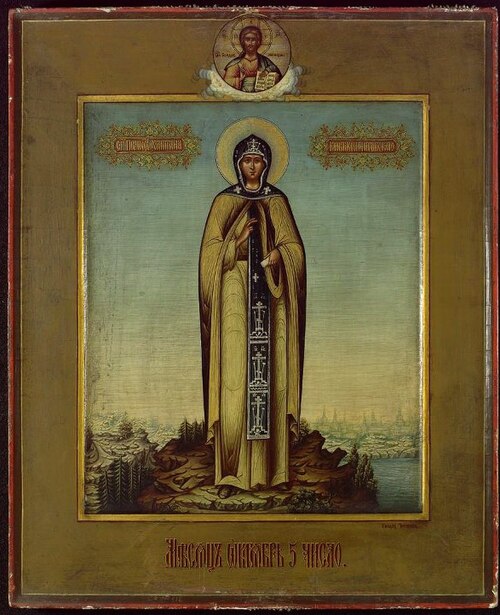
Venerable
Charitina of Lithuania
Nun of Novgorod
Noblewoman of still pagan Lithuania who became a nun in Novgorod; died in 1281, her Life has not survived.
- Feast
- October 5old style October 18
- Reposed
- 128113th century
- Order
- Venerables
Life
Venerable Charitina of Lithuania was a noblewoman from still pagan Lithuania who became a nun at Novgorod and rose to be abbess of the convent of Saints Peter and Paul. She reposed in 1281 and is commemorated on 5 October. Her written Life has not survived, so little is known, and part of her story rests on popular tradition.
Origins
The most important surviving testimony is the inscription on her gravestone in the church of Saints Peter and Paul on Sinichya Hill in Novgorod: she came from a family of Lithuanian princes and was a nun of the convent that owned the church. She was born when Mindaugas was founding the Grand Duchy of Lithuania. The second half of the thirteenth century was a stormy and bloody time for Lithuania, and many Lithuanian nobles moved with their families to the Rus lands. Among them Prince Dovmont (a saint, died 1299) settled at Pskov, and Tautvilas fled with his whole court from Polotsk to Novgorod.
According to popular tradition, the young Charitina left her homeland too, with her parents. She is said to have been betrothed to Prince Theodore Yaroslavich, brother of Saint Alexander Nevsky, but Theodore died unexpectedly on the eve of the wedding, in 1233. Some scholars think tradition here confuses her with another bride of the same prince. In 2009 the Lithuanian literary historian Algimantas Bučys suggested that she might be a daughter of Tautvilas, who fled to Novgorod after her father was murdered by Treniota.
Monastic life
Remaining unmarried, she was tonsured with the name Charitina, which means "the merciful one", in the convent of Saints Peter and Paul on Sinichya Hill. The tale says she sought nothing more in the world and wished to give her life to God. Like all the sisters she did her obediences and grew in humility, abstinence, fasting and prayer. Her pure life led the sisters to choose her as abbess, and to the end she was an example of humility and purity for her community.
Veneration
According to church tradition she finished her labours on 5 October 1281, the day of the memory of the Holy Martyr Charitina. Soon after her death a local veneration began in the convent. She is regarded as protectress of Lithuania, and the Russian Church commemorates her on 5 October.
Commemorated the same day October 5
 Hippolytus of RomeHieromartyr · Theologian of RomeOct 5
 Dionysius the GreatSaint · Patriarch of AlexandriaOct 5
 Philip of MoscowHieromartyr · Metropolitan of MoscowOct 5
- John MauropousSaint · Metropolitan of EuchaitaOct 5
 Charitina of AmisusMartyr · Martyr of AmisusOct 5
 Gregory of KhandztaVenerable · Abbot and founder of monasteriesOct 5
 Placidus of TrasaccoHieromartyr · Roman priestOct 5
 MeinolfSaint · German archdeaconOct 5
 Ampelius of BordigheraVenerableOct 5
 Onesimus PylaevHieromartyr · Bishop of TulaOct 5
 PeregrinaMartyrOct 5
 Galla of RomeSaintOct 5