Hieromartyr
Placidus of Trasacco
Roman priest
Roman priest martyred at Trasacco in Italy during the persecutions of Christians.
Life
Holy Hieromartyr Placidus of Trasacco was a Christian priest in third-century Italy. According to local tradition he received the crown of martyrdom at Trasacco, near Lake Fucino, in the year 237, during the persecution begun by Emperor Maximinus Thrax.
Very little is known for certain about his life. The Church honours him as one of the martyrs before Saint Constantine the Great, and his relics, brought from the catacombs of Rome, are kept today at Montecarotto in Italy.
What is known
Placidus should not be confused with another and far better known Placidus venerated at Messina in Sicily. Of Placidus of Trasacco the sources say only that he was a Christian priest who lived in the third century.
Medieval legends, drawn from a note in the Martyrologium Hieronymianum, made him one of the two beloved disciples of Saint Benedict of Nursia, together with Maurus. The same account speaks of other saints commemorated on 5 October who were all supposedly killed at Messina in the sixth century, in a raid by pirates whom Peter the Deacon wrongly took to be Arabs.
Martyrdom at Trasacco
To understand the martyrdom of Placidus, the sources point to the sacrifice of the priest Cesidius, a native of Trasacco. Cesidius was entered in the Roman Martyrology in 1583 by Cardinal Caesar Baronius, at the request of the historian's father Camillo, whose wife Porzia Febonia came from Trasacco.
The Roman Martyrology records the death of the priest Cesidius on 31 August, together with other Christians of the Lake Fucino area. The account, probably taken from a Latin passion connected with the Acts of Saint Christopher, says that three priests, Cesidius, Placidus and Eutychius, fell victim to the persecution ordered by Emperor Maximinus Thrax. Almost nothing more is known of Eutychius.
The three priests were killed during the Divine Liturgy at Trasacco. There Bishop Rufinus of Assisi, the father of Cesidius, had founded a church and entrusted it to his son. An unknown number of the faithful died with them.
That church was destroyed in 936 during an incursion of the Magyars and was rebuilt as the Church of Saints Cesidius and Rufinus.
The link with Saint Cesidius
Placidus is thought to have come from the land of the Marsi and to have met Cesidius after the latter, released from imprisonment suffered with his father at Amasya in Asia Minor, took refuge in the West at Trasacco. Only later did Rufinus settle in Assisi.
According to this reconstruction, Cesidius was condemned to death for secretly taking away the body of his father, who had been martyred at Assisi after a second imprisonment. The killing of Placidus, Eutychius and the faithful present at the Liturgy followed mainly from the sentence passed on Cesidius.
After the martyrdom, the remains of Placidus were taken away in secret and carried to Rome, where they stayed until 1686. Removing the bodies of martyrs was then a crime punishable by death, and Christians did it at great risk.
The translation of the relics to Montecarotto
In 1686, with the permission of Pope Innocent XI, the martyr's relics were taken from the catacomb of Calepodius in Rome and brought to Montecarotto. Calepodius was a Roman priest killed five years before Placidus by order of Emperor Alexander Severus.
At that time many relics were taken from the Roman catacombs and given to churches. The request for Montecarotto seems to have been supported by the Cybo-Malaspina family: Bishop Lorenzo Cybo of Jesi had died there in 1680, and his brother, Cardinal Alderano Cybo, was the pope's Secretary of State.
The choice fell on Placidus. His relics reached Montecarotto on 5 October, the day on which the monk of Messina was commemorated, and since then the two saints have often been confused.
On 6 July 1693, during a canonical visitation, Monsignor Orazio Perozzi carefully examined the reliquary and the relics. He checked the seals placed in Rome when the relics were removed and authenticated, and allowed them to be displayed for the veneration of the faithful.
Later legend
After 1843 a legend spread in Montecarotto that made Placidus the nephew and favourite disciple of Saint Benedict, sent to Sicily to found monasteries and killed by raiders, Saracens or Vandal pirates. Historians reject this identification.
The relics of Placidus of Messina were found in that city on 4 August 1588 and have been kept in Sicily ever since. This shows that the two saints are different people, probably linked only by their name.
The Martyrologium Hieronymianum also mentions a Placidus and a Eutychius killed in Sicily and commemorated on 5 October, with a varying number of companions: thirty in some manuscripts, eight in others. The identity and period of these martyrs cannot be established with certainty.
The origin of the relics in the Roman catacombs, however, shows that the martyr of Montecarotto belongs to the age of persecution before Constantine the Great.
Veneration
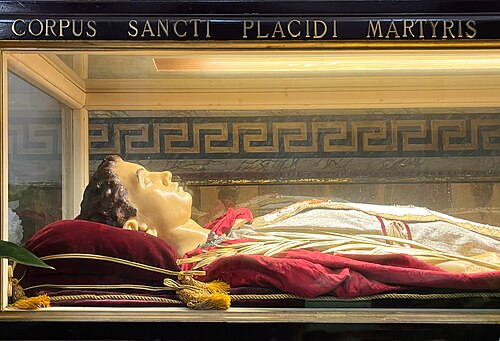
In 1843 Pope Gregory XVI formally recognised Saint Placidus as patron of Montecarotto and fixed his feast on 5 October. Since then he has often been depicted in the habit of a Benedictine monk, although his relics are clothed in ancient Roman dress.
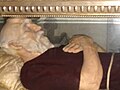
On 5 October 1948 his bones were placed in a new reliquary and clothed in Roman civil dress, in the likeness of a young man. The wax figure holds a palm branch along the right arm, the sign of the martyrs' victory. The choice of lay clothing recalls that before Constantine priests did not wear distinctive dress outside the services.
The relics of Saint Placidus are kept today in the Church of the Santissima Annunziata in Montecarotto, in a glass reliquary in the side chapel of the Mother of God. The church also has a gilded wooden statue from 1695 inscribed "Saint Placidus Martyr", though by its appearance it seems rather to depict Saint Florian. His feast is kept on 5 October.
Commemorated the same day October 5
 Hippolytus of RomeHieromartyr · Theologian of RomeOct 5
 Dionysius the GreatSaint · Patriarch of AlexandriaOct 5
 Philip of MoscowHieromartyr · Metropolitan of MoscowOct 5
- John MauropousSaint · Metropolitan of EuchaitaOct 5
 Charitina of AmisusMartyr · Martyr of AmisusOct 5
 Charitina of LithuaniaVenerable · Nun of NovgorodOct 5
 Gregory of KhandztaVenerable · Abbot and founder of monasteriesOct 5
 MeinolfSaint · German archdeaconOct 5
 Ampelius of BordigheraVenerableOct 5
 Onesimus PylaevHieromartyr · Bishop of TulaOct 5
 PeregrinaMartyrOct 5
 Galla of RomeSaintOct 5