Hieromartyr
Hippolytus of Rome
Theologian of Rome
One of the great Christian thinkers of the second and third centuries, who died in exile in Sardinia around 235.
Life
The Holy Hieromartyr Hippolytus of Rome was one of the most important Christian thinkers of the second and third centuries and died a martyr, in exile, in Sardinia, around 235. Much about his life remains uncertain: neither Eusebius nor Jerome, though they had read his works, could say at the head of which community he stood. He is a saint of the undivided Church, whose memory appears in the Orthodox calendar on 30 January and in the Western calendar on 13 August.
Life and writings
He is thought to have been born around 170 (other sources give 165), of Greek descent, and to have worked in Rome. He wrote in Greek, and his education was Hellenic. Scholars disagree on his place of service: many have taken him for a presbyter at Rome in the days of Pope Zephyrinus (199 to 217), but older traditions call him bishop of Portus near Rome, and other theories connect him with Palestine, Egypt or Anatolia. Origen, then a young man, is said to have heard him preach at Rome. Patriarch Photios calls him a disciple of Saint Irenaeus of Lyons, who is said to have been a disciple of Saint Polycarp, but this chain is doubtful.
His writings range across exegesis, homiletics, apologetics, polemic, chronography and church law, and in variety are compared with Origen's. The biblical commentaries are regarded as authentic: On Daniel, On David and Goliath, On the Song of Songs (partly preserved), On the Blessings of Isaac and Jacob, and On the Antichrist. The commentary on Daniel contains the earliest reference to the celebration of the Nativity of the Lord on 25 December. The commentary on the Song of Songs is the earliest preserved Christian interpretation of the book, in which the bridegroom is Christ and the bride the Church. On Christ and the Antichrist, from around 200, sets out his teaching on the second coming and rejects the idea that the end is near: six thousand years must pass from the Creation.
Other works ascribed to him, among them the Refutation of All Heresies (Philosophumena) and the Apostolic Tradition, are now disputed. The Refutation circulated long among the works of Origen; its books IV to X were found, without the author's name, in a monastery on Mount Athos in 1842, and recent scholarship prefers to treat it as the work of an unknown author. The Apostolic Tradition, which contains the earliest known ordination rite, is usually ascribed to him, but its authorship is hotly contested. The oldest mention of infant baptism is found, according to some, in a work of his.
Conflict with the popes
According to an older theory, Hippolytus came into conflict with the popes of his day: he accused Zephyrinus of modalism and was scandalized that Callixtus I gave absolution for grave sins such as adultery, and for a time he is said to have headed a dissident group as a rival to the bishop of Rome, being counted the first antipope. He is thought to have gone on attacking Popes Urban I and Pontian. Wikipedia presents this as one theory among others. In any case, he is said to have been reconciled to the Church before dying as a martyr.
Exile and martyrdom
In the persecution under Emperor Maximinus Thrax, Hippolytus and Pope Pontian were exiled in 235 to Sardinia, probably to the mines, where Hippolytus died. He was very probably reconciled to the Church before his death, for under Pope Fabian (236 to 250) his body and that of Pontian were brought to Rome. The Chronography of 354, also called the Liberian Catalogue, says that on 13 August, probably in 236, the two bodies were buried, that of Hippolytus in a cemetery on the Via Tiburtina, his funeral conducted by Justin the Confessor. The document calls him a priest, not a bishop, which shows that the schismatic had been received back into the Church. By about 255 he was considered a martyr.
The statue and the legends
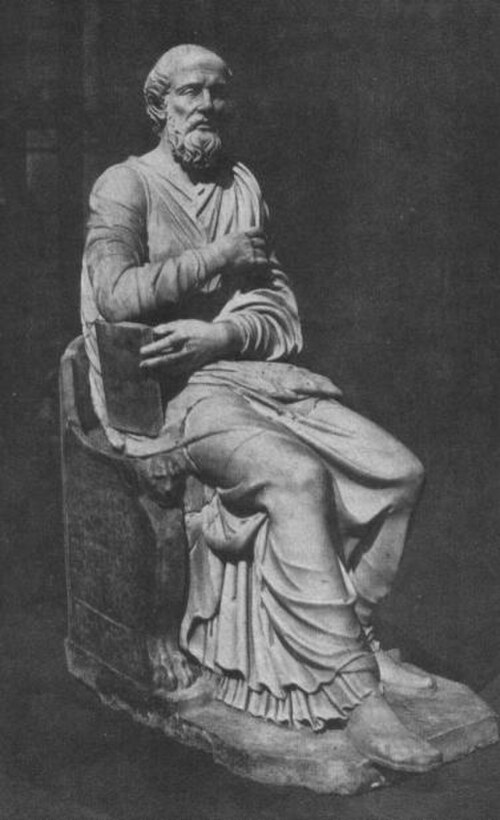
In 1551 a marble statue of a seated figure, heavily restored, was found on the Via Tiburtina, with a paschal cycle carved on the sides of the seat and the titles of several writings of Hippolytus on the back. Research by Guarducci showed that the original statue represented a woman, perhaps a personification of a science, so its original purpose remains unclear. It is kept in the Vatican Library.
From the fourth century legends arose about a Hippolytus: a priest of the Novatianist schism, in the verses of Pope Damasus and in Prudentius, or a soldier converted by Saint Lawrence, in the passionals of the seventh and eighth centuries. He was also confused with another martyr of the same name, buried at Portus, put to death by drowning in a deep well, or, in Prudentius, dragged by wild horses. For this reason Hippolytus became regarded as the patron of horses. The Menaion also keeps his name on 13 August, the day of the apodosis of the Transfiguration, as the martyr converted by Lawrence; the acts of that saint are mixed with those of the writer.
Veneration
The Orthodox Church commemorates on 30 January "Saint Hippolytus, Pope of Rome", who may or may not be the same person as the writer. In the Roman Catholic Church, Hippolytus is honoured on 13 August together with Pontian. He is patron of the towns of St. Pölten, Saint-Hippolyte in Alsace, Delft and Zell am See. Iacob Zugravul painted him among the popes in the Holy Trinity Cathedral in Blaj, in 1748 and 1749.
Commemorated the same day October 5
 Dionysius the GreatSaint · Patriarch of AlexandriaOct 5
 Philip of MoscowHieromartyr · Metropolitan of MoscowOct 5
- John MauropousSaint · Metropolitan of EuchaitaOct 5
 Charitina of AmisusMartyr · Martyr of AmisusOct 5
 Charitina of LithuaniaVenerable · Nun of NovgorodOct 5
 Gregory of KhandztaVenerable · Abbot and founder of monasteriesOct 5
 Placidus of TrasaccoHieromartyr · Roman priestOct 5
 MeinolfSaint · German archdeaconOct 5
 Ampelius of BordigheraVenerableOct 5
 Onesimus PylaevHieromartyr · Bishop of TulaOct 5
 PeregrinaMartyrOct 5
 Galla of RomeSaintOct 5