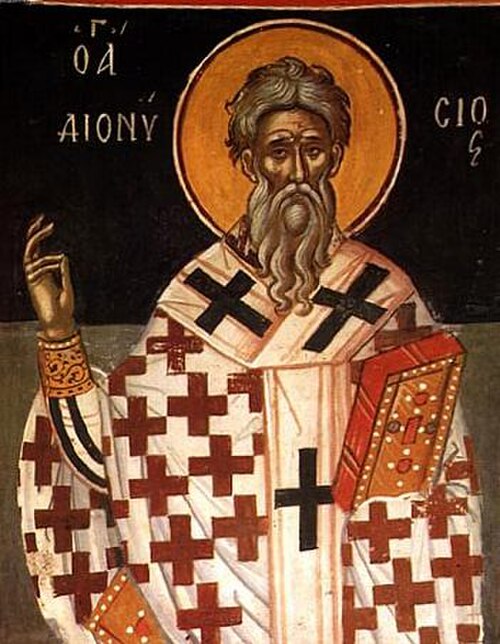
Saint
Dionysius the Great
Patriarch of Alexandria
Patriarch of Alexandria from 248 to 264, whose letters preserve much knowledge of the Church of his time.
Life
The Holy Hierarch Dionysius the Great was patriarch of Alexandria from 248 until his death in 264, a pupil of Origen and a good governor of the Church in the time of the persecutions of Decius and Valerian. His letters, preserved mostly in the writings of Eusebius, show the life of the Church of his time. He is commemorated on 18 October and on 19 January.
Youth
He was born around 190, at Alexandria, into a wealthy pagan family. He read much and studied the teachings of the pagans with care. According to the tradition, while still young he read the epistles of Saint Paul the Apostle, believed in Christ and received Baptism. It is also said that a vision commanded him to examine and refute the heresies threatening the Church. He entered the Catechetical School of Alexandria, where he was a pupil of Origen and of Patriarch Heraclas, then head of the school and presbyter, around 231. In 248 he succeeded Heraclas as bishop of Alexandria and patriarch of the see of Saint Mark.
The persecutions
Eusebius and Saint Basil the Great called him the Great. He was rather a good administrator than a theologian, as the Catholic Encyclopedia said. In 249 a pagan mob began in Alexandria a persecution in which hundreds of Christians were beaten, stoned, burned or killed because they would not deny the faith. Dionysius escaped it. In January 250 the emperor Decius issued an edict of persecution. Many Christians, out of fear, denied the faith by sacrificing, and others sought false certificates that they had sacrificed. Those who refused were mocked and, if caught, tortured and killed. Many fled into the desert, where many died of hunger, thirst, cold or attacks by bandits and wild beasts.
The prefect Aurelius Appius Sabinus sought out Dionysius and sent an assassin to kill him. He hid for three days, then left with his servants and other faithful brethren on the fourth night. He escaped the soldiers and settled in the Libyan desert, until the end of the persecution the following year.
Governing the Church
In 251 he supported Pope Cornelius in the dispute with Novatian, a learned presbyter of Rome, who founded a schismatic church with a harsh teaching against those who had lapsed in the persecution. Against him, Dionysius ordered that no one should be refused Holy Communion at the hour of death, not even those who had lapsed earlier. In 252 the plague of Cyprian broke out in Alexandria, and Dionysius, together with other clergy, tended the sick and dying. Under Valerian he was imprisoned and then exiled. When Gallienus came to power, he freed all the Christians in prison and recalled those in exile, and Dionysius received a letter from the emperor, which gave them security to reopen their churches.
His writings
He wrote many letters to bishops and clergy, among them interpretations of the Gospel of Luke, of the Gospel of John and of the Apocalypse. He wrote against Sabellius, against Nepos and millenarianism, and was known for his letter on repentance. He drew up the first paschal table and has some canons received by the Church. It is said that Saint Basil the Great wrote to Pope Damasus about aid sent by Dionysius to the Church of Caesarea.
Repose
He died on 22 March 264, in the view of some in 265, in the twelfth year of Gallienus.
Commemorated the same day October 5
 Hippolytus of RomeHieromartyr · Theologian of RomeOct 5
 Philip of MoscowHieromartyr · Metropolitan of MoscowOct 5
- John MauropousSaint · Metropolitan of EuchaitaOct 5
 Charitina of AmisusMartyr · Martyr of AmisusOct 5
 Charitina of LithuaniaVenerable · Nun of NovgorodOct 5
 Gregory of KhandztaVenerable · Abbot and founder of monasteriesOct 5
 Placidus of TrasaccoHieromartyr · Roman priestOct 5
 MeinolfSaint · German archdeaconOct 5
 Ampelius of BordigheraVenerableOct 5
 Onesimus PylaevHieromartyr · Bishop of TulaOct 5
 PeregrinaMartyrOct 5
 Galla of RomeSaintOct 5