Saint
John Mauropous
Metropolitan of Euchaita
Cleric, poet, hymnographer and author of letters and orations of the eleventh century, Metropolitan of Euchaita.
Life
Saint John Mauropous, Metropolitan of Euchaita, was in the eleventh century a Byzantine cleric, scholar, poet, hymnographer and author of letters and orations. He is venerated as a hierarch in the Orthodox Church and is remembered on 5 October.
He was born in Paphlagonia around 1000 and came to Constantinople, where he soon gained a reputation as a teacher. Among his students was Michael Psellos, the most important of them. Psellos introduced him to the emperor Constantine IX Monomachos (1042-1055). For a few years John belonged to the circle of poets and scholars the emperor gathered around him and served as court orator. Around 1050, for reasons unknown, these friends suddenly fell from favour, and it seems that on this occasion John was made metropolitan of Euchaita in Asia Minor. In many letters he lamented this “honourable exile” and asked his friend Psellos to urge the following emperors to call him back to the capital. This seems to have succeeded near the end of his life, when he retired to the monastery of Saint Petra in Constantinople. He died toward the end of the eleventh century, in a year the sources give differently, between 1070 and 1100.
During his life he prepared a collection of his works, preserved in the manuscript Vaticanus Graecus 676: ninety-nine poems (epigrams, polemical and autobiographical poems, funeral orations in verse), seventy-seven letters and thirteen speeches, mostly of religious content. He also composed a great many liturgical canons, among them the canon for the departure of the soul and the canon to the Guardian Angel, still used in the services of the Church. An etymological lexicon is also ascribed to him. He has been seen as a precursor of the new cultural mentality of mid-eleventh-century Byzantium: the blend of devout faith and classical culture links him with his pupil Psellos and with contemporary poets such as Christopher of Mytilene. In his poems and letters the dangers of public life and political careers are a constant theme, in uncertain times.
Tradition ties his name to the feast of the Three Hierarchs, Basil the Great, Gregory the Theologian and John Chrysostom. It is told that when the people were quarrelling over which of the three was greater, the three hierarchs appeared to him and explained that all are one before God, and the quarrel subsided. The founding of the common feast, in the year 1084, is attributed to him. It is kept on 30 January. Saint John himself is remembered separately on 5 October.
Commemorated the same day October 5
 Hippolytus of RomeHieromartyr · Theologian of RomeOct 5
 Dionysius the GreatSaint · Patriarch of AlexandriaOct 5
 Philip of MoscowHieromartyr · Metropolitan of MoscowOct 5
 Charitina of AmisusMartyr · Martyr of AmisusOct 5
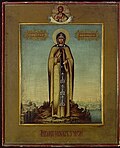 Charitina of LithuaniaVenerable · Nun of NovgorodOct 5
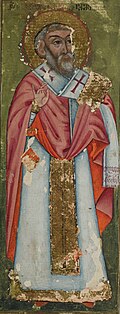 Gregory of KhandztaVenerable · Abbot and founder of monasteriesOct 5
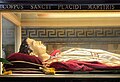 Placidus of TrasaccoHieromartyr · Roman priestOct 5
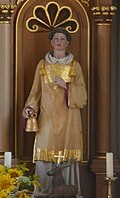 MeinolfSaint · German archdeaconOct 5
 Ampelius of BordigheraVenerableOct 5
 Onesimus PylaevHieromartyr · Bishop of TulaOct 5
 PeregrinaMartyrOct 5
 Galla of RomeSaintOct 5