Saint
Galla of Rome
Roman widow of the sixth century, known for her generosity.
- Feast
- October 5old style October 18
- Reposed
- 5506th century
- Place
- Rome
Life
Saint Galla of Rome was a Roman widow of the sixth century, known for her generosity to the poor and the sick. She is considered a saint in the Roman Catholic Church and, according to some sources, also in the Orthodox Church. Her life is in the Dialogues of Saint Gregory the Great, and our sources show no Orthodox act of canonization. She is commemorated on 5 October.
Life
Galla was the daughter of the Roman patrician Quintus Aurelius Memmius Symmachus the Younger, consul in 485, from one of the richest and most famous Roman families of the West. Her sister, Rusticiana, was the wife of Boethius, and Galla had another sister, Proba. Her father, a Christian, one of the most learned of his time, known for his wealth and his great library, was unjustly condemned to death by King Theodoric in 525 or 526, accused of treason. Galla married at a rather young age, but became a widow a little more than a year after the wedding.
Being wealthy, she decided to retire to the Vatican Hill and founded a hospital and a convent near the basilica of Saint Peter. She stayed there to the end of her life, tending the sick and the poor, and died around 550. According to tradition, she once healed a deaf and mute girl by blessing a little water and giving it to her to drink.
Her memory
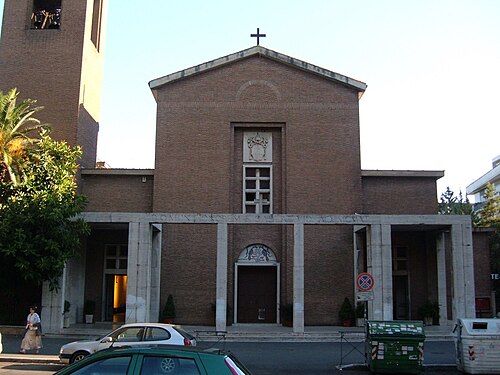
According to tradition, in 524, in the portico of Saint Galla's house, in the pantry where she kept food for the poor, an icon of the Mother of God appeared. At that place the oratory of Santa Maria in Portico was built, which kept the icon, said to have been carried in processions since 590 to stop the plague. Pope Celestine III founded a shelter for the poor next door. When the icon was moved to the new church of Santa Maria in Campitelli, the church of Santa Maria in Portico began to be called Santa Galla Antiqua, in honour of its foundress. The old church was demolished in 1930, and a new one, in the Ostiense quarter, was consecrated in 1940. Galla is believed to have been the inspiration for the letter of Fulgentius of Ruspe On the State of Widows. Her image is among the 140 statues of saints on the colonnade of Saint Peter's Square.
Commemorated the same day October 5
 Hippolytus of RomeHieromartyr · Theologian of RomeOct 5
 Dionysius the GreatSaint · Patriarch of AlexandriaOct 5
 Philip of MoscowHieromartyr · Metropolitan of MoscowOct 5
- John MauropousSaint · Metropolitan of EuchaitaOct 5
 Charitina of AmisusMartyr · Martyr of AmisusOct 5
 Charitina of LithuaniaVenerable · Nun of NovgorodOct 5
 Gregory of KhandztaVenerable · Abbot and founder of monasteriesOct 5
 Placidus of TrasaccoHieromartyr · Roman priestOct 5
 MeinolfSaint · German archdeaconOct 5
 Ampelius of BordigheraVenerableOct 5
 Onesimus PylaevHieromartyr · Bishop of TulaOct 5
 PeregrinaMartyrOct 5