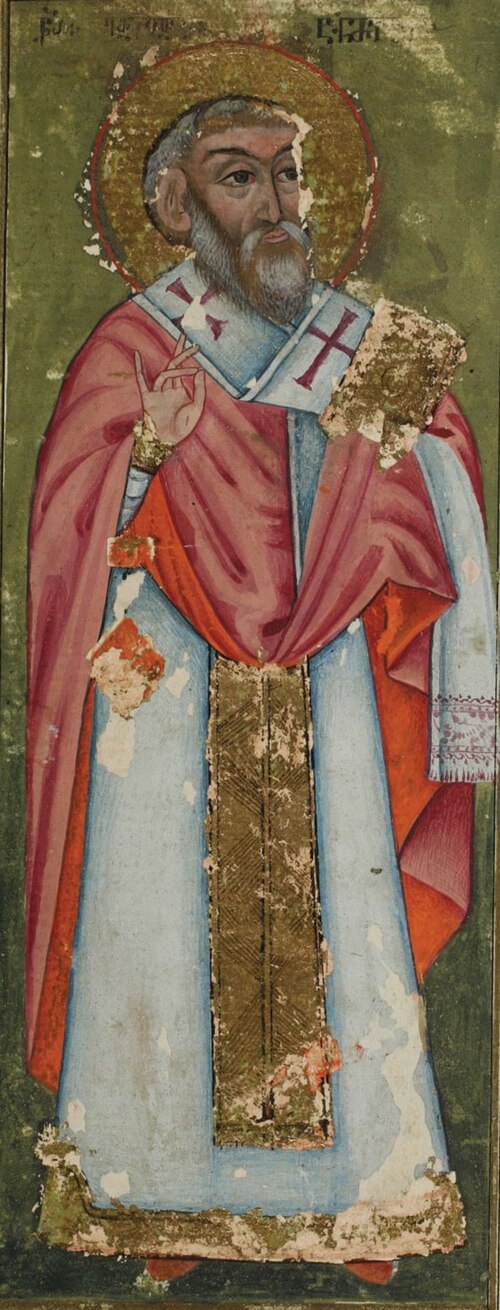
Venerable
Gregory of Khandzta
Abbot and founder of monasteries
Georgian monk, a central figure in the revival of monasticism in Tao-Klarjeti, where many monasteries arose.
- Feast
- October 5old style October 18
- Reposed
- 8619th century
- Place
- Khandzta
- Order
- Venerables
Life
The venerable Gregory of Khandzta was a Georgian monk, abbot and founder of monasteries, a central figure in the revival of monasticism in Tao-Klarjeti, a region of old Georgia now in Turkey. Born on 5 October 759, he fell asleep on 18 October 861, a man of over a hundred years. The monasteries raised by him and his disciples became centres of learning, manuscript copying and spiritual life.
Youth
Gregory was born into a noble family of Kartli and was the nephew of the wife of Nerse, the eristavi (ruler) of Kartli. He was raised in his household and received a broad education: church sciences, liturgical chant, the order of the services, hymnography, Georgian literature, philosophy and foreign languages. His relatives meant to prepare him for the priesthood and for the rank of bishop. The young man, however, longed for the monastic life and thought himself unworthy of so high an office. He fled his home for Klarjeti, then laid waste by the Arab conquerors, with his cousin Savva, later bishop of Ishkhani, and the monks Christopher and Theodore. They found shelter at the monastery of Opiza, where the abbot George of Opiza received them into the brotherhood.
Khandzta and Shatberdi
After two years Gregory went to Khandzta, where he settled beside the hermit Hvedios. Tradition tells that he had a vision: it was foretold that a "man of God" would come there and build a monastery, and that the fragrance of his prayers would rise before God like good incense. After surveying the place, Gregory and his disciples settled there. In the 780s, around 782, they built on the site of the present Khandzta monastery a wooden church, a refectory and a few cells. The local feudal lord, Gabriel Dapanchuli, helped them with food, labourers, building materials and tools.
Gregory's ascetic labour came to the notice of King Ashot I the Great, who called him to the palace, received him with great honour and granted him the land of Shatberdi. On that land Gregory founded a monastery that became an important centre of manuscript copying and illumination. The monks also adorned book bindings with gold and silver, and some of the books made in this scriptorium survive to this day.
Disciples and the rule
Gregory's disciples founded, at the start of the ninth century and with his help, a number of new monasteries: Theodore, Nedzvi; Christopher, Kviriketsminda; and Hilarion of Jerusalem, Ubisi. The women's monastery of Mere was also founded, with the disciple Febronia, and the cathedral of Ishkhani and other churches, such as Mijnadzori and Tsarostavi, were restored. The central regions of Georgia, Kartli and Kakheti, were then under Arab rule, in the emirate of Tbilisi.
Life in the monasteries founded was ordered by strict rules, like those of the Lavra of Saint Sabbas the Sanctified: a hard bed in the cell, where there was nothing but a jug of water, with no fire and no lit candles.
Role in the Church
Gregory enjoyed great respect from the Georgian nobility and clergy. His word was decisive in the choice of Saint Arsenius I the Great as patriarch-catholicos of Kartli, who served from 860 to 887. His life records many miracles: he healed the sick, calmed animals and stopped natural phenomena.
Toward the end of his life he laboured at Shatberdi, but he felt his death approaching and commanded that he be buried at the Khandzta monastery. He fell asleep surrounded by the brethren of all the monasteries of Klarjeti.
Veneration
The Georgian Orthodox Church canonized him, and his memory is kept on 18 October. His life was written in 951 by George Merchule and was found in Jerusalem by Giorgi Chubinashvili, then published in a Russian translation in 1911 by Nikolai Marr. The only known icon of the saint is in a Festal Menaion of the eighteenth century, in a stock type without portrait features. A street in Tbilisi bears his name.
Commemorated the same day October 5
 Hippolytus of RomeHieromartyr · Theologian of RomeOct 5
 Dionysius the GreatSaint · Patriarch of AlexandriaOct 5
 Philip of MoscowHieromartyr · Metropolitan of MoscowOct 5
- John MauropousSaint · Metropolitan of EuchaitaOct 5
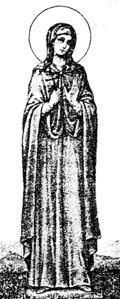 Charitina of AmisusMartyr · Martyr of AmisusOct 5
 Charitina of LithuaniaVenerable · Nun of NovgorodOct 5
 Placidus of TrasaccoHieromartyr · Roman priestOct 5
 MeinolfSaint · German archdeaconOct 5
 Ampelius of BordigheraVenerableOct 5
 Onesimus PylaevHieromartyr · Bishop of TulaOct 5
 PeregrinaMartyrOct 5
 Galla of RomeSaintOct 5