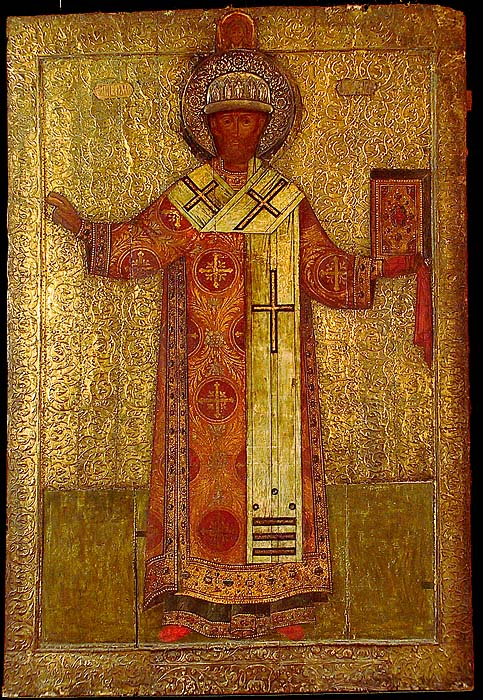
Hieromartyr
Philip of Moscow
Metropolitan of Moscow
Metropolitan of Moscow and all Rus from 1566 to 1568, who died a martyr in 1569.
Life
The Holy Hieromartyr Philip II was metropolitan of Moscow and all Rus from 1566 to 1568, famous for rebuking Tsar Ivan the Terrible to his face, and the crimes of the oprichniki. He received a martyr's death in 1569, at Tver.
He was born on 11 February 1507, with the name Fyodor Stepanovich Kolychev, into an old boyar family of Moscow, of the line of Andrei Kobyla. His father prepared him for service at court, and his mother, Varvara, who later became a nun with the name Varsonofia, raised him in the faith. He learned to read from Holy Scripture and received military training, but felt more drawn to prayer and books. Until the age of thirty he was at the court of Grand Prince Vasily III. The sources differ about why he left Moscow in 1537: according to some, his family fell into disgrace at the time of the revolt of Prince Andrei of Staritsa; according to his life, he heard in church, during the Liturgy, the Gospel words No man can serve two masters and decided to leave the world. He left secretly, dressed as a commoner, reached Lake Onega, was taken in at the village of Khizna by Sidor Suboda and for a time tended his sheep. Then he went to the Solovetsky monastery on the White Sea, where he was received as a novice, cut wood, dug earth and carried stones, and worked also at the forge and the bakery. After a year and a half he was tonsured a monk with the name Philip, with the elder Jonah Shamin as his spiritual father.
In 1548, when Abbot Alexis withdrew because of age, the community chose Philip as abbot. Under him the monastery raised two cathedrals, a brickyard, water mills, storehouses and a network of canals joining seventy-two lakes, and he laboured beside the others. The community knew a spiritual renewal, received a new typicon, and most of his works survive today. The tsar, hearing of him, asked him to accept the vacant metropolitan see of Moscow. Philip accepted on condition that Ivan abolish the oprichnina. He was consecrated metropolitan on 25 July 1566.
After two years Ivan continued the killings under cover of the oprichnina. On the Sunday of the Veneration of the Cross, 2 March 1568, when the tsar came to the Liturgy in the cathedral, Philip refused to bless him and rebuked him publicly for the massacres. The massacre of Novgorod followed. The tsar had him arrested during the Liturgy in the Dormition cathedral, accused him of sorcery and loose living, and a synod deposed him in November 1568. He was imprisoned in the Epiphany monastery, in chains, with a heavy collar on his neck, left without food for days on end, then moved to the Otroch monastery at Tver, where on 23 December 1569, two days before Christmas, he was strangled by Malyuta Skuratov. As if he knew the end, he had asked to receive Communion three days before.
In 1652, on the initiative of Patriarch Nikon, his relics were brought to Moscow, and he was honoured throughout Russia as a holy hierarch. His memory is kept on 9 January, 3 July and 5 October (Synaxis of the Hierarchs of Moscow).
Commemorated the same day October 5
 Hippolytus of RomeHieromartyr · Theologian of RomeOct 5
 Dionysius the GreatSaint · Patriarch of AlexandriaOct 5
- John MauropousSaint · Metropolitan of EuchaitaOct 5
 Charitina of AmisusMartyr · Martyr of AmisusOct 5
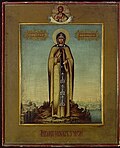 Charitina of LithuaniaVenerable · Nun of NovgorodOct 5
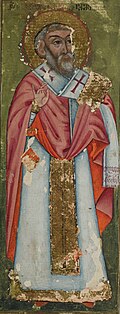 Gregory of KhandztaVenerable · Abbot and founder of monasteriesOct 5
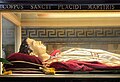 Placidus of TrasaccoHieromartyr · Roman priestOct 5
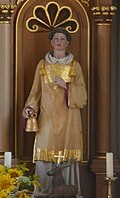 MeinolfSaint · German archdeaconOct 5
 Ampelius of BordigheraVenerableOct 5
 Onesimus PylaevHieromartyr · Bishop of TulaOct 5
 PeregrinaMartyrOct 5
 Galla of RomeSaintOct 5