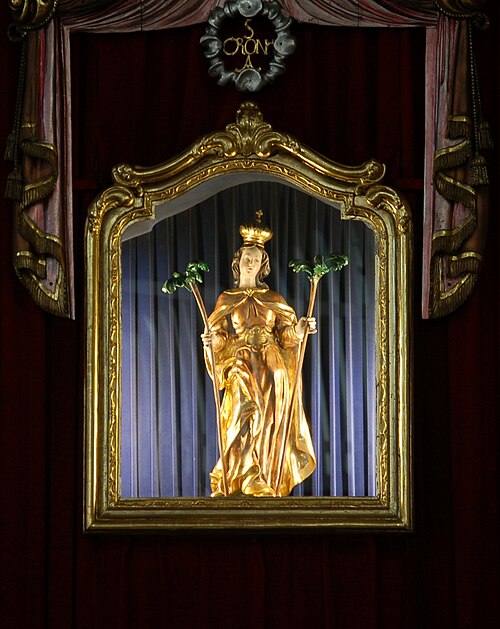
Martyr
Corona (Stephanie)
Martyr of the 2nd century
Martyr of the 2nd century, venerated as Corona, together with Saint Victor.
- Feast
- November 11old style November 24
- Reposed
- 1772nd century
- Order
- Martyrs
Life
Saint Corona (Stephanie, Stephana), martyr, is a martyr of the early centuries whose life is not known with certainty. The sources link her to Saint Victor of Damascus and to the time of the persecutions of the second or third century. Her veneration is mostly Western, with centres in Austria and eastern Bavaria and at Feltre, and our sources show no Orthodox act of canonization. She is commemorated on 14 May.
What the sources say
According to some sources, Corona was killed in Syria, at Damascus, together with Saint Victor, in the time of Emperor Marcus Aurelius, around 170. The hagiographic sources, however, give different places for their passion: besides Damascus, Antioch (according to the Coptic sources), Alexandria and even Sicily. The dates are also debated: others place her under Antoninus Pius or under Diocletian, and the Roman Martyrology in the third century. A Ukrainian source says she was born around 160, in Egypt or Syria, and died in 177, at sixteen.
According to tradition, while Victor was being tortured, Corona, sixteen years old and the wife of one of his comrades in arms, comforted and encouraged him. For this she was seized and interrogated. According to a story whose reliability is doubted, she was tied to two palm trees bent to the ground, and when the trees were released they straightened and tore her body apart. Some sources say Victor was beheaded. Other sources say that Victor and Corona were husband and wife.
Veneration
On Mount Miesna, three kilometres from Feltre, in 1096 crusaders returning from the First Crusade built a church in which the relics of Saints Victor and Corona, the city's patrons, were kept. Emperor Otto III took her relics to Aachen around the year 1000. She is especially venerated in Austria and eastern Bavaria, with pilgrimage places at Sankt Corona am Schöpfl and Sankt Corona am Wechsel, and in popular belief she became patroness of money, butchers and treasure seekers, because her name means crown, a name for coins in German. The Corona prayer, a popular ritual used for hidden treasure, is a magical practice of folk tradition, foreign to the Church. In the Strasbourg Cathedral she is depicted in stained glass, with a long dress, veil and the palm of martyrdom.
Commemorated the same day November 11
 Martin of ToursSaint · Bishop of ToursNov 11
 Vincent of SaragossaMartyr · Deacon of SaragossaNov 11
 Theodore the StuditeVenerable · Abbot of the Stoudios MonasteryNov 11
 Stefan Uroš III of DečaniRight-Believing · King of SerbiaNov 11
 Menas of EgyptGreat MartyrNov 11
 Bartholomew the YoungerVenerable · Abbot of GrottaferrataNov 11
 Five Holy Martyrs of PolandHoly Venerable Martyrs · Camaldolese hermit monksNov 11
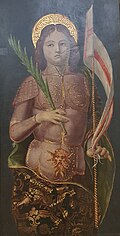 Victor of DamascusMartyr · Roman soldier of DamascusNov 11
 UrošicaVenerableNov 11
 Eugene KobranovHieromartyr · Bishop of RostovNov 11
- Jeftimije of DečaniVenerable Martyr · Monk of DečaniNov 11
- AbibusSaintNov 11