Venerable
Urošica
Serbian prince of the Nemanjić dynasty, younger son of King Stefan Dragutin, who became a monk.
- Feast
- November 11old style November 24
- Reposed
- 131614th century
- Order
- Venerables
Life
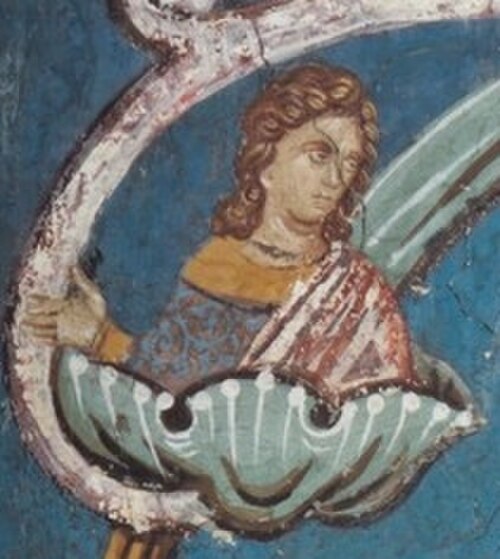
Venerable Stefan Urošica (Stefan Urošić Nemanjić) was a Serbian prince and monk of the Nemanjić dynasty, the younger son of King Stefan Dragutin and the Hungarian princess Catherine. He died young, before 1315, as a monk with the name Stefan, and was buried in the church of Saint Achillius at Arilje, his father's foundation. According to tradition, myrrh flowed from his tomb, and the Serbian Orthodox Church venerates him as a saint, on 11 November (24 November by the new calendar).
Family
Urošica was born around 1285, the youngest of the three children of King Stefan Dragutin and Catherine of Hungary. His grandfather on his father's side was the Serbian king Uroš, and on his mother's side King Stephen V of Hungary. Through his father he belonged to the ruling Nemanjić family, and through his mother to the Árpád dynasty, which ruled Hungary from 1000 to 1301. He had an elder brother, Vladislav, who would briefly succeed their father on the throne in 1316, and at least three sisters, of whom Elizabeth is known by name, wife of Stephen I Kotromanić of Bosnia and mother of Stephen II Kotromanić.
The year of his birth is discussed. Miodrag Purković, who gathered the scarce data from the sources, thought he was born around 1285, because he does not appear in the painting of the chapel at Đurđevi Stupovi made by his father Dragutin, where his brother Vladislav appears. Dejan Ječmenica writes that he was certainly born after 1283. His likeness is on the fresco in the church of Saint Achillius at Arilje, painted in 1296, where he is shown as a boy of ten or eleven. One theory holds that Urošica and Urošić are two persons.
The war between Milutin and Dragutin
Dragutin ruled from 1276 until in 1282 he broke his leg while hunting and fell ill. He then passed the rule to his younger brother, Stefan Milutin, keeping Syrmia for himself, where he remained king until 1316. The disciple of Archbishop Danilo left an important item: in a civil war that lasted ten years in Serbia, Dragutin rose from the Syrmian land with a great force, wishing to take Milutin's throne and give it to his son Urošica. Earlier historiography judged that Dragutin fought in that war for the rights of his son Vladislav. But it is known that Dragutin fought for his son's right to the Hungarian throne, where in 1301 to 1310 there was a civil war after the death of Andrew III, the last Árpád. Through his mother, Vladislav had rights to the throne of Hungary, like the Angevin claimant Charles Robert. Dragutin's war with Charles Robert ended after the civil war in Serbia, so it may be supposed that in Serbia Dragutin fought for Urošica and in Hungary for Vladislav. The struggle on two fronts ended in defeats on both.
In 1311 Dragutin launched a campaign to take the throne for his son, thought by some to be Vladislav, though Archbishop Danilo II says the probable heir was Urošica.
The monk
He received monastic tonsure with the name Stefan, after the custom of the Nemanjićs. The Tavna monastery on Majevica in Bosnia is regarded as the foundation of him and his brother Vladislav. Some sources say the Papraća monastery on the river Spreča, below Mount Borogovo, was also the foundation of the two brothers and their father. The Serbian chronicles, among them those of Vrhobreznica, Koporin, Peć, Studenica and Belopolje, mention him as a monk. In Danilo's typikon one of Dragutin's sons is called "Stefan the monk". The old genealogies and annals remember him kindly, for virtue and piety.
Death and veneration
The year of Urošica's death is not known, but he certainly died before his father. At the council Dragutin summoned before his death only Vladislav was present. He therefore died before 1315, not yet thirty. He was buried in his father's foundation, the church of Saint Achillius at Arilje, and myrrh flowed from the grave. There are tombs in the church, but no bones have been found. The Tronoša genealogy says Urošica and Vladislav were buried at the Papraća monastery near Zvornik, but the oldest news of it is from the sixteenth century, so the information must be taken with reserve.
He is depicted in the paintings at Peć, Gračanica, Dečani and Arilje, in the narthex on the north wall, on three Nemanjić genealogical trees. The frescoes do not give him the title of saint. Some historians say he may have been the father of Caesar Vojihna, one of the most praised commanders of the Serbian Empire. The Serbian Orthodox Church honours him on 11 November.
Commemorated the same day November 11
 Martin of ToursSaint · Bishop of ToursNov 11
 Vincent of SaragossaMartyr · Deacon of SaragossaNov 11
 Theodore the StuditeVenerable · Abbot of the Stoudios MonasteryNov 11
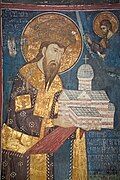 Stefan Uroš III of DečaniRight-Believing · King of SerbiaNov 11
 Menas of EgyptGreat MartyrNov 11
 Bartholomew the YoungerVenerable · Abbot of GrottaferrataNov 11
 Corona (Stephanie)Martyr · Martyr of the 2nd centuryNov 11
 Five Holy Martyrs of PolandHoly Venerable Martyrs · Camaldolese hermit monksNov 11
 Victor of DamascusMartyr · Roman soldier of DamascusNov 11
 Eugene KobranovHieromartyr · Bishop of RostovNov 11
- Jeftimije of DečaniVenerable Martyr · Monk of DečaniNov 11
- AbibusSaintNov 11