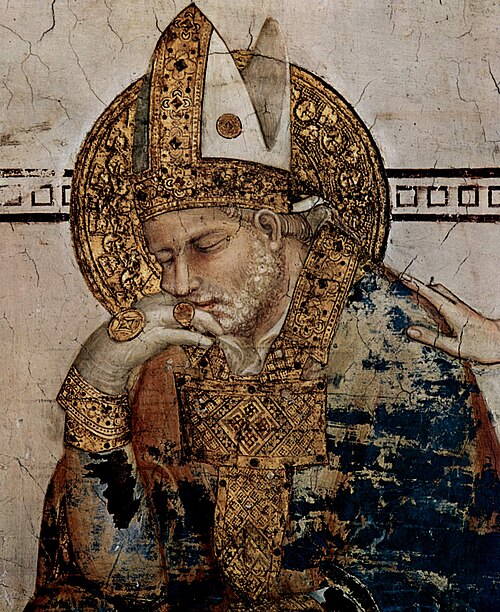
Saint
Martin of Tours
Bishop of Tours
Former Roman soldier who became a monk and bishop of Tours, known for his mercy.
- Feast
- November 11old style November 24
- Reposed
- 3974th century
- Place
- Candes-Saint-Martin
- Order
- Hierarchs
Life
Martin of Tours was bishop of the city of Tours in Gaul in the second half of the fourth century. A former soldier, he became a monk and then a hierarch, and his mercy and holy life made him one of the best-loved saints of the West, honoured also in the Orthodox Church. His life was written soon after his death by his disciple Sulpicius Severus.
Childhood and call
He was born in 316 (some historians say 336) at Savaria in Pannonia, today Szombathely in Hungary, to a pagan family. His father was a military tribune and afterwards retired as a veteran to Ticinum, today Pavia, where Martin grew up. At ten he went to church against his parents' wishes and became a catechumen. As a veteran's son he was made to enter the army at fifteen, in the cavalry.
One winter, at the gates of Amiens in Gaul, he met a poor man almost naked and shivering with cold. He had nothing else to give, so he cut his cloak in two with his sword and gave half. The following night he saw Christ in a dream clothed in that half cloak, telling the angels around Him that Martin, still a catechumen, had clothed Him. Soon afterwards he received Baptism, at about eighteen.
Soldier of Christ
He stayed on in the army for a while, without joy. When barbarians invaded Gaul he asked to be released, since he counted himself a soldier of Christ. The commander charged him with cowardice, and Martin offered to stand unarmed in the front line, trusting in the power of the Cross. Next day the enemy asked for peace without a fight, and he was allowed to leave the army. Sulpicius Severus places the event at Worms.
He then went to Poitiers, to Bishop Hilary, who made him an exorcist. Guided in a dream to visit his parents in Pannonia, he brought his mother to the faith, but his father remained a pagan. There the Arians scourged him and drove him out. For a time he lived as a hermit on the island of Gallinara, near Albenga, feeding on roots. When Hilary returned from exile, in 361, Martin returned to Poitiers and founded nearby, at Ligugé, the first monastic community in Gaul.
Bishop of Tours
In 371, after the death of Bishop Lidorius, the people of Tours brought him into the city and made him bishop against his will; Martin submitted, seeing in it the will of God. He did not change his way of life. He founded on the Loire, a short distance from the city, the monastery of Marmoutier, where nearly eighty brothers, many from noble families, lived in plain cells, wearing rough clothes, copying books and fishing. It became a school for those who then preached the Gospel in the villages of Gaul.
Martin travelled through Gaul on foot, on a donkey or by boat, with his disciples, preached to peasants, tore down pagan shrines and set churches in their place. Sulpicius Severus tells of many miracles, among them the casting out of demons and healings. He struggled against Arianism. At Trier he went to the court of Emperor Maximus and, with Ambrose of Milan, opposed the putting to death of Priscillian and his followers, though he did not share their teaching. Maximus was persuaded to spare the followers. Martin afterwards refused to take part in gatherings of bishops.
Repose and veneration
Old by then, he went to Candes on the Loire to reconcile the clergy there. He fell ill and reposed in the Lord on 8 November 397. The people of Poitou and of Touraine quarrelled over his body, and those of Tours carried it by boat on the Loire to Tours, where he was buried on 11 November. His successor Bricius raised a small chapel over the tomb, and Bishop Perpetuus later built a larger basilica. King Clovis took him as protector of the Franks. The word "chapel" comes from cappa, Martin's cloak, kept with honour in the palace of the Frankish kings.
The basilica at Tours was sacked by the Huguenots in 1562 and demolished after the French Revolution; the relics of Saint Martin, like those of Saint Gregory of Tours, were destroyed in 1793, though some fragments of the former were recovered. A new basilica was built between 1886 and 1924, and his tomb lies in its crypt.
According to the Orthodox Church in America he is commemorated on 11 November, the day of his burial; the Greek synaxarion places him on 12 November, and in the Russian calendar he appears on 12 October, a date the Orthodox Church in America considers a mistake. In the Middle Ages many churches in the West were dedicated to him. His day closed the farming year, and in Germany and Austria lantern processions are still held.
Commemorated the same day November 11
 Vincent of SaragossaMartyr · Deacon of SaragossaNov 11
 Theodore the StuditeVenerable · Abbot of the Stoudios MonasteryNov 11
 Stefan Uroš III of DečaniRight-Believing · King of SerbiaNov 11
 Menas of EgyptGreat MartyrNov 11
 Bartholomew the YoungerVenerable · Abbot of GrottaferrataNov 11
 Corona (Stephanie)Martyr · Martyr of the 2nd centuryNov 11
 Five Holy Martyrs of PolandHoly Venerable Martyrs · Camaldolese hermit monksNov 11
 Victor of DamascusMartyr · Roman soldier of DamascusNov 11
 UrošicaVenerableNov 11
 Eugene KobranovHieromartyr · Bishop of RostovNov 11
- Jeftimije of DečaniVenerable Martyr · Monk of DečaniNov 11
- AbibusSaintNov 11