
Hieromartyr
Eugene Kobranov
Bishop of Rostov
Bishop of Rostov, vicar of the Yaroslavl diocese and orientalist, shot on 20 November 1937 near Chimkent.
- Feast
- November 11old style November 24
- Reposed
- 193720th century
- Order
- Martyrs
Life
Bishop Eugene (in the world Evgeny Yakovlevich Kobranov, 21 January 1892 - 20 November 1937) was Bishop of Rostov, vicar of the Yaroslavl diocese, and a learned orientalist. He was shot in the night of 20 November 1937 in the Fox Gully near Chimkent, with Metropolitans Joseph (Petrovykh) and Cyril (Smirnov). The sources at our disposal say nothing of a canonization of him; the calendar in our archive shows him as a hieromartyr, with commemoration on 11 November, but we have no act of glorification that we can cite here.
Youth and studies
He was born in the village of Blagoveshchenye (now Polibino), Dorogobuzh district, Smolensk province, in the family of a village schoolteacher who later became a deacon. In 1906 he graduated from the church school at Smolensk, in 1912 the Smolensk seminary, and in 1916 the Moscow Theological Academy, with the degree of candidate in theology, remaining afterwards at the academy as a fellow preparing to teach. In 1916-1917 he attended lectures at the Oriental Faculty of the University of Petrograd. At the end of 1917 he was ordained priest by Patriarch Tikhon, for the Moscow church of the Nine Martyrs of Cyzicus. In 1918-1922 he was assistant to the director of the Museum of the Classical East. In 1921 he was tonsured a monk by Bishop Palladius (Dobronravov) at the Novospassky monastery, was archimandrite, deputy and then abbot of the monastery and at the same time a research worker in the museum department of Glavnauka.
Arrests and years of exile
In 1921 he was arrested and released after two weeks; in the same year he was arrested a second time and exiled to Arkhangelsk, released early. In 1922-1923 he joined the Renovationist movement, but quickly left it; on 9 August 1923 the Renovationists dismissed him from the office of abbot and forbade him to serve. Arrested again in spring 1923, after three and a half months he was acquitted by the Moscow provincial court and released. He was arrested again on 18 December 1923. The faithful tried to intercede for him with a letter to the OGPU, which said: "Citizen Kobranov gained the fame and love of the simple people, because he taught us not only to cross our forehead but to tell evil from good". By decision of the OGPU commission for administrative exile of 28 March 1924 he was sentenced to two years of exile in Khiva; in exile he engaged in scientific research. He was released early, in 1926, and served briefly at the church of the Trinity in Kozhevniki, in Moscow.
On 14 March 1926 he was consecrated at Nizhny Novgorod Bishop of Murom, vicar of the Vladimir diocese, by Metropolitan Sergius (Stragorodsky) of Nizhny Novgorod, Bishop Damian (Voskresensky) of Pereslavl and Bishop Macarius (Znamensky). At first he refused to go to Murom, because he was engaged in serious scientific work in orientalism in Moscow, but after the exhortation of Metropolitan Sergius he accepted the appointment. In autumn 1926 he took an active part in the secret election of the patriarch. From 15 September 1927 he was Bishop of Balashov, vicar of the Saratov diocese, and on 14 December of the same year was named Bishop of Rostov, vicar of the Yaroslavl diocese. He preached much, gave lectures for children, young people and adults, with examples from the Russian classics, to prove the existence of God and the need of faith. He set up a free charitable canteen for the poor, organized a "sisterhood" to help the needy, and announced a collection for completing a church and a canteen in the village of Gorinskoe in the Mologa district.
As part of a group of bishops of the Yaroslavl diocese, on 6 February 1928 Bishop Eugene signed the declaration of separation from Metropolitan Sergius (Stragorodsky), supporting the position of his diocesan bishop, Metropolitan Agathangel (Preobrazhensky). On 11 April the Synod forbade him to serve, but already on 10 May he signed a statement of return to prayerful communion with Metropolitan Sergius, and on 30 May 1928 the Synod lifted the ban.
On 7 August 1928 he was arrested at Rostov, charged with anti-Soviet agitation, with religious indoctrination of youth and with assuming administrative functions (by the last were meant the creation of the "sisterhood", the opening of the canteen, etc.); on 28 October 1928 he was sentenced to three years of exile, which he spent at Kzyl-Orda in Kazakhstan. In October 1929 he was drawn into the investigation in the case of the "Yaroslavl branch of the True Orthodox Church" and again sentenced to three years of exile. From 1931 he lived in Vologda under supervision. He served at home, collected food and money for exiled clergy, tried to find lodging and work for clergy returned from exile. At the same time he worked on scholarly writings, the manuscripts "The Kazakh people", "The philosophy of Origen", "The saints of Vologda", which were confiscated in the search of 1935.
Chimkent and martyrdom
He was arrested on 27 July 1934 and on 29 November sentenced to three years of exile, again in Kazakhstan, this time at Chimkent. There he gathered a large library and began to write the history of Chimkent. In autumn 1935 he received an order to go to a settlement 70 km from the regional center, but after an appeal to the prosecutor general of the USSR Vyshinsky he stayed in Chimkent. He kept up correspondence with Metropolitan Cyril (Smirnov) of Kazan, in exile nearby at Yani-Kurgan, and prepared for him a historical note on the possibility of keeping and receiving the Holy Gifts by laypeople (which was often necessary in time of persecution of clergy and closure of churches). It is said that he tried to persuade Metropolitan Cyril and those linked with him to be reconciled with Metropolitan Sergius.
On 23 June 1937 he was arrested on the charge of creating a "counter-revolutionary center of the clergy". At arrest his manuscripts "History of the city of Chimkent" and "Ancestors of the Kazakh people" were taken. At the interrogation of 25 June, when the investigator demanded testimony on counter-revolutionary activity, he answered: "I do not engage in counter-revolutionary activity and can say nothing on this question". At the next interrogation, on 29 July, evidently under torture and moral pressure, he pleaded guilty and gave testimony pleasing to the investigation. By decision of the troika of the UNKVD of the South Kazakhstan region of 19 November 1937 he was sentenced to death, with Metropolitan Joseph (Petrovykh) and Metropolitan Cyril (Smirnov), and was shot in the night of 20 November 1937 in the Fox Gully near Chimkent.
Commemorated the same day November 11
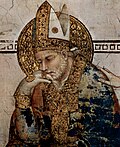 Martin of ToursSaint · Bishop of ToursNov 11
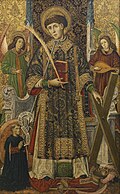 Vincent of SaragossaMartyr · Deacon of SaragossaNov 11
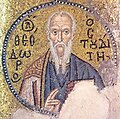 Theodore the StuditeVenerable · Abbot of the Stoudios MonasteryNov 11
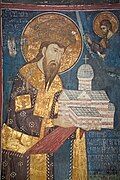 Stefan Uroš III of DečaniRight-Believing · King of SerbiaNov 11
 Menas of EgyptGreat MartyrNov 11
 Bartholomew the YoungerVenerable · Abbot of GrottaferrataNov 11
 Corona (Stephanie)Martyr · Martyr of the 2nd centuryNov 11
 Five Holy Martyrs of PolandHoly Venerable Martyrs · Camaldolese hermit monksNov 11
 Victor of DamascusMartyr · Roman soldier of DamascusNov 11
 UrošicaVenerableNov 11
- Jeftimije of DečaniVenerable Martyr · Monk of DečaniNov 11
- AbibusSaintNov 11