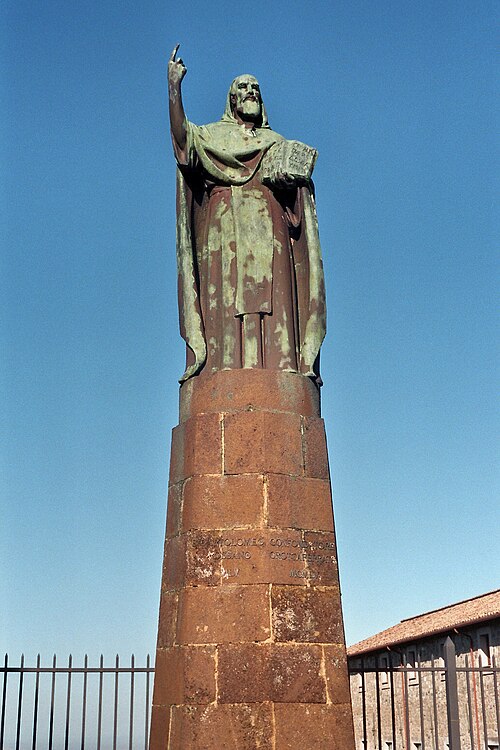
Venerable
Bartholomew the Younger
Abbot of Grottaferrata
Italo-Greek abbot of Grottaferrata, a disciple of Saint Nilus the Younger, died in 1055.
- Feast
- November 11old style November 24
- Reposed
- 105511th century
- Place
- Grottaferrata
- Order
- Venerables
Life
Venerable Bartholomew the Younger (Bartholomew of Grottaferrata) was an Italo-Greek monk and abbot, born at Rossano about 970 or 980 and died at Grottaferrata on 11 November 1055 (another source says about 1050). He is considered the second founder of the Grottaferrata monastery. He is venerated by both the Orthodox and the Catholic Churches and remembered on 11 November.
Disciple of Saint Nilus
His life is known from the life written by one of his successors, Luke, abbot of Grottaferrata (died about 1070). The original is lost, and the oldest known copy is from 1230. According to it, Bartholomew (in the world John) was of a noble Greek family of Rossano and was given by his parents in youth to the monastery of Saint John the Calybite. At twelve he left his parents' house and went to the Greek monastery founded by Saint Nilus of Rossano at Valleluce, near Monte Cassino. Despite the great difference in age, Bartholomew became the best-loved disciple of Saint Nilus. With his spiritual father, in 995 he moved to Serperi, near Gaeta, and in 1004 to Grottaferrata.
According to the tradition of the monastery, in the crypt which gave the monastery its name, the Mother of God appeared to Bartholomew and Nilus and commanded them to found a monastery there. Soon after, Saint Nilus died and the brethren proposed to Bartholomew to lead the community, but he, being very young, refused. Yet, after the death of two abbots, he was elected abbot about the year 1010.
The abbot
In the forty years of his abbacy, Bartholomew set the life at Grottaferrata firmly on the common rule and built the monastery church, dedicated to the Mother of God, consecrated by Pope John XIX on 17 December 1024. Though he held this post, he continued the labours of fasting and hard physical work. Like Saint Nilus, he was a notable calligrapher and many of his manuscripts survive to this day, in the libraries of the Vatican and of Grottaferrata. To him belongs the typikon of Grottaferrata, which still governs the monastic life and services of the monastery. He wrote the service in honour of Saint Nilus, about thirty canons, seventeen kontakia, stichera and the life of Nilus of Rossano. One source says that he had a very gentle nature and could not see anyone suffer without giving him comfort.
Though strict in his life as a hermit, he also influenced public life. It is thought that he turned the unworthy Pope Benedict IX from the struggle for the papal throne. Personally he persuaded Prince Guaimar IV of Salerno to release the Duke of Gaeta, Ataulf I, whom he had taken captive. The life also tells of miracles Bartholomew performed in his lifetime.
After his repose
Saint Bartholomew died about 1050 or in 1055. His relics were later moved to a chapel beside the monastery church, but later disappeared from there, the last mention being from 1300. In 1608 to 1610 some of his miracles were painted in the frescoes of Domenichino in the Farnese chapel at Grottaferrata.
Commemorated the same day November 11
 Martin of ToursSaint · Bishop of ToursNov 11
 Vincent of SaragossaMartyr · Deacon of SaragossaNov 11
 Theodore the StuditeVenerable · Abbot of the Stoudios MonasteryNov 11
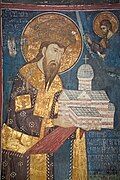 Stefan Uroš III of DečaniRight-Believing · King of SerbiaNov 11
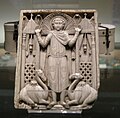 Menas of EgyptGreat MartyrNov 11
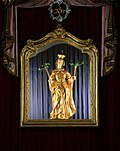 Corona (Stephanie)Martyr · Martyr of the 2nd centuryNov 11
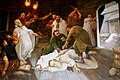 Five Holy Martyrs of PolandHoly Venerable Martyrs · Camaldolese hermit monksNov 11
 Victor of DamascusMartyr · Roman soldier of DamascusNov 11
 UrošicaVenerableNov 11
 Eugene KobranovHieromartyr · Bishop of RostovNov 11
- Jeftimije of DečaniVenerable Martyr · Monk of DečaniNov 11
- AbibusSaintNov 11