Martyr
Victor of Damascus
Roman soldier of Damascus
Christian of Damascus who served in the Roman army, a martyr of the 2nd century; commemorated November 11.
- Feast
- November 11old style November 24
- Reposed
- 1772nd century
- Place
- Damascus
- Order
- Martyrs
Life
Saint Victor of Damascus, martyr, was a Christian soldier in the Roman army at Damascus, a martyr of the second century. He is commemorated on 11 November in the Orthodox Church (Old Style) and on 14 May in the Roman Catholic Church. The sources do not agree with one another about his birthplace, or the place and time of the martyrdom.
The suffering
Victor was a Christian and served in the Roman army at Damascus in Syria. In a time of persecution he was asked to sacrifice to the pagan gods, but refused and was tortured. The Life mentions among the torments fingers broken and pulled out of joint, three days in a fiery furnace like the youths of Babylon, poisoned meat that did him no harm, the stretching of sinews, a cauldron of boiling oil, the putting out of eyes and the flaying of the skin. Seeing his sufferings, a Christian woman, Stephanis, openly confessed her faith and was put to death. Victor was beheaded and, according to tradition, blood mixed with milk flowed from his body.
Differences between the sources
His Life exists in Greek, Latin and Coptic, and there are differences among them: in the Latin Victor is from Cilicia, in the Greek from Italy; the Latin and Greek versions place the martyrdom under Antoninus Pius (138 to 161), the Coptic in the great persecution of Diocletian, while scholars place it under Marcus Aurelius (161 to 180). The place of death is Damascus in the longer Greek Lives, Italy in the short ones from the synaxarion and in the Menologion of Basil II, Antioch or Antinoe in Egypt in the Coptic ones, Alexandria in the Latin ones, and in the late ones, because of confusion with Victor of Marseille, Sicily or Marseille. Two explanations are offered: there were two martyrs named Victor, one in Egypt and one in Syria, whose veneration was merged; or Victor died in Egypt, but his special veneration at Antioch gave rise to the legend of his Syrian origin.
Veneration
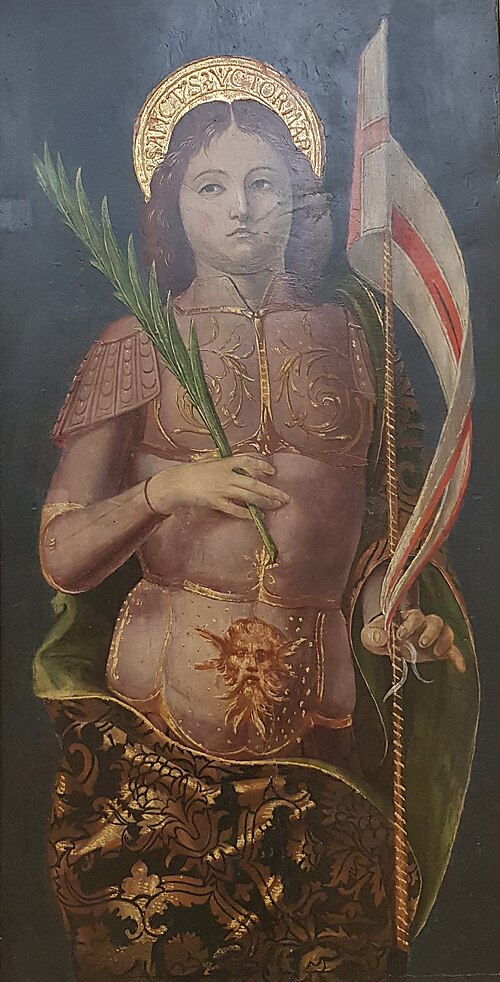
Greek calendars give the commemoration on 11 November (some synaxaria 10 or 12 November), Latin ones on 14 May (in some editions other days too). About the relics there are no clear data: a church at Antioch is known, built on the place of the martyrdom; in the twelfth century the relics were at Constantinople; the Roman part was until 1697 in the church of Saint Pancras, then in a Carmelite monastery and in the church of Saints Marcellinus and Peter. Since 1906 the relics are at Fano, in Italy. In Orthodox icons he is painted young, dark-haired, with a short round beard, in tunic and cloak, with a cross in his hand; the hermeneia of Dionysius of Fourna describes him only as "young, beardless". In Western art he is a young soldier, with a palm branch, banner, sword or olive branch.
Commemorated the same day November 11
 Martin of ToursSaint · Bishop of ToursNov 11
 Vincent of SaragossaMartyr · Deacon of SaragossaNov 11
 Theodore the StuditeVenerable · Abbot of the Stoudios MonasteryNov 11
 Stefan Uroš III of DečaniRight-Believing · King of SerbiaNov 11
 Menas of EgyptGreat MartyrNov 11
 Bartholomew the YoungerVenerable · Abbot of GrottaferrataNov 11
 Corona (Stephanie)Martyr · Martyr of the 2nd centuryNov 11
 Five Holy Martyrs of PolandHoly Venerable Martyrs · Camaldolese hermit monksNov 11
 UrošicaVenerableNov 11
 Eugene KobranovHieromartyr · Bishop of RostovNov 11
- Jeftimije of DečaniVenerable Martyr · Monk of DečaniNov 11
- AbibusSaintNov 11