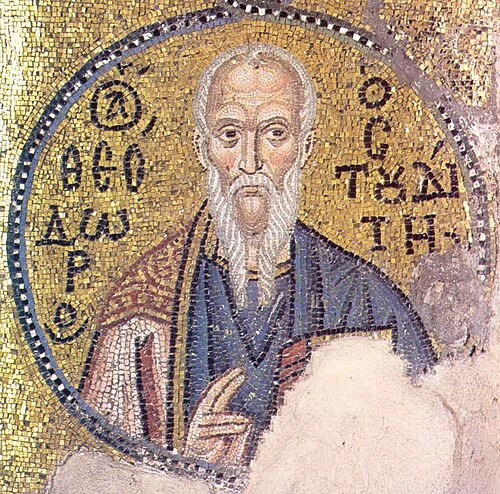
Venerable
Theodore the Studite
Abbot of the Stoudios Monastery
Abbot of the Stoudios Monastery in Constantinople, monastic reformer and great defender of the holy icons.
- Feast
- November 11old style November 24
- Reposed
- 8269th century
- Place
- Bithynia
- Order
- Venerables
Life
Saint Theodore the Studite, the Venerable, was abbot of the Stoudios Monastery in Constantinople, a reformer of Byzantine monasticism and a great defender of the holy icons. His life was spent in exiles, prisons and beatings for the true faith and for the freedom of the Church. The Church commemorates him on 11 November, the day of his repose, and on 26 January, at the translation of his relics.
Childhood and calling
He was born at Constantinople in 759, the eldest son of Photinos, an official of the imperial treasury, and Theoktiste, of a distinguished family of the capital. He was a relative of Saint Romanos the Melodist. He received a good education from his mother and, according to the Orthodox sources, from childhood chose the good life, that is, the monastic life. He would not enter state service, because the emperor Constantine V supported the iconoclasts. His father left his post, and his parents gave their goods to the poor, separated and entered monastic life. His brothers were Joseph, later archbishop of Thessalonica, and Euthymios.
In 781 his uncle Platon, who had lived as a monk in Bithynia since 759, came to Constantinople and persuaded all of Theoktiste's household to become monks. Theodore, with his father and brothers, returned to Bithynia with Platon and they turned the family estate into a monastery, called Sakkudion. Platon was abbot, and Theodore his right hand. They ordered the monastery according to the writings of Saint Basil the Great. In the time of Irene, Platon was a supporter of Patriarch Tarasios and of those who venerated icons at the Seventh Ecumenical Council at Nicaea, in 787. Soon after, Theodore was ordained priest by Tarasios. In 794 he became abbot of Sakkudion, and Platon withdrew into silence.
Conflicts with emperors
Also in 794, the emperor Constantine VI decided to leave his first wife, Maria, and to marry Theodote, a relative of Theodore. The patriarch, though perhaps at first opposed, gave way in the end. The marriage was celebrated in 795 not by the patriarch but by a priest of Hagia Sophia named Joseph. Theodore raised a protest from the monastery and demanded the excommunication not only of Joseph but of all who had communed from him, thus, by implication, the emperor and the court. Constantine tried to make peace with Theodore and Platon, but neither came. Imperial troops dispersed the monastery, and Theodore was cruelly beaten and banished to Thessalonica. After Constantine's fall, in 797, the empress Irene called him back from exile.
In 798 he moved with his disciples to the Stoudios monastery, near Constantinople, almost deserted at the time. Very soon more than a thousand monks gathered in it. Theodore gave them a strict rule of common life, with personal work for each, which took the name of the Studite Rule. The Studites gained great weight in the life of the Church, so that the patriarch and the emperor took them into account. Later, when the priest Joseph was received back into the clergy, Theodore rose again, against the emperor Nikephoros I and the patriarch, and was banished to the Princes' Islands, between 809 and 811. After the death of the emperor Nikephoros, he returned with honour to his monastery.
The struggle for the icons
In 815 the emperor Leo V the Armenian assembled a synod against the holy icons. Theodore told him not to disturb the peace of the Church, for God had placed in the Church apostles, pastors and teachers, and kings are not mentioned, and that he would not listen even if an angel from heaven came to announce the loss of our faith. In iconoclasm Theodore saw a violation of the freedom of the Church and, as to doctrine, a diminishing of the fullness of the human nature of Christ, who sent Abgar His image not made by hands.
For a procession with icons he was imprisoned and exiled. Under Leo the Armenian he suffered much, being held first in the fortress of Metopa, in Phrygia, then in Bonita, in Anatolia. It is said that he received about a hundred blows of the staff on his back and was again tortured by the commander of the army. Then he was taken to Smyrna, imprisoned and put with his feet in stocks. From prison he continued the struggle, appealing to the patriarchs, above all to the pope, to whom Christ had entrusted the keys of the faith. The new emperor, Michael II, ended the persecution. Theodore was met by the people as a martyr and wonderworker, but his monastery was not returned to him, and he lived in wandering.
Repose
Saint Theodore passed to the Lord on 11 November 826, surrounded by disciples, in the monastery of Saint Tryphon in Bithynia. He was a thin man, pale of face, with grey hair. After two years he was numbered among the saints, and at the synod of 842, when the Studites triumphed, his name was glorified among the first. His relics were moved to the Stoudios monastery in 845. His brother Joseph, who also suffered from the iconoclasts, reposed in 830 in the same monastery, where his relics also are.
Writings and influence
He kept up a rich correspondence with many notable people, among them the nun and hymnographer Kassia, who followed his teaching. 276 letters have been preserved. He wrote three books of Refutations against the iconoclasts, of which the first two are dialogues between an Orthodox and a heretic, and the third answers, point by point, their arguments about the visible image of Christ. In his treatises on the icons, Christ is shown as the prototype of His icon. His spiritual discourses were gathered in two Catecheses, the Great and the Little. The Little, with 134 instructions to the brothers, was very well known. His testament was read every year at the service in the Stoudios monastery.
The Studite Rule spread very widely. In the East, above all in Russia, it had the same importance as the Rule of Saint Benedict in the West. It was brought to Kiev in 1065 by Saint Theodosius of the Caves, and the chronicle says that all the monasteries received the rule from him. For posterity Theodore remained one of the great teachers of asceticism and a defender of the veneration of the holy icons.
Commemorated the same day November 11
 Martin of ToursSaint · Bishop of ToursNov 11
 Vincent of SaragossaMartyr · Deacon of SaragossaNov 11
 Stefan Uroš III of DečaniRight-Believing · King of SerbiaNov 11
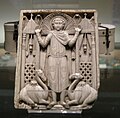 Menas of EgyptGreat MartyrNov 11
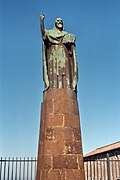 Bartholomew the YoungerVenerable · Abbot of GrottaferrataNov 11
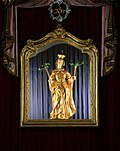 Corona (Stephanie)Martyr · Martyr of the 2nd centuryNov 11
 Five Holy Martyrs of PolandHoly Venerable Martyrs · Camaldolese hermit monksNov 11
 Victor of DamascusMartyr · Roman soldier of DamascusNov 11
 UrošicaVenerableNov 11
 Eugene KobranovHieromartyr · Bishop of RostovNov 11
- Jeftimije of DečaniVenerable Martyr · Monk of DečaniNov 11
- AbibusSaintNov 11