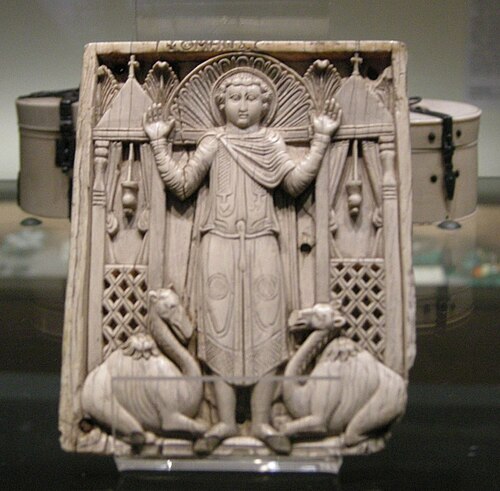
Great Martyr
Menas of Egypt
Martyr and wonderworker of Egypt, venerated throughout Christendom, who died around the year 309.
- Feast
- November 11old style November 24
- Reposed
- 3094th century
- Place
- Phrygia
- Order
- Great Martyrs
Life
Saint Menas of Egypt, great martyr, was a Roman soldier, killed for the faith around the year 309, a wonderworker, much venerated throughout Christendom. He is commemorated on 11 November.
His birth
He was born in Egypt, around 285, in the city of Nikiou, near Memphis. His parents were Christians of austere life, but were long without children. His father was named Eudoxius, his mother Euphemia. On the feast of the Mother of God, Euphemia prayed with tears before an icon of the Virgin that God might give her a son. From the icon a voice was heard that said, “Amen.” A few months later Euphemia bore a boy and named him Menas.
Soldier and hermit
His father, who ruled a region of Egypt, died when Menas was fourteen. At fifteen Menas joined the Roman army and was given a high rank, on account of his father’s name. According to the sources, he served at Cotyaeum, in Phrygia. After three years he left the army, to give his whole life to Christ, and went into the desert. After five years as a hermit he had a vision of angels crowning martyrs in glory and longed to join them. While he was thinking of this he heard a voice: “Blessed are you, Menas, for you have been called to the pious life from childhood. Three immortal crowns shall be given you: one for virginity, one for asceticism and the third for martyrdom.”
Martyrdom
He returned to Cotyaeum, at the time of a pagan festival, and confessed his faith in public. He was arrested by the governor Pyrrhus, subjected to terrible torments and, in the end, beheaded, in the persecution of Diocletian and Maximian.
The relics
Those who killed him set his body on fire for three days, but the body remained unharmed. His sister bribed the soldiers and took the body, which she carried by ship to Alexandria and placed in a church. At the end of the persecution, in the time of Pope Athanasius of Alexandria, an angel appeared to him and ordered him to load the body on a camel and set out for the Libyan desert; at a well beside Lake Mariout the camel stopped and would go no further, and the Christians understood it as a sign from God and buried the body there. The place of the tomb was forgotten, then, according to tradition, found by a shepherd, whose sick sheep was healed by rolling on the ground. The sick who came there were healed, and at the place a church and a shelter for pilgrims were built, at Abu Mena. Menas is greatly venerated by the Copts and by Greek and Balkan Orthodox, and is usually shown as a soldier, often on horseback.
Commemorated the same day November 11
 Martin of ToursSaint · Bishop of ToursNov 11
 Vincent of SaragossaMartyr · Deacon of SaragossaNov 11
 Theodore the StuditeVenerable · Abbot of the Stoudios MonasteryNov 11
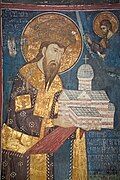 Stefan Uroš III of DečaniRight-Believing · King of SerbiaNov 11
 Bartholomew the YoungerVenerable · Abbot of GrottaferrataNov 11
 Corona (Stephanie)Martyr · Martyr of the 2nd centuryNov 11
 Five Holy Martyrs of PolandHoly Venerable Martyrs · Camaldolese hermit monksNov 11
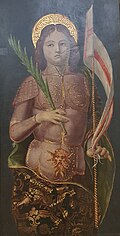 Victor of DamascusMartyr · Roman soldier of DamascusNov 11
 UrošicaVenerableNov 11
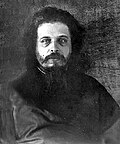 Eugene KobranovHieromartyr · Bishop of RostovNov 11
- Jeftimije of DečaniVenerable Martyr · Monk of DečaniNov 11
- AbibusSaintNov 11