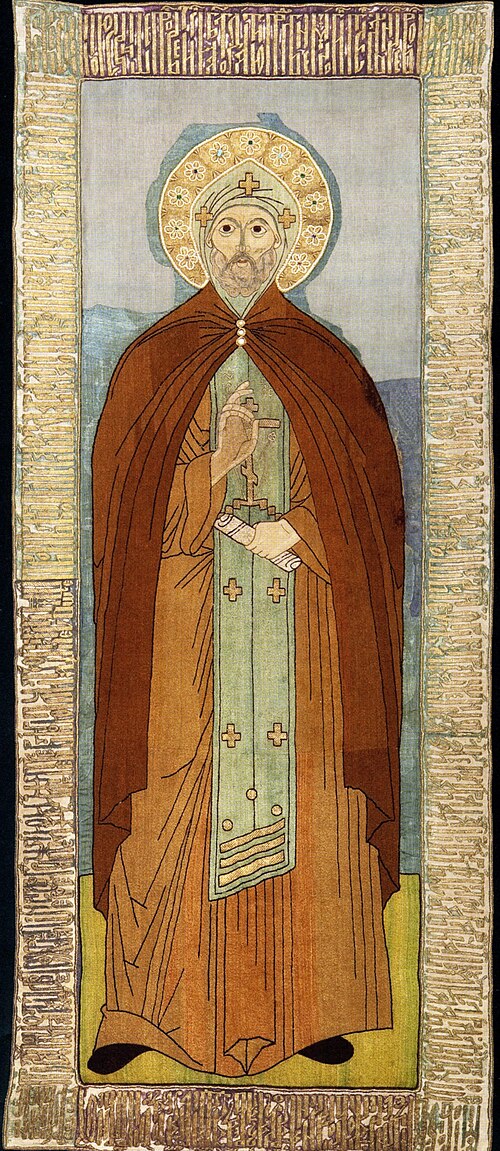
Venerable
Ephraim of Novotorzhok
Founder of the Boris and Gleb Monastery
Monk of Hungarian origin, founder of the Boris and Gleb monastery at Torzhok, died in 1053.
- Feast
- January 28old style February 10
- Reposed
- 105311th century
- Place
- Borisoglebsky Monastery
- Order
- Venerables
Life
Venerable Ephraim of Torzhok (Novotorzhok) was a monk of Hungarian origin, the elder brother of Saints Moses the Hungarian and George the Hungarian, founder of the Saints Boris and Gleb Monastery at Torzhok. He died on 28 January 1053. He is venerated in the synaxis of the saints of Novgorod. He is commemorated on 28 January, on 11 June and on the third Sunday after Pentecost.
Life
He was of Hungarian origin and was born, according to the usual supposition, in the 980s. At the beginning of the eleventh century the three brothers left Hungary and settled in Rus, serving Prince Boris of Rostov. Ephraim was the prince's groom and, after his murder, left the service. His brother George had died in 1015 defending Boris, and Ephraim found his head at the place of death and kept it with him all his life.
After his brother's death he went to the land of Novgorod and built near Torzhok a house for strangers. Then, in 1038, he founded the men's monastery dedicated to the Holy Princes Boris and Gleb, of which he was abbot. He was buried in the church of Saints Boris and Gleb. Among his disciples was Venerable Arkady.
The relics and the written life
According to the tradition in his life, on 11 June 1572, under Archbishop Leonid of Novgorod, the relics of Saint Ephraim were found incorrupt. Under Metropolitan Dionysius of Moscow he was canonized, around 1584-1587, and a service was composed for him. According to Orthodox authors, miracles are linked with this venerable one, among them the protection of Torzhok in the Time of Troubles. His life is known, but the oldest form has not survived. After the finding of the relics, in the sixteenth century, a new redaction appeared, and in the seventeenth century another. The life has reached us in late forms from the seventeenth to the early nineteenth century, and the author is uncertain. Filaret (Gumilevsky) thought it was written by Joasaph in 1572, but Vasily Klyuchevsky disagreed, placing it in the seventeenth century, because the last miracle recorded, of 1647, was told by a contemporary.
Commemorated the same day January 28
 Ephrem the SyrianVenerable · Deacon of EdessaJan 28
 Isaac the SyrianVenerable · Bishop of NinevehJan 28
 Ephraim of PereyaslavlVenerable · Bishop of PereyaslavlJan 28
 Leontius StasievichConfessor · ArchimandriteJan 28
 Emilianus of TreviHieromartyr · Bishop of TreviJan 28
 Theodosius of TotmaVenerable · Monk of Sumorin MonasteryJan 28
 Elias BenemanskyHieromartyr · Priest of TverJan 28
- Palladius of AntiochVenerable · Hermit near AntiochJan 28
- Olga EvdokimovaNew MartyrJan 28
- Vladimir PishchulinHieromartyr · HieromonkJan 28
- Aedhlugh of Eridh CassainSaintJan 28
- Antimus of BrantômeVenerableJan 28