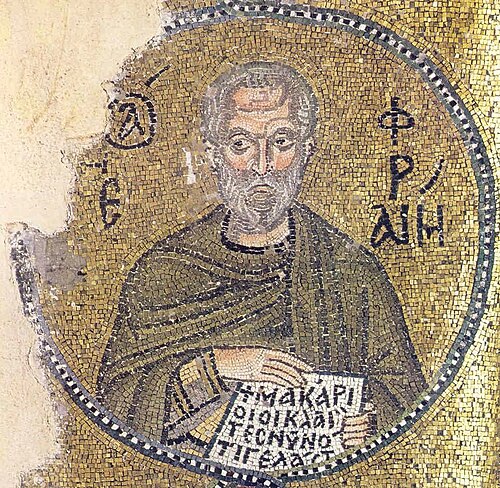
Venerable
Ephrem the Syrian
Deacon of Edessa
Syrian deacon and hymnographer, great Church Father, known for his Lenten prayer.
- Feast
- January 28old style February 10
- Reposed
- 3734th century
- Place
- Edessa
- Order
- Venerables
Life
Venerable Ephrem the Syrian was a deacon, theologian and poet, one of the great Fathers of the Church and the foremost hymnographer of Syriac Christianity. He is known above all for the Lenten prayer, O Lord and Master of my life. The Orthodox Church keeps his feast on 28 January, while Western, Coptic and Anglican calendars keep 9 June, the day he fell asleep.
Youth
He was born around 306 at Nisibis, today Nusaybin, on the border of the Roman and Persian empires. His own hymns suggest that his parents were Christians, though later hagiographers claimed his father was a pagan priest. The synaxarion says the family were poor farmers and that the young man was quick-tempered and rash, even doubting God's providence. Falsely accused of stealing a sheep and thrown into prison, he heard in a dream a voice calling him to repentance. Freed, he went to the mountains to join the hermits.
Saint James, first bishop of Nisibis, was his formator. According to the synaxarion, James made him a humble monk, gave him sermons to preach and children to teach, and took him to the First Ecumenical Council at Nicaea in 325. Ephrem obeyed James for fourteen years, until the bishop died in 338. Wikipedia notes that Ephrem was baptized as a youth, was appointed teacher (malpana) and was ordained deacon at baptism or later. The sources do not agree on everything, and modern scholars see his asceticism as a life among the sons of the covenant, an ascetic community in Nisibis.
The sieges of Nisibis
Nisibis was besieged by the Persians in 338, 346 and 350. In the first siege Ephrem credits Bishop James with defending the city by prayer. In the third siege, of 350, King Shapur diverted the river Mygdonius to undermine the walls, but the Nisibenes repaired them quickly and the Persian elephant cavalry bogged down in the wet ground. Ephrem sang this deliverance in a hymn in which the city is like Noah's ark floating to safety. The Nisibene Hymns date from this time.
The baptistery of the city, built in 359 under Bishop Vologeses, is a physical link to his time. In 363, after the death of Julian the Apostate in the Persian campaign, Emperor Jovian was forced to cede Nisibis to Persia, on condition that the Christians leave. Ephrem set out with the other refugees for Amida and settled at Edessa in 363. He was nearly sixty.
At Edessa
Edessa was full of rival schools and teachings: Arians, Marcionites, Manichees, Bardaisanites and various gnostic sects each claimed to be the true Church, and Nicene Orthodox Christians were called Palutians, after a former bishop. Ephrem wrote a great number of hymns defending Nicene faith. Jacob of Serugh relates that he trained choirs of women to sing the hymns to Syriac folk tunes in the forum of Edessa. From them arose the Syriac tradition of deaconess choirs.
The synaxarion also speaks of a hermit's life. Ephrem struggled in a place near the city, among monks who lived in caves in prayer and psalmody, and became friends with the ascetic Julian. He wrote the first Syriac commentary on the Pentateuch, prayers to the Holy Trinity, to the Son of God and to the Theotokos, hymns for the great feasts and funeral hymns.
Late in life, say the synaxarion and Wikipedia, he went to Egypt to see the labours of the great ascetics, and on the way back he stopped at Caesarea in Cappadocia and met Saint Basil the Great, in 370. Basil wanted to ordain him priest, but Ephrem thought himself unworthy. The synaxarion says he accepted only the diaconate; tradition adds that he was also offered a bishop's throne and feigned madness to escape the honour. Other accounts have him a deacon already at Nisibis, so the traditions do not fit together.
His writings
Ephrem wrote exclusively in Syriac, in the dialect of Edessa. More than four hundred hymns survive, and the historian Sozomen credits him with millions of verses. The most important are the teaching hymns, madrashe, in stanzas using over fifty metrical schemes with a refrain sung by the people. They are grouped by theme: On Faith, On Paradise, On Virginity, Against Heresies and the Nisibene Hymns. The Hymns Against Heresies defend Christ as fully God and fully man against docetism.
He also wrote homilies in verse, prose commentaries on Genesis and Exodus, on the Acts of the Apostles and the Pauline epistles, a commentary on Tatian's Diatessaron, and refutations of Bardaisan, Mani and Marcion. His works were translated very early into Greek and Armenian, then into Latin and Slavonic. Jerome says that in some churches they were read publicly after Holy Scripture. Many later works were attributed to him, called Greek Ephrem, and the hymns On Epiphany seem not to be his.
Prayer and teaching
The Lenten prayer, O Lord and Master of my life, is ascribed to him. It asks to be freed from the spirit of sloth, despondency, lust of power and idle talk, and to be given the spirit of chastity, humility, patience and love, and it ends with the petition to see my own transgressions and not to judge my brother. It is said with prostrations on the days of Great Lent.
The synaxarion calls Ephrem a great teacher of repentance. The tears of repentance, he writes, wash and burn away sin, and forgiveness is not a mere forgetting but the undoing of sin. In one quoted word, the Kingdom of God is within the sinner, who is to enter into himself and dwell in his heart, for God is there. Saint Gregory of Nyssa described him as a zealous follower of the first apostles, without staff or gold, eating oatmeal and vegetables, drinking pure water, his body like a skeleton of clay.
Charity and repose
A terrible famine struck Edessa. With his word Ephrem urged the rich to help, and from the offerings of the faithful he built a poorhouse for the poor and sick. Then he withdrew to a cave near Edessa. After ten years in the city, in his sixties, he died ministering to the plague-stricken. Wikipedia gives 9 June 373, in the days of Emperor Valens; OrthodoxWiki notes that some give 379, and his panegyric on Basil, who died in 379, suggests he may have lived longer.
Ephrem is honoured as a saint by all the traditional Churches, above all in Syriac Christianity, and the Orthodox Church numbers him among the Venerable Fathers. Pope Benedict XV declared him a Doctor of the Roman Catholic Church in 1920. A monastery of his name stands at the foot of Mount Olympus in Greece.
Commemorated the same day January 28
 Isaac the SyrianVenerable · Bishop of NinevehJan 28
 Ephraim of PereyaslavlVenerable · Bishop of PereyaslavlJan 28
 Ephraim of NovotorzhokVenerable · Founder of the Boris and Gleb MonasteryJan 28
 Leontius StasievichConfessor · ArchimandriteJan 28
 Emilianus of TreviHieromartyr · Bishop of TreviJan 28
 Theodosius of TotmaVenerable · Monk of Sumorin MonasteryJan 28
 Elias BenemanskyHieromartyr · Priest of TverJan 28
- Palladius of AntiochVenerable · Hermit near AntiochJan 28
- Olga EvdokimovaNew MartyrJan 28
- Vladimir PishchulinHieromartyr · HieromonkJan 28
- Aedhlugh of Eridh CassainSaintJan 28
- Antimus of BrantômeVenerableJan 28