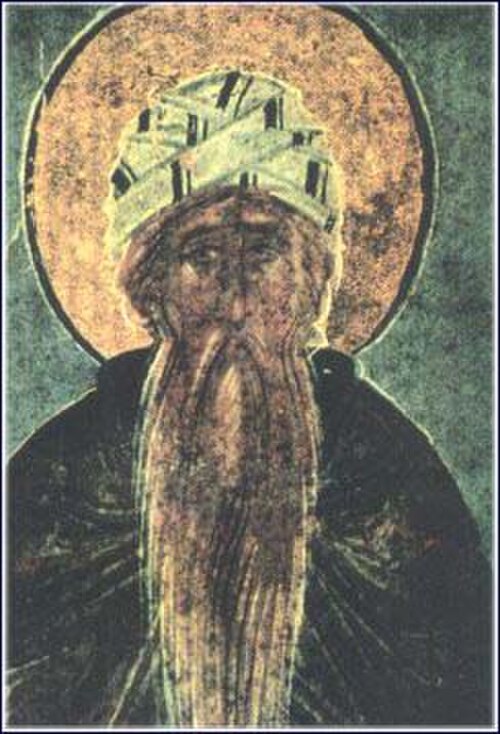
Venerable
Isaac the Syrian
Bishop of Nineveh
Syrian ascetic writer of the seventh century, bishop of Nineveh, author of spiritual homilies.
- Feast
- January 28old style February 10
- Reposed
- 7007th century
- Place
- Shushtar
- Order
- Venerables
Life
Venerable Isaac the Syrian, also called Isaac of Nineveh, was a Syrian ascetic and writer of the seventh century, for a short time bishop of Nineveh in the Church of the East. His spiritual homilies, whose central theme is the merciful love of God, have been read in East and West for more than a thousand years. He is remembered on 28 January, together with Saint Ephrem the Syrian. The Syriac Orthodox Church keeps his memory on 14 May.
Beginnings
He was born around 613, by some accounts later, in the region of Beth Qatraye in Eastern Arabia, a land where Syriac and Arabic were spoken. The Orthodox sources say that he entered a monastery while young, together with his brother, and gave himself to the ascetic struggle. His life was told by later Syriac writers, and the way his story reached us is unusual: after the eighth century little was known in Europe of him beyond his name and writings, a biography of him appeared only in 1719 at Rome, from an unknown Arab author, and further information came to light in 1896.
According to the Syriac sources, when Catholicos George I of the Church of the East visited Beth Qatraye in 676 for a synod, he ordained Isaac bishop of Nineveh, far to the north, in Assyria. An Orthodox source says that the fame of his holy life made him bishop, though he longed for silence and solitude.
Five months as bishop
Isaac remained bishop for only five months. The land was rough and the people unruly. One story says two Christians came to him to settle a quarrel: one owed money to the other and asked for time, while the lender threatened a lawsuit. Isaac begged the lender, by the Gospel, to be merciful and wait. The man told him to leave the Gospel out of it, and Isaac answered that if they would not submit to the Lord's commandments in the Gospel, there was nothing left for him to do there. He gave up his seat and went into the mountains, to the hermits.
He withdrew first to the wilderness of Mount Matout in Beth Huzaye, then, advanced in years and nearly blind from so much reading, to the monastery of Rabban Shabur near Shushtar, in present-day Iran. There he fell asleep, around 700, and was buried. Of his food it is told that it was a little bread and a few raw vegetables, which the hagiographers always marvelled at.
The writings
Abdisho bar Brikha says that Isaac wrote seven volumes. The surviving writings fall into a First Part, a Second Part and a Third Part. Only the First Part was translated early into Greek, and from Greek into other languages, among them Slavonic, and so it reached the Orthodox Church. The Second Part was rediscovered in 1983 by Sebastian Brock, in a manuscript in the Bodleian Library at Oxford, and the Third Part in the 1990s. The Ascetical Homilies are known to Orthodox believers in many languages, in Romanian among others through the work of Saint Paisius of Neamț, who spread them in Slavonic and in Romanian.
His teaching starts from the fact that the love of God is the reason for creation. Isaac speaks of the merciful heart, which burns for all creation, for men, birds, animals and even demons, seized by great compassion. Weeping for sins is, in his words, the gate to the love of God and to peace of soul, and the monk is called to judge himself instead of judging others. On the torments of hell he taught that the suffering of the condemned is the reproach of conscience and the scourge of love, not a vengeance of God.
Isaac and the Church
A few scholars find in the Second Part a hope of the final reconciliation of all. The Church has drawn no new doctrine from it, but reads Isaac as a teacher of repentance and mercy. His melancholy style, full of compassion for the sick and the dead, has deeply influenced Orthodoxy, and his writings have been studied without a break by the theologian monks of the East.
Another matter is his church allegiance: Isaac belonged to the Church of Persia, today called the Assyrian Church of the East, often regarded as Nestorian. Orthodox scholars, in the introduction to the English edition of the Ascetical Homilies, argue that the Church of Persia of his day was neither heretical in teaching nor cut off by a schism from the Chalcedonian Church. For this reason Isaac is honoured as a saint by the Orthodox Church, by the Syriac Church, by the Catholic Church and by the Assyrian Church of the East.
His words remain in Orthodoxy as a spring of discernment: that life is given us for repentance, that we should seek goodness rather than mere justice, and that whoever follows Christ in solitary mourning is greater than one who praises Him in the midst of a crowd.
Commemorated the same day January 28
 Ephrem the SyrianVenerable · Deacon of EdessaJan 28
 Ephraim of PereyaslavlVenerable · Bishop of PereyaslavlJan 28
 Ephraim of NovotorzhokVenerable · Founder of the Boris and Gleb MonasteryJan 28
 Leontius StasievichConfessor · ArchimandriteJan 28
 Emilianus of TreviHieromartyr · Bishop of TreviJan 28
 Theodosius of TotmaVenerable · Monk of Sumorin MonasteryJan 28
 Elias BenemanskyHieromartyr · Priest of TverJan 28
- Palladius of AntiochVenerable · Hermit near AntiochJan 28
- Olga EvdokimovaNew MartyrJan 28
- Vladimir PishchulinHieromartyr · HieromonkJan 28
- Aedhlugh of Eridh CassainSaintJan 28
- Antimus of BrantômeVenerableJan 28