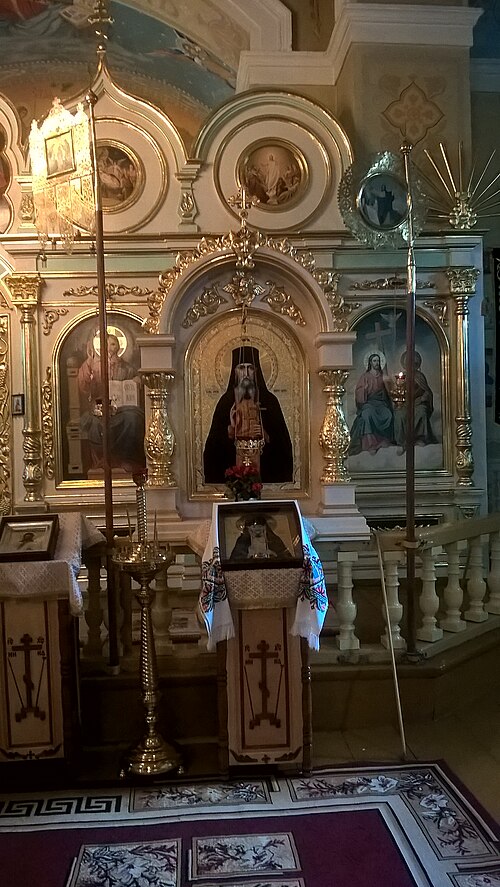
Confessor
Leontius Stasievich
Archimandrite
Archimandrite of the Russian Orthodox Church, 1884 to 1972, counted among the New Martyrs and Confessors.
- Feast
- January 28old style February 10
- Reposed
- 197220th century
- Place
- Mikhaylovskoye, Furmanovsky District
- Order
- Confessors
Life
Saint Leontius Stasievich, also called Leontius of Mikhaylovskoye, was an archimandrite of the Russian Orthodox Church and a well-known elder in the Ivanovo region. He was born in 1884 at Tarnogrod, in present-day Poland, and reposed in 1972 in the village of Mikhaylovskoye. The Church honours him among the New Martyrs and Confessors of Russia for the nearly eleven years he spent in labour camps for his faith and for the gifts of healing and foresight that believers recognized in him during his lifetime.
Youth
His name in the world was Lev Fomich Stasievich, and he was born on 20 March 1884. He was the only son of Katarzyna and Tomasz Stasievich, devout Orthodox peasants of Tarnogrod. His uncle Adam was an Orthodox priest with the rank of archpriest.
He later recalled that pilgrims often spent the night in his parents' house and told him about the shrines they had visited and the saints venerated there. Sources differ on his schooling: according to some he attended the local school and then a four-year gymnasium, according to others only the parish school.
At fifteen he began working as a clerk at the court in Tarnogrod. Six years later his father died. Although he was now the family's only breadwinner, his mother allowed him to give up his job and study at the Orthodox seminary in Kholm so that he could become a priest.
At Yablochin and in Moscow
On 31 December 1910 he entered the monastery of Saint Onuphrius at Yablochin as a novice. On Great Monday of 1912 he made his monastic vows before the superior, Archimandrite Seraphim, and took the name Leontius in honour of Saint Leontius of Rostov. His mother died the same year.
On 29 October 1912 Bishop Eulogius (Georgievsky) of Kholm ordained him deacon, and on 20 May 1913 the new Bishop of Kholm, Anastasius (Gribanovsky), ordained him priest. The years at Yablochin marked him deeply, and all his life he regarded Saint Onuphrius, the monastery's patron, as his special protector.
From 1913 to 1915 he was the monastery's treasurer. In 1915, as the front drew near, he fled with the whole brotherhood to Moscow, where he lived at first temporarily, and in 1916 he was received permanently into the Epiphany Monastery.
According to some sources he began studying at the Moscow Theological Academy but received no diploma because it was closed in 1919. Others say he attended first a lower theological school and then the Moscow seminary. In either case his studies ended in 1919, when the Bolshevik authorities closed the theological schools of the city.
In 1919 he was made a hegumen. The Epiphany Monastery had by then been registered as a labour commune to avoid closure, and Hegumen Leontius chaired the residents' committee.
In Suzdal
In November 1922, at the request of Bishop Basil of Suzdal, he was transferred to the monastery of Saint Euthymius in Suzdal, and that year he became superior of its community of nearly a hundred. He worked to improve the monastery's finances and to restore monastic order, including services held according to the rule.
This brought conflict, since some of the monks sided with the Renovationist movement, and the hegumen was beaten by them several times.
In 1923 the Soviet authorities closed the monastery, but Father Leontius remained in Suzdal. In 1924 Patriarch Tikhon raised him to the rank of archimandrite. He served first at the parish of the Smolensk Icon of the Mother of God and then at another church in the town (Saint Nicholas according to some sources, Saint John the Theologian according to others) until 1930, winning the love and respect of the faithful.
In 1929 he joined the believers who protested against the closing of the cathedral in Suzdal.
Arrests and the camps
In 1930 he was arrested by the OGPU on charges of counter-revolutionary activity. The immediate cause was a breach of the ban on ringing church bells. Thirty-one other clergy and church people were imprisoned with him.
They were accused of organizing a group of "fanatical women", including former nuns, who collected money for the exiled Bishop Gregory and caused disturbances when the cathedral was closed. The archimandrite was also charged with using Scripture to argue that Soviet power would soon fall. He denied the charges and was sentenced to three years in a camp in the Komi Republic, where he worked as a medical assistant with a brigade of prisoners building a road.
After serving his sentence he received a blessing from Bishop John Chrysostom of Yuriev-Polsky to serve in the village of Borodino. After a year he was arrested again, accused of religious propaganda among children, opposing collectivization and belonging to a secret monarchist organization. He admitted only to giving children small presents, pens and pencils, so that they would not fall into hooliganism.
On 15 February 1936 he was sentenced to another three years in a camp at Karaganda, where he served as assistant to the camp doctor. The guards often harassed him for refusing to renounce his faith.
In 1938 he was released and returned to Suzdal, but he took no parish. He only went from time to time to nearby villages and served in people's homes.
Vorontsovo and the third arrest
In July 1947 he resumed his ministry within the Russian Orthodox Church. Bishop Michael of Ivanovo and Kineshma entrusted him with the Holy Trinity parish at Vorontsovo. He restored the church even though he was burdened with a heavy tax.
He lived ascetically, celebrated all the services according to the monastic order, taught the young and urged his parishioners not to work on feast days. The faithful regarded him as a clairvoyant elder.
On 2 May 1950 he was arrested for the third time, charged with spreading anti-Soviet ideas in his sermons, chiefly by foretelling the imminent end of the world and interpreting Scripture against the state. He did not admit guilt and was sentenced to ten years in a labour camp.
He was sent back to the Komi Republic, where he was held in great respect by his fellow prisoners. It is said that through his prayer the daughter of the camp commander was healed, and according to some sources he read the prayers of exorcism over her. As a result his conditions were eased and he was allowed to celebrate the Divine Liturgy at Pascha.
Some years later his case was reviewed. The court found that he had made anti-Soviet remarks only occasionally and reduced his sentence to five years, and on 30 April 1955 he was released.
Pastor at Mikhaylovskoye
On 20 July 1955 Bishop Benedict of Ivanovo sent him to the parish of the Archangel Michael at Mikhaylovskoye. He quickly won great authority among the faithful and obtained permission to repair the church.
In 1960 Bishop Hilarion appointed him to the diocesan council and made him confessor to the clergy of the diocese. In the same year the Patriarch of Moscow granted him the right to celebrate the Liturgy with the royal doors open until the Cherubic Hymn.
The following year, after a false accusation from a cleric who was the bishop's brother, he was suspended, and a month later he was sent to a poor parish at Yelkhovka. In 1963, at the insistent request of many parishioners of Mikhaylovskoye, the new Bishop of Ivanovo, Leonid, sent him back there.
Age and illness no longer allowed him to celebrate the Liturgy daily. He still received the faithful in his home, heard confessions and gave spiritual counsel and guidance. He lived simply, accepted no money, and gave all the gifts of the faithful to the upkeep of the church. In 1969 Patriarch Alexy I granted him the right to wear a second jewelled cross.
On 7 February 1972 he celebrated his last Liturgy. The next day he suddenly fell ill, and on 9 February he reposed in the parish house while the church choir sang hymns for him. His funeral was led by Archimandrite Ambrose (Shchurov), and as he had wished he was buried in the cemetery at Mikhaylovskoye. In 1989 he was fully rehabilitated by the Soviet authorities.
Veneration
Father Leontius was regarded as a saint already in his lifetime, and his veneration began immediately after his death. A spring appeared near his grave which the faithful believe to be healing, and the Church acknowledges that miracles took place at the grave.
The Church ascribes to him the gift of healing through prayer and of foresight. Among the things he is said to have foretold are the Tashkent earthquake, the death of Patriarch Alexy I, the fall of communism, the uncovering of the relics of Saint Seraphim of Sarov and the hour of his own death.
In 1999 Bishop Ambrose of Ivanovo glorified him as a locally venerated saint of the diocese of Ivanovo-Voznesensk, and in 2000 the Council of Bishops of the Russian Church included him in the Synaxis of the New Martyrs and Confessors of Russia. In the same year he was also added to the Synaxis of the Saints of Ivanovo.
His relics rest for veneration in the church of the Archangel Michael at Mikhaylovskoye. He is also honoured by the Polish Orthodox Church as Saint Leontius of Tarnogrod. Since 2008 his icon with a portion of his relics has been in the Holy Trinity church at Tarnogrod, and in 2010 Archbishop Abel of Lublin and Chelm established a local feast there on 11 November. The Russian Church commemorates him on 10 February (28 January, Old Style).
Commemorated the same day January 28
 Ephrem the SyrianVenerable · Deacon of EdessaJan 28
 Isaac the SyrianVenerable · Bishop of NinevehJan 28
 Ephraim of PereyaslavlVenerable · Bishop of PereyaslavlJan 28
 Ephraim of NovotorzhokVenerable · Founder of the Boris and Gleb MonasteryJan 28
 Emilianus of TreviHieromartyr · Bishop of TreviJan 28
 Theodosius of TotmaVenerable · Monk of Sumorin MonasteryJan 28
 Elias BenemanskyHieromartyr · Priest of TverJan 28
- Palladius of AntiochVenerable · Hermit near AntiochJan 28
- Olga EvdokimovaNew MartyrJan 28
- Vladimir PishchulinHieromartyr · HieromonkJan 28
- Aedhlugh of Eridh CassainSaintJan 28
- Antimus of BrantômeVenerableJan 28