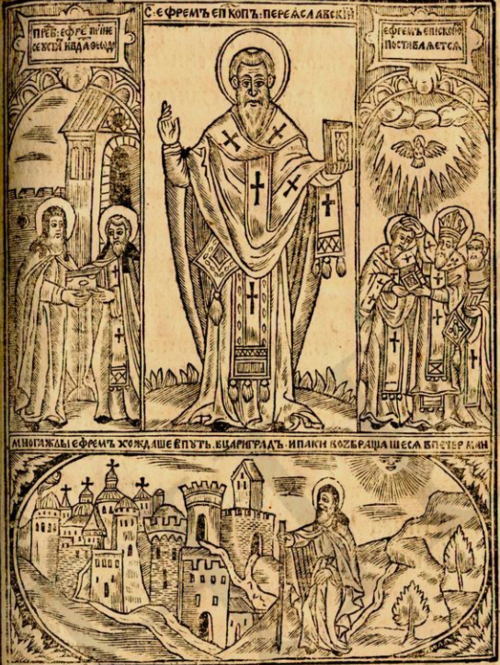
Venerable
Ephraim of Pereyaslavl
Bishop of Pereyaslavl
Bishop of Pereyaslavl, also called Ephraim of the Caves, who died between 1091 and 1101.
- Feast
- January 28old style February 10
- Reposed
- 109811th century
- Order
- Venerables
Life
Saint Ephraim of Pereyaslavl (also called Ephraim of the Caves) was bishop of Pereyaslavl in the eleventh century and fell asleep in the Lord around 1098, by some sources between 1091 and 1101. The Church remembers him as a labourer of the Kiev Caves Lavra, a man of learning and love for people.
The monastic path
He was of Greek descent. Before becoming a monk he was treasurer and steward of household affairs at the court of Grand Prince Iziaslav Yaroslavich, between 1054 and 1068. Weary of the noisy and restless life, he asked to become a monk. With the blessing of Saint Anthony of the Caves, he was tonsured by Hegumen Nikon on 23 March.
The prince grew angry, ordered Ephraim to return, threatened him with prison and the destruction of the caves, and Anthony and the brethren left the monastery. But Iziaslav feared the wrath of God, took his wife's advice and withdrew his forces. Ephraim then wished to venerate the holy places abroad. With Anthony's blessing he came to Constantinople and settled in one of the monasteries.
In Constantinople he copied the Studite Rule at the request of Saint Theodosius of the Caves and sent it to Kiev. On receiving it, Theodosius introduced it in the Lavra, and the Studite Rule soon became the most widespread in the Russian monasteries of the time.
Bishop of Pereyaslavl
After 1072 he was made bishop at Pereyaslavl, with the title of metropolitan, as titular head of a metropolis recently established. Some versions of his life make him metropolitan of Kiev from 1092, but this view is no longer held. He adorned Pereyaslavl with many beautiful churches, among them the cathedral of Saint Michael, the church of Saint Theodore above the Bishop's Gate and the church of Saint Andrew, and with public buildings. He built stone walls around the city in the Greek manner, founded free hospitals for the poor and travellers, and built public baths. The chronicle says he was the first in Rus' to take up "bath building", that is, buildings where a font stood for the baptism of adults.
In 1091 he took part in the opening and solemn translation of the relics of Saint Theodosius. He was a learned man, strict in life and experienced; his contemporaries called him "a wondrous man, a wonderworker and rich in virtues". He is said also to have established the feast of the translation of the relics of Saint Nicholas to Bari, on 9 May. A tale and encomium of Saint Nicholas is attributed to him. A life of him once existed but is lost.
Repose and veneration
He departed to the Lord around 1098, according to tradition on 28 January, and was buried in the Church of the Presentation in the Near Caves of the Kiev Caves Lavra.
He is commemorated on 28 January, on 28 September, in the Synaxis of the Venerable Fathers of the Near Caves, and on the second Sunday of Great Lent, in the Synaxis of All the Venerable Fathers of the Caves.
Commemorated the same day January 28
 Ephrem the SyrianVenerable · Deacon of EdessaJan 28
 Isaac the SyrianVenerable · Bishop of NinevehJan 28
 Ephraim of NovotorzhokVenerable · Founder of the Boris and Gleb MonasteryJan 28
 Leontius StasievichConfessor · ArchimandriteJan 28
 Emilianus of TreviHieromartyr · Bishop of TreviJan 28
 Theodosius of TotmaVenerable · Monk of Sumorin MonasteryJan 28
 Elias BenemanskyHieromartyr · Priest of TverJan 28
- Palladius of AntiochVenerable · Hermit near AntiochJan 28
- Olga EvdokimovaNew MartyrJan 28
- Vladimir PishchulinHieromartyr · HieromonkJan 28
- Aedhlugh of Eridh CassainSaintJan 28
- Antimus of BrantômeVenerableJan 28