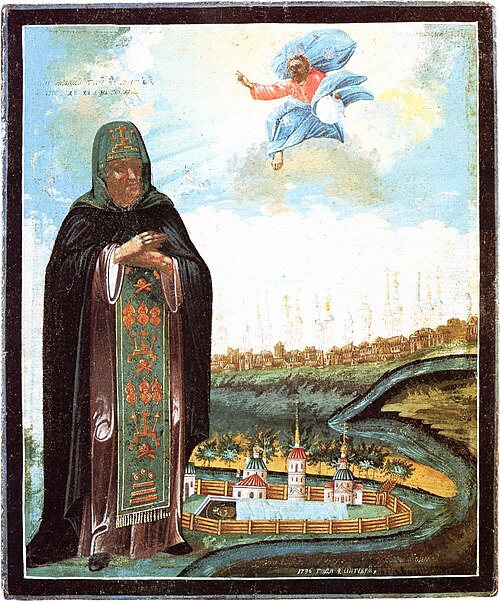
Venerable
Theodosius of Totma
Monk of Sumorin Monastery
Russian monk born at Vologda, who died on January 28, 1568 at the Sumorin monastery.
- Feast
- January 28old style February 10
- Reposed
- 156816th century
- Place
- Spaso-Sumorin Monastery
- Order
- Venerables
Life
Saint Theodosius of Totma (early sixteenth century - 28 January 1568) was a Russian monk, born at Vologda, founder of the Sumorin monastery near Totma and a strict ascetic who hid his labours. The Russian Church commemorates him on 28 January, the day of his death, and on 2 September (15 September in the new style).
His life
He was born at Vologda, probably in the early years of the reign of Vasily III (1505-1533). At the proper age he married, at his parents' wish, and had a daughter, Marina. After the death of his parents and wife he left his property to relatives to raise his daughter and entered the Transfiguration monastery of Saint Demetrius of Priluki in Vologda, where he was tonsured.
In 1554 he received from the tsar a charter of exemption from jurisdiction and began to organize the Totma monastery, where in a year he built a wooden church and cells for the brethren. In 1560 Archbishop Nicander of Rostov gave him a new obedience: the restoration of the desolate Spaso-Nikolaev Ephremov Hermitage, in the Totma district, on the rivers Rezha and Vaga. The tsar's charter given to the elder Ephraim in the early sixteenth century passed by inheritance to Theodosius, who restored the hermitage at his own expense. There stood the churches of the Transfiguration and of Saint Nicholas. In documents of the seventeenth century the hermitage appears as belonging to another monastery, Nikolo-Ugreshsky, and it was abolished in 1764.
His labours
In search of spiritual enlightenment he gathered a large library of spiritual books, buying not only service books but also theological works, costly at that time, of Saint John Chrysostom, Saint Ephrem the Syrian and other teachers of the Church. He led the most strict ascetic life, constantly in prayer and labour, carefully hiding his struggles; only his death revealed the secret. He wore under his clothes iron chains and a hair shirt that tore his body to blood, and on his head, under the schema cowl, an iron cap. Saint Seraphim of Sarov regarded the chains of such ascetics, among them Theodosius of Totma, as the final moment of their struggle, its crowning, which must be prepared by labours of humility, bearing insults and fasting.
After fifteen years at the Totma monastery, foreseeing his end, he called the brethren and ordered a spiritual testament to be written on how the monastery should be governed after his death. This historical document includes his instruction about his commemoration. He asks that ten roubles be given to the Priluki monastery and half a rouble for forty liturgies at each altar in the city of Totma, and begs the brethren to remember him, not to strike from the memorial book his name and his family, to administer justice without deviation, not to take sin on their souls, and to forgive him, a sinner, and remember him in their prayers, that God may forgive them too. He died on 28 January 1568.
His relics
In 1796, when a trench was being dug for the foundation of a new church on the territory of the Spassky monastery, a coffin was found with the fairly well preserved remains of a schemamonk, and it was supposed that they were the relics of Theodosius, who died in 1568. The Vologda consistory thought the supposition groundless and ordered the coffin buried. The governor-general, however, reported to the Synod of the body found as "most wonderful relics", and the Synod ordered the local bishop to make an inquiry. A commission of the consistory examined the coffin and sealed it, without giving the matter any course. Almost a year later, at the request of the city authorities, who wanted a saint of their own, the Synod appointed a second commission of two bishops, who spoke against recognizing the body as the relics of Theodosius, because of the place and type of the coffin and the absence of miracles; the miracles reported turned out to be false. After another year, yielding to the secular authorities, the Synod ordered the bishop to examine again. He understood what was wanted of him and decided that the remains could be regarded as "true relics of the venerable Theodosius", and in September 1798 the Synod decreed that the body found in 1796 be proclaimed the relics of Theodosius of Totma the wonderworker. About a hundred and fifty posthumous miracles are known: the monastery book records 146, and writing them down long ago ceased.
On 17 April 1919 the relics were opened, in the Soviet campaign of "opening of relics". The commission found that the skeleton was dry and largely decayed, with only the bones remaining. In the 1920s the Sumorin monastery was abolished and the relics ended in the Vologda Museum. In 1988, the year of the thousandth anniversary of the baptism of Rus, they were given to the Vologda diocese and kept in the Lazarus church in Vologda. In 1994 the relics were solemnly transferred to Totma, where they were placed in the church of the Nativity of Christ. In 2014 the 460th anniversary of the founding of the Sumorin monastery and the twentieth of the return of the relics were marked, and the monastery has begun to be restored. On 15 September 2016, on the day of his commemoration, the relics were solemnly moved to the Ascension Cathedral of the Sumorin monastery.
Veneration
His memory was especially honoured in the Maroseyka community at the church of Saint Nicholas in Klenniki, led at the beginning of the twentieth century by the righteous Alexei Mechev and, after his death, by his son, the hieromartyr Sergei Mechev. Churches in his honour are in Chernigov, in the Anthony caves of the Trinity-Ilyinsky monastery, where the main church of the monastery, the largest of the three underground ones, is his, and where on 21 November 1941 the first service was held under Saint Lavrentiy of Chernigov. Another altar of his is in the Trinity cathedral church in Nizhny Novgorod (Vysokovo) and a side chapel in the Trinity church in the village of Olesh, in the Kostroma region.
Commemorated the same day January 28
 Ephrem the SyrianVenerable · Deacon of EdessaJan 28
 Isaac the SyrianVenerable · Bishop of NinevehJan 28
 Ephraim of PereyaslavlVenerable · Bishop of PereyaslavlJan 28
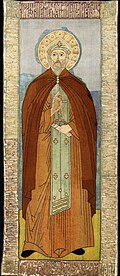 Ephraim of NovotorzhokVenerable · Founder of the Boris and Gleb MonasteryJan 28
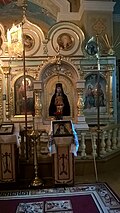 Leontius StasievichConfessor · ArchimandriteJan 28
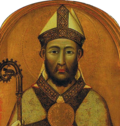 Emilianus of TreviHieromartyr · Bishop of TreviJan 28
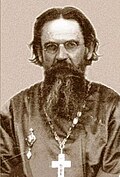 Elias BenemanskyHieromartyr · Priest of TverJan 28
- Palladius of AntiochVenerable · Hermit near AntiochJan 28
- Olga EvdokimovaNew MartyrJan 28
- Vladimir PishchulinHieromartyr · HieromonkJan 28
- Aedhlugh of Eridh CassainSaintJan 28
- Antimus of BrantômeVenerableJan 28