Hieromartyr
Vladimir Pishchulin
Hieromonk
Russian hieromonk born in Kostroma in 1889, who died in Simferopol in 1938 and was canonized in 2000.
- Feast
- January 28old style February 10
- Reposed
- 193820th century
- Place
- Simferopol
- Order
- Martyrs
Life
Holy Hieromartyr Vladimir Pishchulin (Vladimir Fyodorovich Pishchulin) was a hieromonk of the Russian Orthodox Church, born on 6 July 1889 at Kostroma and shot on 10 February 1938 at Simferopol. Between 1925 and 1926 he was a bishop of the Renovationists, but returned to the Orthodox Church. He was numbered among the locally venerated saints of the diocese of Crimea in 1997 and among the saints venerated throughout the Church in August 2000. He is remembered on 28 January, old calendar (10 February).
Youth
He was born into a noble family. He finished the gymnasium at Vitebsk and the faculty of history and philology of Petersburg University (1914). He taught history at a gymnasium and gave lectures on psychology at the People's University. In 1917 he was a member of the Kadet party and secretary of its Vitebsk provincial committee. He was a close friend and schoolmate of Archpriest Alexander Vvedensky. From 24 December 1919 he was deacon, and from 1 January 1920 priest. He served with Vvedensky at the church of Saints Zechariah and Elizabeth in Petrograd and was at the same time rector of the church of Saint Nicholas in the House of the Blind, on Mokhovaya street. He was a member of the House of Scholars, of the philosophical society and assistant at the chair of Christian pedagogy of the Petrograd Theological Institute.
Between the Renovationists and the Church
With Vvedensky, who became the Renovationist metropolitan, he took an active part in the Renovationist movement and was one of its most ardent representatives. His independent position irritated those in power. Already on 31 May 1922 he was arrested on the charge of taking part in an "illegal group" and in September of the same year was sent into exile at Orenburg, as "extremely unreliable politically". In 1924 he returned to Leningrad and on 9 December was tonsured by the Renovationists a rassophore and raised to archimandrite. From 8 March 1925 he was bishop of Okhta, vicar of the metropolis of Leningrad. He took part in the Renovationist council of 1925 and taught dogmatic theology at the Leningrad Theological Institute. In November 1925 he was appointed by the Renovationists bishop of Pskov, but refused the appointment and retired.
On 14 August 1926, in the church of the Saviour on the Waters in Leningrad, he was received into communion with the Orthodox Church, in the rank of hieromonk. His leaving the Renovationists was a heavy blow to their movement. A prominent man in the intellectual life of Leningrad in the second half of the 1920s, he argued openly with Vvedensky and fought actively against Renovationism. He belonged to the circle (brotherhood) of Saint Seraphim of Sarov, formed by I. M. Andreevsky. On 7 April 1928 he was arrested with other members of the circle and in October of the same year was sentenced to the special camp at Solovki, then sent into exile in Kazakhstan for three years. For a time he lived at Melekess, where he had contact with Bishop Benjamin (Troitsky).
Crimea and martyrdom
In 1934 he moved to relatives, at Simferopol, from 1935 to 1937 he worked in the library of the pedagogical institute, then was dismissed and supported himself by lessons in foreign languages. At Simferopol he had contact with those of like mind, a few representatives of the local intelligentsia. On 5 July 1937 he was arrested, on the denunciation of a distant relative, and held in the city prison. He was charged with counter-revolutionary agitation and did not admit guilt. At the investigation he said that he was not an enemy of Soviet power, though in some matters of its policy he stood on very negative positions: he was an opponent of the anti-Christian policy of Soviet power and of materialism, which denies the idea of religion, and said that it was ridiculous and foolish to speak of democracy and freedom when the very foundation of all social and personal life was put in chains. On 10 December 1937 the troika of the UNKVD of the Crimean ASSR sentenced him to death by shooting and, after two months, he was shot. In 1997 he was numbered among the locally venerated saints of the diocese of Crimea by the Holy Synod of the Ukrainian Orthodox Church, and in August 2000 the Council of Bishops of the Russian Orthodox Church glorified him for veneration throughout the Church.
Commemorated the same day January 28
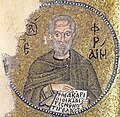 Ephrem the SyrianVenerable · Deacon of EdessaJan 28
 Isaac the SyrianVenerable · Bishop of NinevehJan 28
 Ephraim of PereyaslavlVenerable · Bishop of PereyaslavlJan 28
 Ephraim of NovotorzhokVenerable · Founder of the Boris and Gleb MonasteryJan 28
 Leontius StasievichConfessor · ArchimandriteJan 28
 Emilianus of TreviHieromartyr · Bishop of TreviJan 28
 Theodosius of TotmaVenerable · Monk of Sumorin MonasteryJan 28
 Elias BenemanskyHieromartyr · Priest of TverJan 28
- Palladius of AntiochVenerable · Hermit near AntiochJan 28
- Olga EvdokimovaNew MartyrJan 28
- Aedhlugh of Eridh CassainSaintJan 28
- Antimus of BrantômeVenerableJan 28