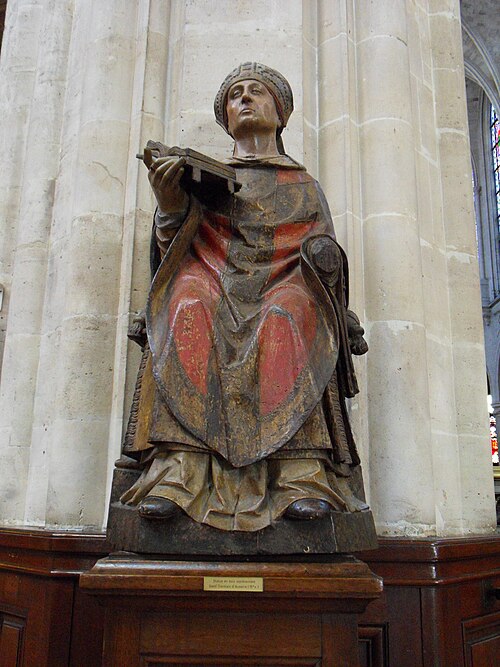
Saint
Germanus of Auxerre
Bishop of Auxerre
Former high Roman official and bishop of Auxerre in Gaul, who died at Ravenna around 448.
Life
Saint Germanus of Auxerre, hierarch, was a high Roman official in Gaul who left his career to become bishop of Auxerre, from 418 to 448. He fought Pelagianism in Britain, defended his flock in dangerous times, and died at Ravenna in 448. He is one of the most venerated saints of France. The Russian Orthodox Church entered him in its calendar in 2017, and he is commemorated on 31 July.
Youth and calling
Germanus was the son of Rusticus and Germanilla, of one of the noblest families of Gaul. He was born around 378 at Appoigny near Auxerre. He studied at the schools of Arles and Lyon, then at Rome rhetoric and civil law, where he had success as an advocate. He married Eustachia, a woman esteemed at the imperial court. The emperor sent him back to Gaul as one of the six governors of the Gallic provinces, with his residence at Auxerre.
It is told that he displeased Bishop Amator by hanging hunting trophies on a tree that had formerly been a site of pagan worship. Amator rebuked him in vain. One day, when the duke was away, the bishop cut down the tree and burned the trophies. Fearing his anger, he sought the prefect's permission to tonsure Germanus. When the duke came to the church, Amator barred the doors, tonsured him against his will, told him to live as one destined to be his successor and made him a deacon. After a short time Amator died, and Germanus was chosen bishop by all, being consecrated on 7 July 418. He distributed his goods to the poor, practised severe austerities, and built on the banks of the river Yonne a great monastery dedicated to Saints Cosmas and Damian, where he would retire in his free moments. With Saint Martin of Tours he stood at the beginnings of communal monasticism in Gaul.
Britain
Around 429 an assembly of bishops of Gaul chose Germanus, with Lupus, bishop of Troyes, to go to Britain, where Pelagianism was said to have spread among the clergy. On the way they passed through Nanterre, where Germanus noticed in the crowd a girl whom he urged to live as a bride of Christ: she was the future Saint Genevieve of Paris. In Britain, before a great crowd, the two bishops confronted the Pelagian clergy, described as rich, brilliantly dressed and surrounded by flatterers, and Germanus defeated them by his gift of speech. Constantius of Lyon, author of his Life, also tells of the healing of the blind daughter of a man of tribunician rank. According to a legend Germanus led the native Britons to victory over the Picts and Saxons, at a mountain site by a river, traditionally at Mold in North Wales. He visited Britain a second time, in 445. He promoted the veneration of Saint Alban, whose passion was revealed to him, according to tradition, in a vision. According to some sources, in 432 he ordained Saint Patrick bishop, though some scholars question their connection.
Death
In 447 he went to Ravenna to Emperor Valentinian III to ask for a lighter penalty for the people of Armorica, in conflict with the general Aetius. There he died on 31 July 448. His remains rest in the crypt of the abbey of Saint-Germain at Auxerre. His Life was written around 480 by Constantius of Lyon.
Commemorated the same day July 31
 Joseph of ArimatheaRighteous · Disciple of the LordJul 31
 John the ExarchSaint · Bulgarian scholarJul 31
 Benjamin of PetrogradHieromartyr · Metropolitan of PetrogradJul 31
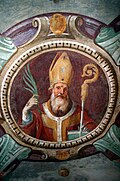 Calimerius of MilanSaint · Bishop of MilanJul 31
 Neot of CornwallVenerable · Hermit in CornwallJul 31
 George NovitskyMartyr · Professor of lawJul 31
 John KovsharovMartyr · Lawyer of Alexander Nevsky LavraJul 31
 Basil of KineshmaConfessor · Bishop of KineshmaJul 31
 Sergius SheinHieromartyr · Archimandrite and former Duma deputyJul 31
- Arsen of NinotsmindaVenerable · Georgian bishop and calligrapherJul 31
- Anna SerovaMartyrJul 31
- Julitta of CaesareaMartyrJul 31