Saint
John the Exarch
Bulgarian scholar
Bulgarian scholar, writer and translator, a leading figure of the Preslav Literary School at the turn of the ninth and tenth centuries.
Life
Saint John the Exarch (John the Exarch of Bulgaria) was a Bulgarian scholar, writer, exegete and translator, one of the leading figures of the Preslav Literary School at the end of the ninth and the beginning of the tenth century. He worked in the time of Tsar Boris I and his son Simeon I (893-927). His feast is on 31 July (in other sources, 13 August; in a manuscript of the Gospels in the National Library of Serbia the date given is 13 February).
What is known of his life
News of his life is scarce and mostly comes down to conjecture, but sure testimonies show that he was a collaborator of Tsar Simeon in his work of enlightenment. His literary legacy shows an excellent knowledge of the Greek language, so it is held that he received his education in the Byzantine Empire (according to some, at Constantinople, together with the future tsar Simeon). From certain places in the Hexameron it is clear that he was one of the most learned men of his time: he knew Slavonic, Greek and Hebrew, had deep knowledge of Holy Scripture and knew both the writings of the holy Fathers and the philosophers of ancient Greece. He belonged to the generation of Bulgarian men of letters that followed Cyril and Methodius.
What the sobriquet "the Exarch" means is debated. Some historians think it shows that he was archbishop of Bulgaria; by a hypothesis supported by Trendafil Krastanov, John stayed at Rome as envoy of Prince Boris I as early as 866, later received from Pope John VIII the title of exarch of Bulgaria and, after the death of Methodius, succeeded him as archbishop of Moravia. According to others, the sobriquet has no connection with episcopal rank. There is another view, that he was head of the library and of a group of scholars and translators and, as deputy of the Greek archbishop, directed church affairs in the eastern part of the peninsula, where the tsar's residence was. Attempts have also been made to identify him with Chernorizets Hrabar or with Saint John of Rila.
His works
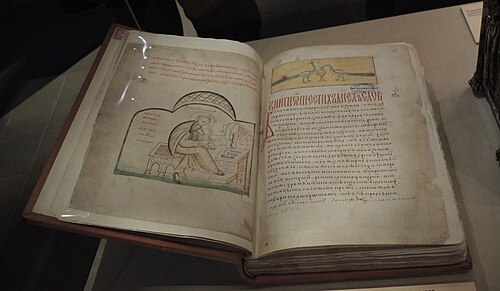
John translated into Slavonic part of the Exact Exposition of the Orthodox Faith of Saint John of Damascus (called "The Heavens"), around 893 or 895, with an explanatory preface written by himself, and the Philosophical Chapters (Dialectica) of the same saint, as well as the Damascene's Greek grammar on the eight parts of speech and several discourses, translated in part and adapted to the Slavonic language. He compiled the Hexameron (Shestodnev), a commentary on the first chapters of Genesis, using the writings of Severian of Gabala, of Saint Basil the Great and of Saint John Chrysostom, and also of Aristotle, Plato and others. The compilation contains not only translations of Byzantine authors (first of all Basil the Great) but also original parts, among them the earliest Slavonic texts on medicine and astronomy, which give valuable first-hand testimony about the Bulgarian Empire under Simeon I: John describes the royal palace and the Bulgarian ruler, with his attire, the boyars, the social stratification of Bulgarian society and similar matters. The oldest surviving manuscript of the Hexameron was made in 1263 by Theodore the Grammarian at the Hilandar monastery.
He wrote a series of discourses and sermons for church feasts, among them the Discourse on the Ascension of our Lord Jesus Christ; the Discourse on the Transfiguration and the work From the Gospel Narrative are also attributed to him. Under the name of the presbyter John, whom most scholars identify with John the Exarch, several sermons are preserved: Eulogy of Saint John the Theologian, two discourses on the Nativity, on the Theophany, on the Meeting of the Lord, on the Ascension, on the Transfiguration, on Pascha and others.
Remembrance
Besides the veneration of the Russian Church, which canonized him, a street in the Lozenets district of Sofia and secondary schools in Varna and Vratsa bear his name.
Commemorated the same day July 31
 Joseph of ArimatheaRighteous · Disciple of the LordJul 31
 Germanus of AuxerreSaint · Bishop of AuxerreJul 31
 Benjamin of PetrogradHieromartyr · Metropolitan of PetrogradJul 31
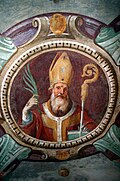 Calimerius of MilanSaint · Bishop of MilanJul 31
 Neot of CornwallVenerable · Hermit in CornwallJul 31
 George NovitskyMartyr · Professor of lawJul 31
 John KovsharovMartyr · Lawyer of Alexander Nevsky LavraJul 31
 Basil of KineshmaConfessor · Bishop of KineshmaJul 31
 Sergius SheinHieromartyr · Archimandrite and former Duma deputyJul 31
- Arsen of NinotsmindaVenerable · Georgian bishop and calligrapherJul 31
- Anna SerovaMartyrJul 31
- Julitta of CaesareaMartyrJul 31