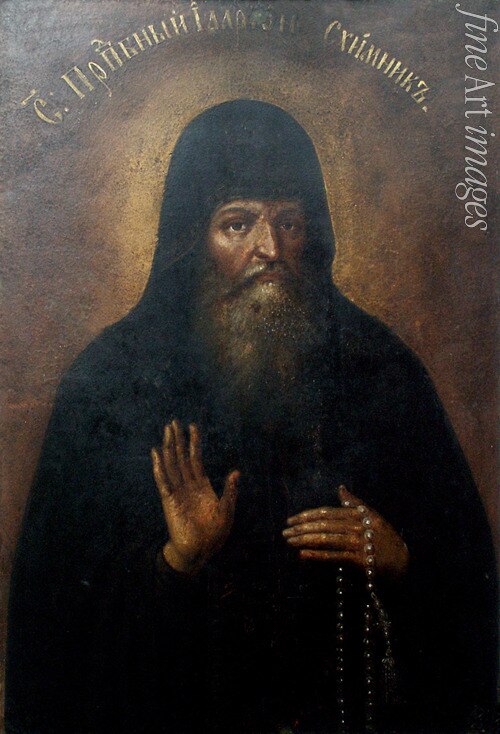
Venerable
Hilarion the Schemamonk
Schemamonk of the Caves Lavra
Schemamonk of the Kiev Caves Lavra, a strict ascetic and disciple of Theodosius of the Caves; died in 1074.
- Feast
- October 21old style November 3
- Reposed
- 107411th century
- Place
- Kyiv
- Order
- Venerables
Life
Saint Hilarion the Schemamonk (died 1074) was a monk in the schema of the Kyiv Caves Monastery, a disciple and companion of Saint Theodosius of the Caves, a strict ascetic in fasting and prayer. Some mistakenly take him to be the same as Metropolitan Hilarion of Kyiv. He is commemorated on 28 August (with the other venerable ones of the Far Caves), on 21 October, on 3 May and in the second week of Great Lent.
Life
The basic source is the Life of Saint Theodosius, written by Nestor, where it is said of Hilarion that he knew how to write books skilfully and day and night wrote in Saint Theodosius's cell, while the latter quietly sang the psalms and spun wool. The scholar Yu. A. Artamonov thinks Hilarion was one of those who told Nestor about the life of Theodosius, and his accounts have an autobiographical character. Spending much time in the saint's cell, he witnessed several miracles. Once, when the monastery lacked money and food, after Theodosius's prayer a handsome young man in monastic dress appeared, who brought a grivna of gold. Another time Hilarion asked to move to another cell, because in his own he could not rest and pray because of the harassment of demons. The abbot strictly ordered him not to leave the cell, so that the demons would have no power over him in future, and after Theodosius's prayers the demons were driven out. The story of the appearance of a demon in the form of a black dog also comes from Hilarion.
A seventeenth-century account of the lives of the saints, composed from ancient inscriptions on the boards that covered the caves, says that Hilarion the Schemamonk was so abstinent that he ate only once a week and little, emulating Saint Theodosius, whose companion he was, and that he made many prayers and prostrations, day and night, with tears, and pleased the Lord. Troparia and kontakia praise him for his "quiet and gentle" nature.
Relics and veneration
He reposed in the monastery and was buried in the Far Caves. Anthropological studies show that he died at thirty to forty and was 165 cm tall; on his body, as on that of Saint Theodore the Silent, healed broken ribs were found. His relics, first mentioned on a plan of the Far Caves made in 1795 by Metropolitan Samuel of Kyiv, are in the Far Caves, opposite the relics of Paphnutius the Recluse, beside those of Moses the Wonderworker and near the underground church of the Annunciation. Earlier, on the same spot, the incorrupt relics of Saint Zeno were indicated.
It is also said that he was one and the same person as the fifth Metropolitan of Kyiv, Hilarion, ordained in 1051 by the council of Russian bishops at the wish of Grand Prince Yaroslav. Metropolitan Macarius (Bulgakov) rejected this identification, though he thought the metropolitan too was buried in the caves of the Lavra. More than fifteen engravings and a number of lithographs with his likeness survive; an icon painters' manual of the end of the eighteenth century says he was an old man with a beard like Saint Sergius's, with the schema on his head, in monastic robe.
Commemorated the same day October 21
 Hilarion the GreatVenerable · Hermit of GazaOct 21
 Viator of LyonSaintOct 21
 Hilarion of MeglenSaint · Bishop of MeglenOct 21
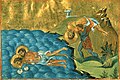 Dasius, Gaius and ZoticusHoly Martyrs · Martyrs of NicomediaOct 21
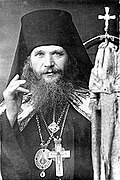 Paulin KroshechkinHieromartyr · Archbishop of MogilevOct 21
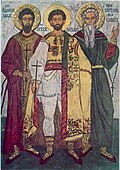 Visarion SaraiVenerable MartyrOct 21
- Sophronius of CioaraVenerable · Defender of Orthodoxy in TransylvaniaOct 21
 Jacob of OmuchVenerableOct 21
 Neophytus OsipovVenerable Martyr · ArchimandriteOct 21
- Theophilus of LugaVenerable · Founder of Omuch HermitageOct 21
 Pelagia TestovaNew MartyrOct 21
 Damian VoskresenskyHieromartyr · Archbishop of Kursk and OboyanOct 21