Hieromartyr
Luke Vukmanović
Priest of Crmnica
A priest of Crmnica in Montenegro, killed in 1945 near Kamnik in Slovenia; canonized in 2000 by the Serbian Church.
Life
Holy Hieromartyr Luke of Crmnica (Vukmanović, 1907-1945) was a priest, professor and doctor of theology from Montenegro, killed in 1945 near Kamnik in Slovenia. He was canonized in May 2000 by the Serbian Orthodox Church; he is commemorated on 29 July (11 August by the new calendar).
He was born on 14 October 1907 in the village of Podgor-Utrg in Crmnica, near Cetinje, into a well-off peasant family: his parents, Nikola and Maria (née Pejović), had four children, among them Đuro, who died at twenty-three as a communist student at the Sorbonne, and Svetozar, the future Tempo. His father, back from the mines of North America, was, after the union of Montenegro with Serbia (1918), on the side of the "Greens" and spent two years in prison. Luke finished the school in his native village with excellent results, then the lower gymnasium and the seminary at Cetinje, and served as parish priest at Grahovo for a year and at Podgor-Utrg for five or six years. At the request of his mother, left a widow, he interrupted for a time his theological studies at Belgrade, to help support the family, and with his teacher's salary he helped his brother Svetozar in his studies. With his wife Dragina he had four children, all educated.
On 6 (19) April 1931, while serving the Liturgy in the church of Saint George at Utrg, he survived an assassination attempt: as he came out of the altar for the Great Entrance a man named Stjepčević shot at him; two bullets struck him in the shoulder and abdomen. The priest had so much strength that he set the Holy Gifts, which he carried in the chalice and on the diskos, on the Holy Table, and then fell unconscious. Metropolitan Gavrilo Dožić judged that behind the attempt lay a communist action, though the assailant was held to be mentally ill. In 1935 he graduated from the Faculty of Theology in Belgrade and became a professor at the Cetinje seminary, and in 1940 he took his doctorate with the thesis "Materialist and Christian Conception of History." He restored churches, cared for the enlightenment of parishioners, founded a reading room and a charity fund. Between 1927 and 1943 he contributed to many publications. He was secretary of the priests' association.
Metropolitan Gavrilo dismissed him from service because of disagreements about the running of the seminary; Luke went as parish priest to Gostivar, then, at the call of Metropolitan Joseph Cvijović, as teacher of religion at the gymnasium in Skopje, from which the Bulgarians expelled him at the start of the war. He returned to Montenegro, taught German at the Cetinje gymnasium and, after the appointment of the new metropolitan, Joanikije I, in January 1941, re-entered the service of the Metropolitanate. He was arrested and condemned to death, but Metropolitan Joanikije saved him. He supported the struggle against the German and Italian occupiers, but not the communist revolution for which his brother Svetozar Vukmanović Tempo fought. Toward the end of the war he set out, with Metropolitan Joanikije and the Montenegrin Chetniks, toward Bosnia. He was shot near Kamnik, toward the end of May 1945, by members of the Fifth Montenegrin Brigade, whose unit was led by a friend of Tempo's from Crmnica. His eldest son, Čedomir, was spared but forced to join the partisans. In May 2000 Patriarch Pavle, with all the Serbian bishops, in the Cathedral of Saint Sava in Belgrade, numbered among the saints the new martyrs of the Serbian Orthodox Church, among them Luke.
Commemorated the same day July 29
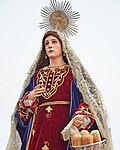 MarthaSaint · Sister of LazarusJul 29
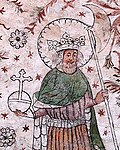 Olaf of NorwayRight-Believing · King of NorwayJul 29
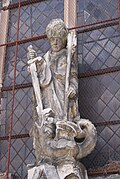 Lupus of TroyesSaint · Bishop of TroyesJul 29
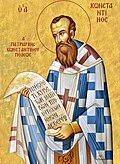 Constantine I of ConstantinopleSaint · Patriarch of ConstantinopleJul 29
- Constantine III of ConstantinopleSaint · Patriarch of ConstantinopleJul 29
 Serapia of RomeMartyr · Martyr of RomeJul 29
 Eustathius of MtskhetaMartyr · Persian convert, martyr in GeorgiaJul 29
 Callinicus of GangraMartyrJul 29
 Constantine of KosinoVenerable · Abbot of Kosino MonasteryJul 29
 Cosmas of KosinoVenerableJul 29
 Anatoly KamenskySaint · Archbishop of IrkutskJul 29
 Daniel of CherkasyMartyrJul 29