Venerable
Matoi of Mere
Venerable of Mere Convent
A venerable of Mere Convent in Klarjeti; canonized in 2003 by the Church of Georgia.
- Feast
- October 5old style October 18
- Era
- 9th century
- Place
- Mere convent, Klarjeti
- Order
- Venerables
Life
Venerable Matoi of Mere (eighth-ninth centuries) was a priest, confessor of the convent of Mere, dedicated to the Mother of God, in the Klarjeti desert, a wonderworker, disciple and fellow-ascetic of Venerable Gregory of Khandzta. He is venerated as a saint in the Synaxis of the Venerable Fathers and Mothers of Klarjeti of the Orthodox Church of Georgia, canonized in October 2002 (by other data in 2003); he is commemorated on 5 October (old calendar).
The life of Matoi
His monastic life is told at length in Gregory's Life, written by George Merchule in 951 (chapters 12, 37-39). When the number of brothers began to grow at Khandzta, "there arrived at that time from Kartli Father Epiphanius and the priest Matoi," who had been Gregory's friends earlier and came to Khandzta drawn by his name. When the priest sent by Gregory as confessor of the nuns of Mere died, the abbess of Mere, Pheronia, was concerned, and God made known to her that a new priest would shepherd them better. She wrote to Gregory, and he blessed Matoi to take the place of confessor of the convent, saying to him: "A horseman's victory over many armies cannot be known until he enters the battle." Matoi refused at first.
The source calls him a wonderworker, "great and glorious in deeds." In the forty years of his obedience at the convent "no one heard from him an idle word or a needless objection"; those who saw him did not dare to idle about, seeing his temperance, holiness and blameless conduct. He kept "true virginity, not only of body but of soul, of speech, of hearing and of sight," for he said that monasticism means self-restraint, and so he would not even take the censer from the hand of the convent's deaconess, Themestia. When he fell gravely ill, he intensified his prayers, stopped eating, and increased his vigil, standing and prostrations, and so "weakened the enemies of the spirit." In another incident, learning that they meant to rob him, he met the thieves with food; when the leader dared to take the saint's property, he was thrown to the ground by the evil enemy; his companions asked pardon for him, and Matoi signed him with the cross, and he quickly recovered.
The repose of Matoi
In old age, from many labours, he fell ill and could no longer care for himself; he believed this was by the enemy's contrivance, that women might serve him, which breaks the monastic rule. He asked his friends, "good monks," who served as servants of Gregory's mother at the Berta monastery in Klarjeti, to carry him on a stretcher to Berta. He blessed with tears the nuns of Mere, "full of tears of sorrow," and the brothers set out; but once they had left Mere, "fullness of strength" suddenly returned to him, he walked to Berta himself, stayed there in health for a year, and then fell asleep "like a valiant fighter." At midnight Themestia and the hermit Anatoly, called Anthony, had a vision: to Anatoly appeared a radiant man, who announced to him Matoi's death; he saw a pillar of light descend from heaven over the monastery and angels singing to God, and then saw them rise to heaven, leading Matoi by the hands, in unspeakable glory. Themestia saw Matoi as a tall, handsome man, "more adorned with glory than in his youth," in shining vestments, with a golden censer in his hand. She said to him: "How strong you have become after your weakness, teacher," and he answered that he had been counted worthy to stand before the heavenly Throne and serve unceasingly. When Anatoly and Themestia had finished, people came and announced Matoi's death.
Commemorated the same day October 5
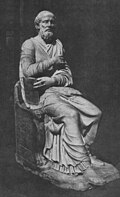 Hippolytus of RomeHieromartyr · Theologian of RomeOct 5
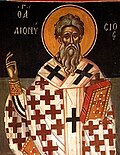 Dionysius the GreatSaint · Patriarch of AlexandriaOct 5
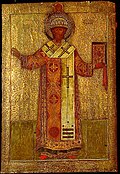 Philip of MoscowHieromartyr · Metropolitan of MoscowOct 5
- John MauropousSaint · Metropolitan of EuchaitaOct 5
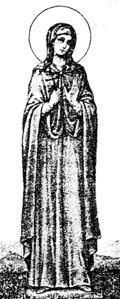 Charitina of AmisusMartyr · Martyr of AmisusOct 5
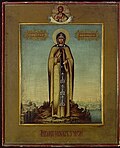 Charitina of LithuaniaVenerable · Nun of NovgorodOct 5
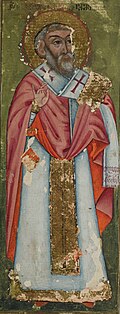 Gregory of KhandztaVenerable · Abbot and founder of monasteriesOct 5
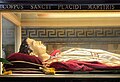 Placidus of TrasaccoHieromartyr · Roman priestOct 5
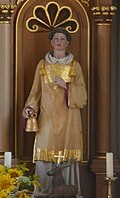 MeinolfSaint · German archdeaconOct 5
 Ampelius of BordigheraVenerableOct 5
 Onesimus PylaevHieromartyr · Bishop of TulaOct 5
 PeregrinaMartyrOct 5