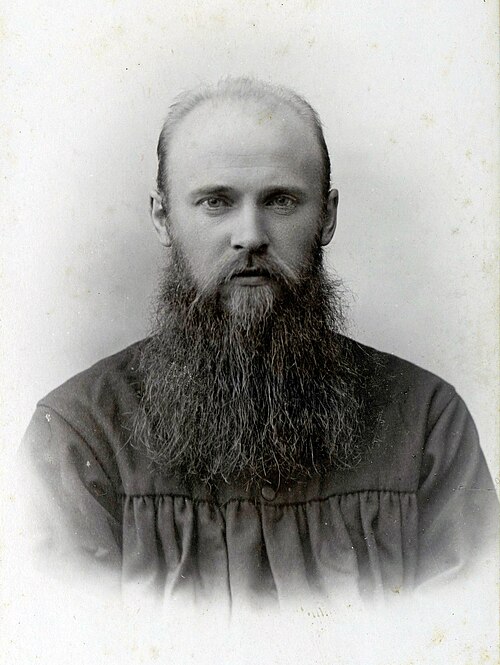
Martyr
Michael Novoselov
A martyr of the Russian Church, commemorated in the Orthodox calendar.
Life
Holy Martyr Michael Novoselov (Mikhail Alexandrovich Novoselov) was born in 1864 in the village of Babye, Domoslavl volost, Vyshny Volochyok district of Tver province, to Alexander Grigorievich and Kapitolina Mikhailovna Novoselov. The Novoselov family, known from the seventeenth century, was a priestly line; the grandfather, Archpriest Grigory, had been forty years a dean. The father, Alexander Grigorievich, did not choose the priestly path: he graduated from the University of Saint Petersburg in 1860, was from 1873 to 1881 director of the gymnasium at Tula, where he grew close to Tolstoy, then director of the fourth gymnasium in Moscow until his death.
Youth and return to the Church
Michael wanted to be a physician, but his father opposed it, and he came to the faculty of history and philology of Moscow University. He was an admirer of Tolstoy's "teaching" and, though he saw in it a Christian ideal, he did not overlook the difference between what the new teacher preached and how he lived. He printed on a hectograph writings of Tolstoy banned by the censor, and was arrested after a search, but Tolstoy went in person to the head of the gendarmerie and the affair was hushed up; Novoselov was placed under police supervision and forbidden to live in the capitals. He bought land in the village of Dugino, in Tver province, and founded one of the first Tolstoyan communities, five intellectuals, which soon fell apart. He joined the Tolstoyans in relief of the starving in Ryazan province in 1891-1892.
One of the reasons for his break with Tolstoy was the latter's hatred of Christ. Novoselov told how one evening, when the great founders of religions were being listed, someone asked Tolstoy which of them he would like to see; Tolstoy named someone, but not Christ, and to Novoselov's question he answered sharply that he would not wish to meet him, that he had been a very unpleasant gentleman. The words were so unexpected and so dreadful that everyone fell silent. The reproaches of his conscience and his thoughts about faith led him to the Orthodox Church, to which he returned after long wanderings through sectarianism. Only in 1901, when the leaders of the Church publicly testified to Tolstoy's falling away from the Church, did he write to him a letter, begging him to choose the right way, life instead of death; he said that Tolstoy's God is only his own idea, and that, rejecting Christ the Redeemer, he deprives his soul of His grace. He ended the letter by asking forgiveness and saying that he prayed for him and for those close to him.
The work of enlightenment
Returned to the Church, he clung with his whole being to the written sources of the holy Fathers and to the living bearers of grace, and drew close to Father John of Kronstadt and the elders of the Zosima Hermitage. From 1902 he began, with a group of companions, to publish the "Religious and Philosophical Library", a series of pamphlets and books answering the questions of life, free of the faults of rationalist or Protestant school theology, returning to the sources of Christianity. Thirty-nine books appeared, some twenty more books on more specialized subjects, and leaflets of the Library in two series: writings of the holy Fathers and thoughts on faith by Russian writers and scholars. In 1912 he was elected honorary member of the Moscow Theological Academy and for many years he was a member of the School Council of the Holy Synod. He founded the "Circle of Seekers of Christian Enlightenment in the Spirit of the Orthodox Church of Christ", took an active part in the Brotherhood of the holy hierarchs of Moscow Peter, Alexis, Jonah and Philip, of which Fyodor Dmitrievich Samarin was chairman. In 1912 he brought out a pamphlet against Rasputin, banned by the censor. After the godless came to power in 1917, he joined the Provisional Council of the United Parishes of Moscow, which called the faithful to defend the churches.
Letters to friends
On 11 July 1922 the OGPU searched his lodging, wishing to imprison him; he was not at home, and the case was closed on 26 February 1923. Mikhail Alexandrovich went underground, living now in villages, now with friends in Moscow and Petrograd, preparing for the hour when he would have to confess Christ before the persecutors. Then he began to write the theological work "Letters to Friends", twenty letters in which he answered the questions that reality put to church society. He said that the Church is a mystery, "the Body of Christ", not a mere organization, and that there is no Christianity without the Church. Of the collapse of the state he wrote that its root lay in decades of seeds of godless humanism scattered by the intelligentsia, in the theological school infected with Protestant ideas, in the hypocrisy of the secular power and in the servility of church authorities, and that God's chastisement might be for the saving of what could be saved through the fire of trial. In the last letter he spoke of the destruction of Sarov and Diveyevo in 1927 and of the great trial that had come upon the Church. After the declaration of Metropolitan Sergius in 1927, he joined the movement of Metropolitan Joseph (Petrovykh) and Bishop Demetrius (Lyubimov), as a man of spotless moral reputation.
Arrest and confession
On 22 March 1929, near the church of the Exaltation of the Cross on Vozdvizhenka Street in Moscow, he was arrested and held first at the OGPU, then at Butyrka. At interrogation he was shown the typewritten book "Letters to Friends". He said that he saw the present situation as a trial for believers and a judgment of history on the former state order, that he did not believe in progress, and that he upheld "passive martyrdom", not active resistance, toward Soviet power. On 17 May 1929 he was sentenced to three years of imprisonment, taken to Suzdal and then, on 25 June, to the political isolator at Yaroslavl. He suffered heart attacks and an inflammation of the eyes, had asked for a doctor and feared for his sight. In September 1929 he thanked the authorities for returning a Menaion and asked for his notebooks of extracts from the service books. Having no close relatives, he had to ask the administration for articles, among them shoes, so that he could go out for walks.
In 1930 the OGPU arrested throughout Russia clergy and laity who disagreed with Metropolitan Sergius, among them Metropolitan Joseph and Bishop Demetrius. On 7 August 1930 Novoselov was called into a new case and taken to Moscow for inquiry, which lasted almost a year. He told the investigators that as a believer he regarded himself as an enemy of Soviet power, because of its godless and God-fighting character, but that he had belonged to no monarchist organization. On 3 September 1931 the OGPU Collegium sentenced him to eight years of imprisonment. From the middle of the thirties the regime in the prisons worsened; in 1935 a doctor, without looking at him, proposed to the administration that his regime be made harsher, depriving him of white bread, though he was seventy and had been six years in prison. On 23 March 1937 his term ended, but on 7 February, without a trial, a Special Council of the NKVD sentenced him to three more years, which the Central Executive Committee confirmed on 3 March. He was moved to the prison at Vologda, where he arrived on 29 June 1937, and was given the number 227.
Here the regime was harsher still. The prison staff punished him for every word: a walk taken away, the right to the prison shop, correspondence. An informer placed in the cell noted him as "a fierce monarchist, a hopeless obscurantist, a religious fanatic". The prison's report said that he was seventy-four, had been in prison nine years, that he did not repent of his convictions and did not intend to, and had reconciled himself to dying in prison for them, having no relatives and not wishing to trouble his friends. He also told how a cellmate had died in his arms, ill, without being taken to a hospital. On 14 January 1938 a report was drawn up for the NKVD troika accusing him of counter-revolutionary activity; on 17 January the troika sentenced him to death, and Mikhail Alexandrovich Novoselov was shot on 20 January 1938 in the Vologda prison and buried in an unknown common grave.
He is commemorated on 21 January, in the new style, with the Synaxis of the New Martyrs and Confessors of the Russian Church (a movable day), on 11 July with the Synaxis of the Saints of Vologda (a movable day) and on 5 September with the Synaxis of the Saints of Moscow (a movable day).
Commemorated the same day January 8
 Abo of TiflisMartyr · Patron of TbilisiJan 8
 Atticus of ConstantinopleSaint · Archbishop of ConstantinopleJan 8
 Kyros of ConstantinopleSaint · Patriarch of ConstantinopleJan 8
 Apollinaris of HierapolisSaint · Bishop of HierapolisJan 8
 ShemaiahProphet · Prophet in the time of RehoboamJan 8
 George of ChozibaVenerable · Abbot of Choziba MonasteryJan 8
 Lucian of BeauvaisHieromartyr · Apostle of BeauvaisJan 8
 Gregory of the Kiev CavesVenerable Martyr · Wonderworker of the Kiev CavesJan 8
 Isidore of YuryevHieromartyr · Priest at TartuJan 8
 Domnica of CarthageVenerable · Virgin of CarthageJan 8
- Elias the HermitVenerable · Hermit of EgyptJan 8
- Gregory of OhridSaintJan 8