Saint
Nerses III the Builder
Catholicos of Armenia
Catholicos of Armenia from 641 to 661, born at Ishkhani in Tao, commemorated by the Church of Georgia.
Life
Saint Nerses III the Builder (Nerse Ishkhneli), catholicos of the Armenian Church from 641 to 661/662, born at Ishkhan, in Tayk, is commemorated by the Church of Georgia on 5 October (old calendar), in the Synaxis of the Venerable Fathers and Mothers of Klarjeti. He remains known above all as the builder of the church at Zvartnots.
Youth and elevation
He was born in the village of Ishkhan, in the Tayk region, and was raised from childhood in the Orthodox (Chalcedonian) faith. He studied in Byzantium and learned Greek. He served in the Byzantine army and probably took part in the Byzantine-Persian war (602-628). The Armenian historian Sebeos held that, despite his piety and the esteem he enjoyed among the Armenians, Nerses remained all his life secretly attached to Chalcedonianism. After leaving the army he was ordained deacon, then bishop of Tayk, and was elected catholicos with the approval of the Armenian princes and the general Theodore Rshtuni. Because of his great activity as a builder he received the epithet Shinogh, "the Builder."
The catholicate
His catholicate fell in the time of the Arab conquests, when the Armenians were trying to preserve their independence from Islamic expansion. The Armenian principalities were allied with Byzantium, especially under Emperor Heraclius. Under Constans II (641-668) Nerses maintained the alliance with Byzantium and was a mediator between the Byzantine authorities and the divided Armenian princes. In 644 he supported the appointment of Theodore Rshtuni as Byzantine commander-in-chief in the East. In his time the councils of Dvin of 645 and 648 were held: in 645 twelve canons were adopted, which entered the Armenian Book of Canons, and in 648 a confession of faith was drawn up, explaining the Armenians' position and condemning Chalcedon, but recognising Byzantium as the one Christian power. In 647 the Arabs took Dvin, the catholicos's residence. In 652 Emperor Constans came to Armenia; Nerses received him in the palace at Dvin, and the emperor raised again the question of church union. On a Sunday, by Constans's order, the Liturgy was served at Dvin by the Byzantine rite. Nerses's position as ally of Byzantium led to a break with the party of Theodore Rshtuni. After the emperor left for Constantinople, he was forced to leave Dvin and lived briefly, in 653, at Constantinople. His hopes of Constans's support came to nothing and he moved to Tayk, where most of the population professed Chalcedonian Orthodoxy.
The years in Tayk and the buildings
He lived as a hermit in his native village of Ishkhan (about 653-659). In this period he renewed and strengthened the monastic movement not only in Tayk but throughout the southern Caucasus, which is reflected more in the Georgian sources. Through his gift of organisation, tolerant nature and love of monastic asceticism he built several churches here, among them the catholicosal cathedral at Ishkhan, named after his village. The tenth-century Georgian writer George Merchule, author of the Life of Gregory of Khandzta, speaks of this. He was in close contact with the Georgian clergy of Tayk, which is why the Georgians too count him a saint. After the death of Theodore Rshtuni (658) he returned, about 659, as catholicos to central Armenia, to Vagharshapat. In 660, at Dvin, he took part in the assembly of princes, in which the Armenian principalities acknowledged their dependence on the Muslims.
He patronised the building of churches. In the 640s he raised the complex at Zvartnots, near Vagharshapat, to which he probably meant to move his residence; the church was consecrated in 652 in the presence of Emperor Constans II, who wished to build a like church in Constantinople. He also rebuilt the church of Saint Sergius at Dvin and the monastery of Dzoravank in Vaspurakan, and about 642 laid the foundation of a church at Khor Virap, where, by tradition, Saint Gregory the Illuminator was held in prison. To him is attributed also the establishing, in 653, of one of the most important Armenian feasts, the Appearance of the Cross on Mount Varag, where, after the finding of a particle of the Wood of the Holy Cross, he built the church of the Holy Cross. He was buried in the northern part of the Zvartnots precinct, in a tomb prepared for him in his lifetime.
Commemorated the same day October 5
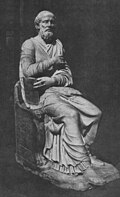 Hippolytus of RomeHieromartyr · Theologian of RomeOct 5
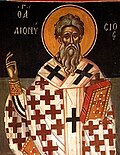 Dionysius the GreatSaint · Patriarch of AlexandriaOct 5
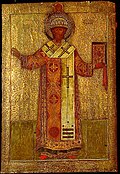 Philip of MoscowHieromartyr · Metropolitan of MoscowOct 5
- John MauropousSaint · Metropolitan of EuchaitaOct 5
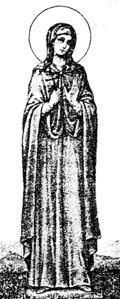 Charitina of AmisusMartyr · Martyr of AmisusOct 5
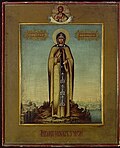 Charitina of LithuaniaVenerable · Nun of NovgorodOct 5
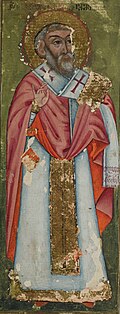 Gregory of KhandztaVenerable · Abbot and founder of monasteriesOct 5
 Placidus of TrasaccoHieromartyr · Roman priestOct 5
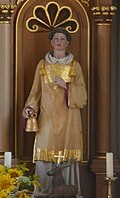 MeinolfSaint · German archdeaconOct 5
 Ampelius of BordigheraVenerableOct 5
 Onesimus PylaevHieromartyr · Bishop of TulaOct 5
 PeregrinaMartyrOct 5