Confessor
Seraphim Zagorovsky
Hieromonk
Born Nikolai Zagorovsky in Akhtyrka into a deacon's family, a hieromonk venerated locally in the Ukrainian Church, who died in 1943.
- Feast
- May 19old style June 1
- Reposed
- 194320th century
- Place
- Przemyśl
- Order
- Confessors
Life
Saint Seraphim Zagorovsky, the Venerable Confessor (in the world Nikolai Mikhailovich Zagorovsky, 1872 to 1943), was a married priest of Kharkov and then, in the camp, a secretly tonsured monk and hieromonk, a confessor of the faith in the time of Soviet persecution. He was born at Akhtyrka in Ukraine, served for years in Kharkov, bore arrests, exile and camp, and fell asleep in 1943 at Przemyśl, on the road to the West. He is venerated as a local saint of the Ukrainian Orthodox Church.
Family and youth
Nikolai was born on 27 July 1872 at Akhtyrka, to the deacon Mikhail Feoktistovich Zagorovsky and Praskovia Andreevna, born Romenskaya. He had a brother, Mikhail, who became a priest and died young, and a sister, Anna. He graduated from the Kharkov theological seminary. He loved the Ukrainian language and songs composed in it, wrote verses and acted wonderfully in school plays, showing a particular talent as a comic actor. He was even called to a Ukrainian theatre troupe, but his mother forbade him to think of it and strengthened in him the readiness to serve the Church.
In due time he married an educated young woman who had finished the diocesan school. They had a son, Vladimir, and a daughter, Lydia, married name Bobrishcheva. In 1894 Nikolai received the priesthood. From 1894 to 1898 he served in the village of Polichkovskaya, in the Bogodukhov district, and from 1898 to 1907 in the village of Malyzhino in the same district. To give his children a good education he moved to serve in Kharkov. There, in 1908 and 1909, he served at the church of Saint Seraphim, and from 1909 to 1922 at the church of Saint Theodore Stratelates beside the Alexandrovsky hospital.
The women's community
In Kharkov, under his guidance, a monastic community of women began to be organized. In the 1910s Archbishop Anthony (Khrapovitsky) of Kharkov blessed the opening of a convent dedicated to the icon of the Mother of God "Seeking of the Lost", of which Father Nikolai was to be the confessor. The revolution drove it underground. In June 1918 he was arrested but soon released. In 1922 and 1923 he served at the church of the Nativity in the city.
Persecution
On 17 March 1923, by then an archpriest, he was arrested for opposing the Renovationists. Until the sentence was announced he was held in the Kholodnogorsk prison. The new authorities expelled him from Kharkov for three years. Afterwards he lived in Petrograd, where he set up a house church and served in it. By letters he continued to guide the secret convent in Kharkov, which he called the "Quiet Hermitage", after the wonder-working icon "Seeking of the Lost".
After the publication in 1927 of the "Declaration" of loyalty of the Russian Church to the Soviet power by Metropolitan Sergius (Stragorodsky) and the Synod around him, Father Nikolai was among those who could not accept that document. He went on serving in the hidden church in his flat, supported the Josephites and was among those who did not commemorate.
On 17 January 1930 a new arrest followed, with a sentence of five years in camps. Part of that term he spent in the Solovki camp, where he was secretly tonsured a monk, with the name Seraphim. The other part passed in the conditions of the Far North. On the way, once, spending a night by an old chapel, he found on waking that he had slept under the icon "Seeking of the Lost", which encouraged and strengthened him. Of the whole convoy of prisoners he alone reached the appointed place of residence, the others dying of exhaustion. To his exile came the novice he had guided, Ulyana Nozdrina, who obtained from the guards permission for the father to be let go to her for dinner.
In 1935, after release from the camp, he was sent to settlement in the Far North, from where he continued, by letters, to direct the women's community. After exile he settled at Oboyan, in present-day Kursk region, near Kharkov. Return to Kharkov was not possible, and at Oboyan, as he learned in a conversation on a train with the wife of another exiled priest, a convent secretly existed. Fearing surveillance, the portress refused to admit Father Seraphim and Ulyana. He asked all the same that the abbess be told. Mother Abbess soon came out and received the travellers. It turned out that the day before she had seen in a dream Saint Seraphim of Sarov, who told her to receive Seraphim of Kharkov, who would arrive at her door.
The end
During the Nazi occupation of Ukraine he was able to move to Kharkov, where he served in his own house and continued to direct the secret convent dedicated to the icon "Seeking of the Lost". In 1943, at the retreat of the German army, Father Seraphim left for the West with his daughter's family and Ulyana. On 13 October 1943, on the eve of the feast of the Protection of the Mother of God, he suffered a stroke, followed the same day by death. He was buried at Przemyśl. On 30 December 1992 he was rehabilitated by the Prosecutor's Office of the Kharkov region.
Canonization and veneration
In 1981 the Russian Orthodox Church Outside Russia canonized him as a holy confessor. One of its future bishops was tonsured in his honour. On 22 June 1993 the Holy Synod of the Ukrainian Orthodox Church decided on his local canonization in the Kharkov diocese, in the Synaxis of the New Martyrs and Confessors of Slobozhanshchyna. The glorification service took place during the visit to Kharkov, on 3 and 4 July 1993, of the Primate of the Ukrainian Orthodox Church, Metropolitan Vladimir of Kyiv, in the Annunciation Cathedral of the city.
Commemorated the same day May 19
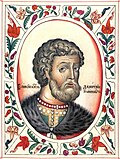 Dmitry DonskoyRight-Believing · Grand Prince of MoscowMay 19
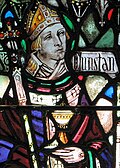 Dunstan of CanterburySaint · Archbishop of CanterburyMay 19
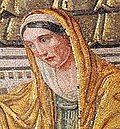 PudentianaMartyrMay 19
 John of GothiaSaint · Bishop of GothiaMay 19
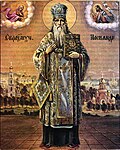 Alexander PetrovskyHieromartyr · Archbishop of KharkivMay 19
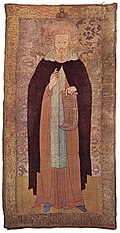 Cornelius of KomelVenerable · Founder of Komel MonasteryMay 19
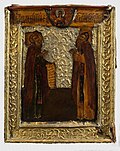 Ignatius of VologdaVenerable · Prince of Uglich turned monkMay 19
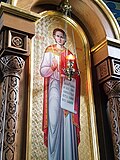 Parthenius of RomeMartyr · Martyr of Armenian originMay 19
 Konstantin DyakovHieromartyr · Metropolitan of KyivMay 19
 Onufry GagalyukHieromartyr · Archbishop of KurskMay 19
 Cornelius of PaleostrovVenerable · Founder of Paleostrov MonasteryMay 19
 Sergius of ShukhtovoVenerable · SchemamonkMay 19