Hieromartyr
Sergius Amanov
Cleric martyred for the faith of Christ in 1916.
- Feast
- November 27old style December 10
- Reposed
- 193720th century
- Order
- Martyrs
Life
Holy Hieromartyr Sergius Amanov was a country priest in Ryazan province who received the crown of martyrdom by shooting on 10 December 1937, having already been sentenced to a camp in 1929.
The priest of Kolesnya He was born on 1 April 1873 in the town of Kasimov, in the family of the psalm-reader Ivan Amanov, who died in 1916. He graduated from the Ryazan seminary in 1894, married, and in 1897 was ordained a priest for the church in the village of Kolesnya. The village was very poor, with about two hundred houses. The priest and his wife, Maria Yakovlevna, had eleven children, three of whom died in infancy. When the persecution began, in 1918, the Bolsheviks tried to kill him and came to his house; he was saved only because he had gone to another village for the funeral of a priest.
The trial of 1929 In 1929, during collectivization, the villagers of Kolesnya were required to deliver grain in a quantity they had never harvested, and Father Sergius was asked for more than anyone. The peasants resolved to give only half. The authorities suspected that some force opposed to the grain collection stood behind the refusal. On 24 September 1929 the priest was interrogated and accused of obstruction and anti-Soviet activity. He answered that he did not admit guilt: he had asked believers for money help because some paid him nothing while he was charged for the whole parish; he declared himself loyal to the authorities and held the quota of 175 poods of rye to be unjust and beyond his means.
On 23 October he was arrested together with six peasants. In a statement to the investigator he explained that as early as 5 September he had promised to hand over his surplus, had asked for supervision of the threshing at his own cost and, when this was not granted, had threshed the grain himself and delivered it to the state; he had refused only to buy rye to make up the quota. He wrote that the accusation came from those who used him as a screen for their own surpluses. The inquiry closed on 22 November, charging that he had used the religious prejudices of the peasants, especially the women, to weaken Soviet power. On 29 January 1930 he was sentenced to three years in a camp and served his term in the Penyuzh, Arkhangelsk and Vishera camps.
Arrest and death In February 1932 he returned home. He worked for a time as a bookkeeper at a state farm, was dismissed, spent half a year without work, and was then appointed rector of the church of Saint Paraskeva in the village of Myagkoe, Serebryanye Prudy district. On 22 November 1937 he was arrested and imprisoned in the Tula region. Witnesses stated that he held anti-Soviet conversations; he rejected their testimony as false and explained only what he had said at the funeral of a young woman of Esipovo, whom he had communed a few days earlier: that she had known how to work and how to pray, and that the Holy Mysteries were dearest to her. The inquiry closed on 26 November, an NKVD troika sentenced him to death on 2 December, and Father Sergius was shot on 10 December 1937 and buried in an unknown common grave.
The saint is commemorated on 10 December and, in the new style, on 7 February (a movable date) in the Synaxis of the New Martyrs and Confessors of the Russian Church, on 23 June in the Synaxis of the Saints of Ryazan and on 5 September (a movable date) in the Synaxis of the Saints of Moscow.
Commemorated the same day November 27
 Barlaam and JoasaphHoly VenerablesNov 27
 Virgil of SalzburgSaint · Bishop of SalzburgNov 27
 Palladius of HelenopolisSaint · Bishop of HelenopolisNov 27
 James the PersianGreat Martyr · Martyr of PersiaNov 27
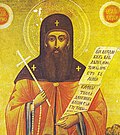 Theodosius of TarnovoVenerable · Bulgarian hermit and clericNov 27
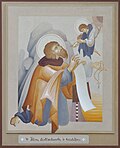 Damaskinos the StuditeSaint · Patriarchal exarch of AitoliaNov 27
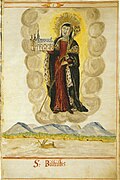 Bilihildis of AltmünsterVenerable · Abbess of AltmünsterNov 27
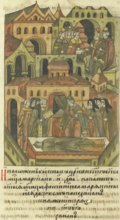 Roman Olgovich of RyazanRight-Believing · Grand Prince of RyazanNov 27
 James of RostovSaint · Bishop of RostovNov 27
 Acacius of SebasteHieromartyr · Priest of SebasteNov 27
 Kronid LyubimovHieromartyr · Superior of the Trinity LavraNov 27
 Alexis GavrinVenerable Martyr · MonkNov 27