Right-Believing
Theodosius II the Younger
Byzantine emperor
A Byzantine emperor of the 5th century, in whose reign the Third Ecumenical Council was held at Ephesus.
- Feast
- July 29old style August 11
- Reposed
- 4505th century
Life
Holy Right-Believing Emperor Theodosius II the Younger was born on 10 April 401, son of the Emperor Arcadius and Aelia Eudoxia. He was proclaimed augustus on 10 January 402, before he was nine months old. After his father's death on 1 May 408 he became sole ruler of the empire, but until 414 the regent Anthemius governed in his stead. By the will of Arcadius, the Persian king Yazdegerd I was named guardian, whom Arcadius had begged to use all his power and wisdom to keep the throne for his son. From 414 power was concentrated in the hands of Theodosius's elder sister Pulcheria, proclaimed augusta and co-ruler.
Education
Theodosius received a brilliant education. He knew Greek and Latin, mathematics, astronomy and history, drew, and illustrated the books he copied himself, and for the beauty of his handwriting was nicknamed the Calligrapher. He read much, often at night, by the light of a special lamp he had built himself. His sister instructed him how to behave at imperial appearances, how to dress, sit and walk, but she also guided his piety, teaching him to pray constantly and honour priests. In 421 Pulcheria married him to Eudocia, daughter of the philosopher Leontius, a woman gifted with mind, beauty and eloquence, whom Theodosius loved warmly. For all his gifts, Theodosius went down in history as a weak-willed and mediocre ruler, always subject to those close to him, first his sister, then his wife, and after 441 and almost to his death his favourite, the eunuch Chrysaphius. Yet his long reign had a certain strength, through the presence in his government of fairly capable advisers.
Piety
Of the usual amusements Theodosius preferred hunting, and had no inclination for military exercises, although he was physically strong. The emperor was very pious and full of zeal for the faith, and loved church singing. In the palace he set an order like that of a monastery: he rose early in the morning and sang antiphons with his sisters to the glory of God, knew Holy Scripture by heart and discussed it with bishops. Once, at the hippodrome, instead of the races the people expected, he held a great service of supplication, which he himself directed. No one ever saw him angry. One of those close to him asked why he never punished with death a man who insulted him.
Religious strife
In the years of his reign the state was shaken by religious strife. In 428 he invited to Constantinople, as patriarch, the famous preacher Nestorius, a Persian by birth, abbot of a monastery of Antioch. Patriarch Cyril of Alexandria obtained from Theodosius the calling of an Ecumenical Council to condemn the teachings of Nestorius, at Ephesus in 431. Nestorius was deposed and sent back to Syria. Another grave quarrel broke out fifteen years later between the theologian Eusebius and Patriarch Flavian of Constantinople on one side and the Monophysite heresiarch Eutyches on the other. Eutyches was condemned at a local council in the capital in 448, but Eusebius and Flavian did not rejoice long: on the initiative and under the presidency of Patriarch Dioscorus of Alexandria, a friend of the favourite Chrysaphius, the council of 449 met at Ephesus, which restored Eutyches and condemned Flavian and Eusebius. The persecution of pagans in the empire continued without relief.
The reign
In 438, by the emperor's order, the Theodosian Code was published, gathering the legislative material of the edicts of the Roman emperors, and in 425 he founded at Constantinople a school that would today be called a state university. He carried out great building works in the capital and other cities. In his reign the empire had to fight many wars, with varied success. The regent Anthemius repulsed the attack of the Huns in 412 and began the building of new fortifications for the capital; they were strengthened in the 440s, after an earthquake, by the prefect Cyrus of Panopolis, with a deep moat. With the western half of the empire good relations were kept, sealed in 437 by the marriage of the western emperor Valentinian III with Theodosius's daughter Eudocia. Towards the end of his reign, in 442, Attila demanded tribute and the surrender of those who had fled to the Romans, and, after the emperor's answer, moved his hordes against the empire and crushed the Roman army in three battles.
Death
The Emperor Theodosius died suddenly on 28 July 450: while hunting, his horse threw him into the river Lycus, he injured his spine and died the next day. His name is not included in the present Menologion of the Russian Church. He is commemorated on 11 August (new style).
Commemorated the same day July 29
 MarthaSaint · Sister of LazarusJul 29
 Olaf of NorwayRight-Believing · King of NorwayJul 29
 Lupus of TroyesSaint · Bishop of TroyesJul 29
 Constantine I of ConstantinopleSaint · Patriarch of ConstantinopleJul 29
- Constantine III of ConstantinopleSaint · Patriarch of ConstantinopleJul 29
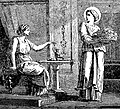 Serapia of RomeMartyr · Martyr of RomeJul 29
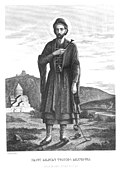 Eustathius of MtskhetaMartyr · Persian convert, martyr in GeorgiaJul 29
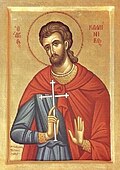 Callinicus of GangraMartyrJul 29
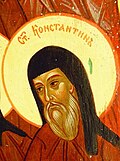 Constantine of KosinoVenerable · Abbot of Kosino MonasteryJul 29
 Cosmas of KosinoVenerableJul 29
 Anatoly KamenskySaint · Archbishop of IrkutskJul 29
 Daniel of CherkasyMartyrJul 29