Hieromartyr
Victor Usov
Cleric martyred for the faith of Christ.
Life
Holy Hieromartyr Victor Usov was a priest in the village of Levash in the Totma district, Vologda province, and died in a camp on 20 January 1937, worn out by hunger and labor.
He was born on 19 March 1876 in the village of Vsekhsvyatsko-Orlovsky Pogost in the Veliky Ustyug district, in the family of the deacon Simeon Vasilievich Usov and Agnia; their five sons were all servants of the Church. He finished the Vologda seminary in 1900 and was a teacher in several parish schools. He married Maria, daughter of the priest Dimitry Ryabinin. On 8 September 1904 he was ordained deacon, and on 4 March 1907 priest, at the church of the Dormition at Podolskaya in the Kadnikov district. In 1908 he was teacher of religion at the parish school. In 1913 he was moved to the church of the Nativity of the Mother of God at Levash, in a remote corner of the Totma district, where he served until his arrest, without reducing his preaching and care of the flock in the years of persecution.
In the middle of the thirties the authorities resolved to close the church and arrest the priest. In May 1935 witnesses were summoned. One woman said that the priest had come to give communion to her sick mother and had advised her schoolgirl daughter not to go to school on Saturday, and that, seeing the "Lenin corner" in the front room, he proposed that it be moved and that the poster "Priests are the enemies of workers and peasants" be replaced with the inscription "Where there is counsel, there is light; where there is love, there is God." At the interrogation of 13 May the priest admitted some of the facts, in particular that he had recommended the inscription to the pupils, but denied acting against the authorities. On 2 June he admitted that in the first years of collectivization he had advised people to wait before joining a collective farm, but that later, seeing that life was improving, he had said nothing more. He refused to name those he had spoken with or his relatives, the more so since his wife had died and they had no children.
On 9 June the investigation closed. He was charged with counter-revolutionary propaganda, that is, with asking pupils to take down revolutionary slogans and put religious ones in their place, and with drawing them into processions with icons. On 11 September 1935 the Special Panel of the Northern regional court sentenced him to five years in a camp. On 8 October he was sent by transport to Vologda, and on 27 October he reached the camp near the town of Sokol, where the prisoners pulled logs from the water of the Sukhona and made rafts for the White Sea-Baltic Combine. Because of hunger and labor beyond his strength, he did not live to the end of his term. He died on 20 January 1937 and was buried in an unknown place.
The saint is commemorated on 21 January and, in the new style, on 7 February (movable) in the Synaxis of the New Martyrs and Confessors of the Russian Church and on 11 July (movable) in the Synaxis of the Saints of Vologda.
Commemorated the same day January 8
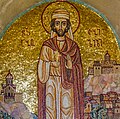 Abo of TiflisMartyr · Patron of TbilisiJan 8
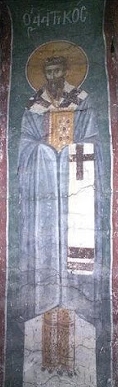 Atticus of ConstantinopleSaint · Archbishop of ConstantinopleJan 8
 Kyros of ConstantinopleSaint · Patriarch of ConstantinopleJan 8
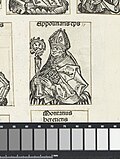 Apollinaris of HierapolisSaint · Bishop of HierapolisJan 8
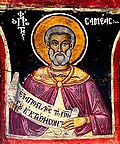 ShemaiahProphet · Prophet in the time of RehoboamJan 8
 George of ChozibaVenerable · Abbot of Choziba MonasteryJan 8
 Lucian of BeauvaisHieromartyr · Apostle of BeauvaisJan 8
 Gregory of the Kiev CavesVenerable Martyr · Wonderworker of the Kiev CavesJan 8
 Isidore of YuryevHieromartyr · Priest at TartuJan 8
 Domnica of CarthageVenerable · Virgin of CarthageJan 8
- Elias the HermitVenerable · Hermit of EgyptJan 8
- Gregory of OhridSaintJan 8