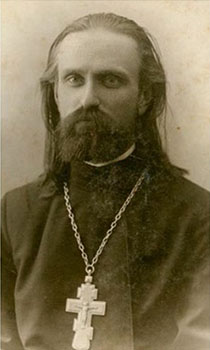
Confessor
Vladimir Khirasko
Archpriest
Archpriest and school teacher, honored locally in Belarus, glorified in 2000 as a confessor; he died in 1933.
- Feast
- February 3old style February 16
- Reposed
- 193320th century
- Place
- Gagarin
- Order
- Confessors
Life
Saint Vladimir Khirasko (1874-1933), confessor, was an archpriest in Minsk, a religion teacher, a father to blind children and a beloved preacher. Arrested and exiled several times, he returned from exile blind and ill and fell asleep in 1933 at Gzhatsk (now Gagarin). He was glorified in 1999 as a local saint of the Belarusian Orthodox Church and in 2000 as a confessor, for veneration throughout the Russian Church. He is commemorated on 11 (24) January and 15 (28) October.
Youth and priesthood
He was born on 11 January 1874 at Kamianets-Podilskyi, in the family of the priest Grigory Khirasko. He graduated from the Podolia seminary with top marks, which gave him the right to enter a theological academy without examination, but he chose the work of a teacher. From 1895 he taught at the parish school in Kievets, then at Turov. In 1899 he was ordained priest at the church of the Holy Cross in Minsk and served at the church of the Ascension in the Igumen district and at other churches, also teaching religion in the surrounding schools. He married Maria Titovna in 1899, also from a priest's family, and they raised five children, four daughters and a son.
In 1911 he was appointed rector of the wooden church of Joy of All Who Sorrow beside the school for the blind in Minsk. He helped the blind and partially sighted children, who lived in hard conditions, a great deal, and taught religion at two gymnasiums in the city. He led several Orthodox brotherhoods, was raised to archpriest and, from 1913, was head and teacher of the boys' church school. From 1915 he was rector of the Kazan church by the railway station and served there until 1922, and then at the church of Joy of All Who Sorrow.
Persecution
After the revolution he was arrested several times. In 1919 the Bolsheviks arrested him for links with the Socialist Revolutionaries and released him for lack of evidence, and in 1920 the Polish occupation authorities arrested him for sheltering Bolsheviks. On 29 December 1925 he was arrested again, officially for links with the Polish consulate, but in reality because he supported Bishop Melchizedek of Minsk, who actively opposed the Renovationists. Many thousands of Red Army soldiers came to his sermons, which worried the authorities. Many parishioners wrote him letters of support in prison, and when the investigators found them they demanded that he name the writers, but he refused. In March 1926 he was sentenced to three years of exile and sent to Oryol.
He returned to Minsk in 1929 and served at the church of Joy of All Who Sorrow, but on 26 March he was arrested again, on a charge of counter-revolutionary activity, starting from an anonymous article in a newspaper. It seems that the real reason was his attempt to prevent the demolition of the church, in whose place the Government House was to be built. At interrogation he said that he had preached sermons but had carried out no anti-Soviet agitation. On 26 July 1929 he was sentenced to three years of exile in Siberia. He returned in July 1932, already gravely ill and blind, without being able to see his family. He categorically refused to admit any guilt. He settled in Gzhatsk, today the town of Gagarin in the Smolensk region, and died after a few months from illness and total blindness, and was buried there.
Veneration
On 28 October 1999 he was canonized by the Synod of the Belarusian Orthodox Church as a locally venerated saint. In 2000 he was included, as confessor, in the Synaxis of the New Martyrs and Confessors of Russia, for veneration throughout the Church. His name is borne by the first parish in Minsk for the blind and partially sighted, founded in 2015, with a Braille library and a choir of blind singers, as well as a church in Minsk opened in the same year. In 2018 the altar of the southern side chapel of the Kazan church in Gagarin was consecrated in his honour.
Commemorated the same day February 3
 Anna the ProphetessProphet · Prophetess of the TempleFeb 3
 AnsgarSaint · Archbishop of Hamburg-BremenFeb 3
 Simeon the God-receiverRighteous · The Righteous of the TempleFeb 3
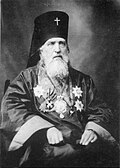 Nicholas of JapanEqual-to-the-Apostles · Archbishop of JapanFeb 3
 Laurence of CanterburySaint · Archbishop of CanterburyFeb 3
 WerburghVenerable · Abbess, patron of ChesterFeb 3
 Ignatius of MariupolSaint · Metropolitan of Gothia and KaffaFeb 3
 HadelinVenerable · Missionary monk in BelgiumFeb 3
 Roman of UglichRight-Believing · Prince of UglichFeb 3
 Simeon of TverSaint · First bishop of TverFeb 3
 Oliver of AnconaVenerableFeb 3
 Alexius of NovgorodSaint · Archbishop of NovgorodFeb 3