Right-Believing
Abgar of Edessa
King of Edessa
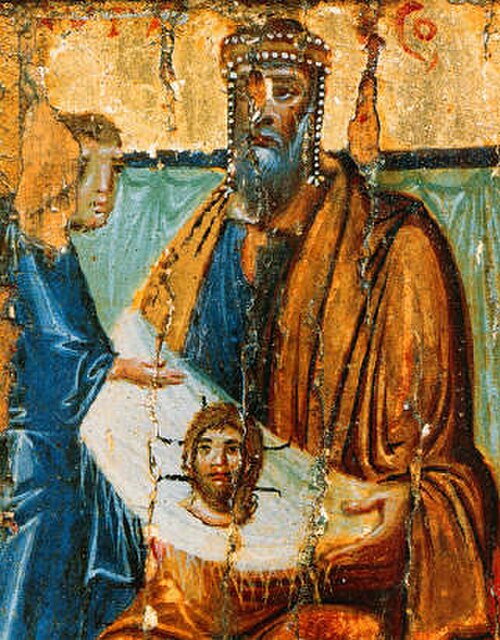
King of Osroene with his capital at Edessa, who according to tradition received the Holy Mandylion from Christ.
- Feast
- October 28old style November 10
- Reposed
- 501st century
Life
Abgar V, called Ukkama ("the Black"), was king of Osroene, with his capital at Edessa, in the first century. According to a very old Christian tradition, he wrote to the Lord Jesus Christ asking to be healed, and received a letter from Him in reply. The Orthodox Church honours him as a pious king, and the Armenian and Syriac Churches also keep his memory. His day is 28 October. How much of the story is history is still disputed.
The king
Osroene was a small kingdom on the border between the Roman Empire and Persia, ruled by the Abgarid dynasty. Abgar V reigned from 4 before Christ to 7 after Christ, and again from 13 to about 50. The Roman historian Tacitus calls a ruler of this house "king of the Arabs," and modern scholars agree that the family was of Arab stock, though the Armenian historian Movses Khorenatsi calls Abgar an Armenian. A tomb with a cross and an inscription naming him "the first Christian ruler of Edessa" was found among about eighty early Christian tombs at the citadel of Urfa.
The letter to Christ
Eusebius of Caesarea writes in his Church History that he found in the archives of Edessa a Syriac document containing a letter from Abgar to Jesus and the Lord's answer. Abgar, afflicted by a grave illness, had heard of the miracles of Jesus and confessed Him as God or the Son of God. He asked Him to come to Edessa, and offered his city as a shelter, since the Jews were plotting against Him. Jesus replied that He must first complete His mission at Jerusalem, blessed the king for believing without having seen, and promised that after being taken up He would send one of His disciples to heal him.
After the Ascension, the Apostle Thomas sent Thaddeus (Addai), one of the seventy, to Edessa. According to the tradition, Thaddeus healed the king, preached the Gospel there and baptized Abgar. The same story appears, with many additions, in the Syriac Teaching of Addai, written in the fourth or fifth century.
The Holy Mandylion
Later versions say that Abgar's messenger, Ananias, tried to paint the likeness of the Lord, and that Christ pressed a cloth to His face and left the image on it. This is the Holy Mandylion, the image not made by human hands, which according to the tradition was sent to the king. It was kept at Edessa, and was brought to Constantinople on 15 August 944. The Church keeps the feast of its translation on 16 August. Eusebius himself says nothing about an image.
History and devotion
The pilgrim Egeria read the letter at Edessa around 384, and copies of the Lord's reply were used for centuries as protective amulets. Modern scholars doubt that the exchange of letters is genuine, and many place the conversion of Edessa to Christianity later, under a descendant, Abgar the Great, around the year 200. Still, the story has been important to the Christian Church of Edessa and to the Churches of the East, who remember Abgar as the first king to believe in Christ.
Commemorated the same day October 28
 Arsenije of SerbiaSaint · Archbishop of SerbiaOct 28
 Arsenios the CappadocianVenerable · Spiritual father from CappadociaOct 28
 Job of PochaevVenerable · Abbot of PochaevOct 28
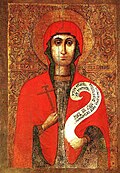 Paraskevi of IconiumGreat Martyr · Great Martyr, called FridayOct 28
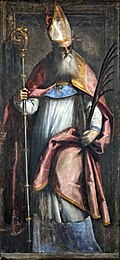 Judas CyriacusSaint · Bishop of JerusalemOct 28
- Arsenius AutorianusSaint · Patriarch of ConstantinopleOct 28
- FirmilianSaint · Bishop of Caesarea in CappadociaOct 28
 Stephen the SabaiteVenerable · Hymnographer of Mar SabaOct 28
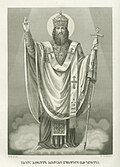 Neophytus of UrbnisiSaint · Bishop of UrbnisiOct 28
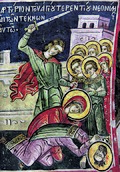 Terence and NeonillaMartyrOct 28
- Theodora of WallachiaSaint · Tsaritsa of BulgariaOct 28
- Abraham of EphesusSaint · Archbishop of EphesusOct 28