Saint
Arsenius Autorianus
Patriarch of Constantinople
Ecumenical Patriarch of Constantinople in the 13th century, died in 1273 on Marmara Island.
- Feast
- October 28old style November 10
- Reposed
- 127313th century
- Place
- Marmara Island
- Order
- Hierarchs
Life
Saint Arsenius Autoreianus was twice Patriarch of Constantinople, in 1254-1260 and 1261-1265, in the time of the Empire of Nicaea and the first Palaiologoi. A monk who loved stillness, raised almost against his will to the patriarchal throne, he steadfastly defended the rights of the young emperor John IV Laskaris and excommunicated Emperor Michael VIII Palaiologos after he had the boy blinded. For this he was deposed and exiled, and his removal gave rise to a long division in the Church known as the Arsenite schism. He died in exile in 1273 and was honoured as a saint soon after his death.
Family and monastic life
He was born around 1200 in Constantinople into a distinguished Byzantine family. His father, named in the sources as Alexios Autoreianos or Theodore (Alexios) Agallianos, was judge of the dromos, one of the senior officials of imperial justice, and his mother Irene came from the noble Kamateros family. The family was related to Patriarch Michael IV Autoreianos. At birth he was named George.
After the crusaders captured Constantinople in 1204, his life was bound up with the Empire of Nicaea in Asia Minor. He grew up and was educated in a monastery at Nicaea and entered monastic life with the name Gennadios. His father also became a monk at the end of his life, with the name Arsenius; after his father's death Gennadios took his monastic name, by which he is known.
He was abbot of a monastery, according to some sources that of Oxeia on one of the Princes' Islands in the Sea of Marmara, though he was not ordained. Then he devoted himself to the solitary life in a monastery in Bithynia and, according to some traditions, spent time on Mount Athos. Later he settled in a small monastery on an island of Lake Apollonias in Bithynia. In 1253-1254 he took part in an embassy sent by Emperor John III Doukas Vatatzes to Pope Innocent IV concerning the restoration of church unity, and then returned to his monastic life.
First patriarchate
After the death of Patriarch Manuel II in 1254, the scholar Nikephoros Blemmydes was spoken of as his successor, but he lacked the necessary support. Emperor Theodore II Laskaris imposed the monk Arsenius, even against the wishes of the bishops of the synod, and in November 1254 he was elected patriarch. Not being a cleric, he was ordained deacon, priest and patriarch within a single week. The chroniclers describe him as virtuous and venerable but not greatly learned. The first years of his patriarchate passed quietly, in good accord with the emperor.
Defender of the boy emperor
In August 1258 Theodore II died, leaving as emperor his seven-year-old son John IV Laskaris, under the guardianship of George Mouzalon. Some later historians say that the patriarch was also named guardian, but contemporary chroniclers mention only Mouzalon. A few days after the emperor's death Mouzalon and his brothers were murdered during a memorial service, and at an assembly of nobles presided over by the patriarch, Michael Palaiologos was appointed regent.
Arsenius strove to protect the boy's rights. He required John and Michael to swear mutual oaths of loyalty and insisted that at their joint coronation John should be crowned first. Palaiologos saw this as an obstacle to his usurpation and put pressure on the patriarch, even threatening the young emperor. Arsenius found no support among the bishops: apart from two, all held that Michael should be crowned first. At the coronation at the end of 1258 or the beginning of 1259 the patriarch gave way and crowned Michael and his wife, while John received only a special head-dress, without a full coronation. He did, however, make Michael swear not to move against John.
After the ceremony Arsenius withdrew to the monastery of Paschasios, keeping the title of patriarch but no longer exercising his office. In February or March 1260 he was replaced by the former Metropolitan of Ephesus, Nikephoros II.
Second patriarchate
After the death of Nikephoros, Michael VIII agreed to the return of Arsenius, who resumed the patriarchal throne in May or June 1261. On 25 July 1261 Byzantine forces recovered Constantinople from the Latins, and the patriarch was able to return to the city. At the end of the summer of 1261 he crowned Michael again in Hagia Sophia, but John was not present at the ceremony, only Michael, his wife and their eldest son.
At the end of December 1261, on Michael's orders, the young John IV, about ten or eleven years old, was blinded and imprisoned so that he could never reign. Arsenius judged the deed a grave crime and excommunicated the emperor, forbidding him to enter Hagia Sophia. He refused to lift the excommunication without true repentance and, according to some sources, even demanded that Michael give up the throne. The emperor tried to frighten him by threatening to appeal to the pope, but the patriarch did not yield.
Deposition and exile
At last Michael VIII convened a synod, which deposed Arsenius on the plainly false charge of taking part in a conspiracy against the emperor. Towards the end of May 1265 he was sent into exile on the island of Proconnesus in the Propontis (the island of Marmara). Several hierarchs took his side, among them Constantine of Neocaesarea, Alexios of Euchaita and Theodore of Heraclea, as well as Patriarch Nicholas II of Alexandria.
Arsenius never lifted the excommunication of the emperor. He reposed in exile on 30 September 1273. His testament has also survived.
The Arsenite schism
The deposition and exile of a patriarch loved by the people deeply troubled the Church. When the new patriarch, Joseph I, absolved the emperor, many clergy, monks and faithful refused to recognise him and remained loyal to Arsenius. The division between “Arsenites” and “Josephites” lasted for decades, until the reconciliation proclaimed by Patriarch Niphon I in 1310 (according to other sources in 1315).
Writings
A collection of canons compiled from the decisions of the councils and the writings of the Fathers, the Synopsis canonum, is attributed to Arsenius. Some scholars hold it to be the work of another Arsenius, a monk of Athos; the attribution depends on whether the patriarch did or did not live on the Holy Mountain.
Veneration
Veneration of him as a saint began soon after his death, and a service was composed in his honour. In 1284, under Emperor Andronikos II, his relics were brought from Proconnesus to Constantinople, to the church of Hagia Sophia. The incorrupt relics of Saint Arsenius were greatly venerated and drew many pilgrims. His name is entered in the calendar of the Church of Greece; the sources give 11 October or 28 October as his day of commemoration.
Commemorated the same day October 28
 Abgar of EdessaRight-Believing · King of EdessaOct 28
 Arsenije of SerbiaSaint · Archbishop of SerbiaOct 28
 Arsenios the CappadocianVenerable · Spiritual father from CappadociaOct 28
 Job of PochaevVenerable · Abbot of PochaevOct 28
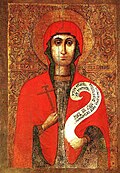 Paraskevi of IconiumGreat Martyr · Great Martyr, called FridayOct 28
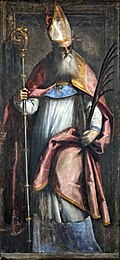 Judas CyriacusSaint · Bishop of JerusalemOct 28
- FirmilianSaint · Bishop of Caesarea in CappadociaOct 28
 Stephen the SabaiteVenerable · Hymnographer of Mar SabaOct 28
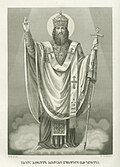 Neophytus of UrbnisiSaint · Bishop of UrbnisiOct 28
 Terence and NeonillaMartyrOct 28
- Theodora of WallachiaSaint · Tsaritsa of BulgariaOct 28
- Abraham of EphesusSaint · Archbishop of EphesusOct 28