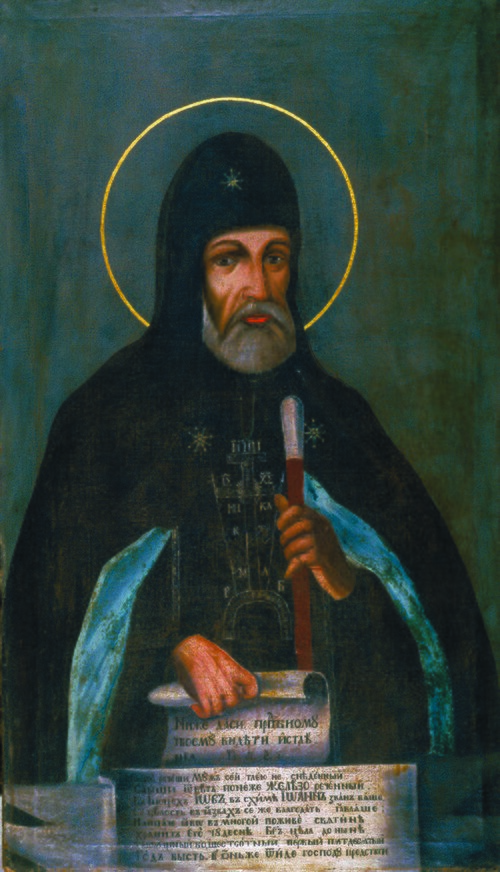
Venerable
Job of Pochaev
Abbot of Pochaev
Ukrainian monk born Ivan Zalizo, abbot at Pochaev, who lived over a hundred years; died in 1651.
- Feast
- October 28old style November 10
- Reposed
- 165117th century
- Place
- Pochaiv
- Order
- Venerables
Life
Saint Job of Pochaev, in the world Ivan Zalizo, in the great schema John, was a monk and abbot at Pochaev, born around 1551 near Kolomyia in Galicia, and fell asleep on 28 October 1651, at over a hundred years of age. He is venerated as a defender of Orthodoxy and as author of a collection of teachings, The Bee of Pochaev. The Church remembers him on 28 October, the day of his repose, on 28 August, the finding of his relics in 1659, and on the third Sunday after Pentecost, in the Synaxis of the Saints of Galicia.
His pious parents, John and Agapia, of the Zalizo family, "iron", named him Ivan, after Saint John the Baptist. The lives of Rastko Nemanjić and of John of Damascus and The Ladder of John Climacus were his models of virtuous life. According to his biographer and disciple Dositheus, small in years, he was perfect in wisdom and differed from other children by his high aspirations, and his word, knowledge and deeds never contradicted one another. At ten he secretly left home for the Transfiguration monastery at Ugornik and asked the abbot to take him in to serve the brethren. At twelve he was tonsured with the name Job, after the long-suffering Job. At thirty-one he received priestly ordination.
At the urging of Prince Konstanty Ostrogski, defender of Orthodoxy, he was moved to the monastery of the Exaltation of the Cross near Dubno in the Rivne region, set up by the rule of Saint Theodore the Studite. There for twenty years he was abbot and wrote theological books. At Ostroh, in the prince's press, the Ostrog Bible, the first Bible printed in Church Slavonic, was printed by Ivan Fyodorov in his time. His work, The Book of the Venerable Job of Pochaev, Written by His Own Hand, contains eighty teachings, conversations and sermons, with extracts from the Holy Fathers, and was printed in Russian in 1881 as The Bee of Pochaev. In his writings he defended Orthodoxy against Protestant heresies, especially the Socinians, writing on the Holy Trinity, the divinity of Christ, the Mother of God and baptism, and criticized Roman Catholic teachings, especially unleavened bread, in the time of persecution after the Union of Brest in 1596, when many Orthodox in Poland were deprived of rights and pressed to turn Catholic. He answered by copying and spreading Orthodox books.
Because his fame was growing, in 1604 he withdrew as a hermit to the caves of the mountains at Pochaev near Kremenets and was elected abbot. He was quiet and brief of speech, and from his lips nothing was heard but the Jesus Prayer. For days and weeks he would retire into his locked cave, so narrow it was hard to enter and so small that one could neither sit, stand nor lie comfortably. From long kneeling his knees were wounded, and marks were worn in the stone. His disciple Dositheus recounts that he saw a supernatural light coming from the depths of the cave, shining for two hours onto the other side of the church, and fell to the ground terrified. Job introduced strict order and other reforms. In his time the monastery had to fend off the attacks of Andrzej Firlej, castellan of Belz, who sued the monks over a bequest of his grandmother's, of wide lands and a miracle-working icon of the Mother of God. In 1623 Firlej raided the monastery and took the icon, keeping it until 1641, when a court decision returned it. He built the monastery walls, the Holy Trinity Cathedral and six more churches, and founded the Pochaev press. In 1628 he took part in the Synod of Kyiv, called to defend the Orthodox Church against Uniatism. After 1642 he received the great schema, with the name John.
He fell asleep in 1651 and was glorified soon after. After his death he appeared three times in a vision to Metropolitan Dionysius Balaban of Kyiv, commanding him to uncover his relics. His relics were found incorrupt in 1659. On 28 August 1833, by decision of the Holy Synod, they were opened a second time for examination.
Commemorated the same day October 28
 Abgar of EdessaRight-Believing · King of EdessaOct 28
 Arsenije of SerbiaSaint · Archbishop of SerbiaOct 28
 Arsenios the CappadocianVenerable · Spiritual father from CappadociaOct 28
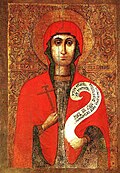 Paraskevi of IconiumGreat Martyr · Great Martyr, called FridayOct 28
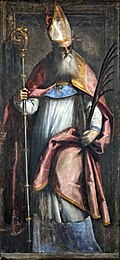 Judas CyriacusSaint · Bishop of JerusalemOct 28
- Arsenius AutorianusSaint · Patriarch of ConstantinopleOct 28
- FirmilianSaint · Bishop of Caesarea in CappadociaOct 28
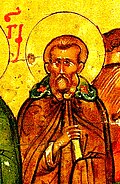 Stephen the SabaiteVenerable · Hymnographer of Mar SabaOct 28
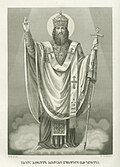 Neophytus of UrbnisiSaint · Bishop of UrbnisiOct 28
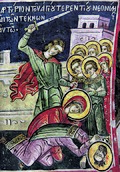 Terence and NeonillaMartyrOct 28
- Theodora of WallachiaSaint · Tsaritsa of BulgariaOct 28
- Abraham of EphesusSaint · Archbishop of EphesusOct 28