Saint
Theodora of Wallachia
Tsaritsa of Bulgaria
Daughter of Basarab I, tsaritsa of Bulgaria as wife of Ivan Alexander, who divorced her in 1345.
- Feast
- October 28old style November 10
- Reposed
- 135214th century
- Place
- Second Bulgarian Empire
Life
Venerable Theophana Basarab, in the world Theodora, was the daughter of the grand voivode Basarab I of Wallachia, tsaritsa of Bulgaria as wife of Ivan Alexander and, after he put her aside, a nun in a monastery at Vidin. She is considered the first known nun in Romanian history. She was born around 1301, and the year of her death is not known with certainty, but she died old, after 1356. The Romanian Orthodox Church canonized her in 2022, and her commemoration is on 28 October.
Family and marriage
Around 1310 Basarab I united several voivodeships and principalities south of the Carpathians and laid the foundation of the state that would become Wallachia. He married Margareta (or Marghita) and had three children, Nicholas Alexander, Theodora and Ruxandra. Theodora was educated at the voivode's court and is said to have shown wisdom early, as the Romanian church life of her says. In 1322 or 1323 (the sources differ) her father married her to Ivan Alexander, despot of Lovech and nephew of Tsar Michael III Shishman, to strengthen the tie with the Shishman dynasty, while Ruxandra became the wife of the Serbian prince Stefan Uroš III Dečanski. Both princes came to the throne, one as tsar of Bulgaria, the other as king of Serbia. For a young state such as Wallachia, an alliance with the Bulgarian tsardom was significant.
Theodora settled at Lovech, where, according to the hagiography, she had a fruitful cultural and spiritual activity. Her life says she found spiritual refuge in a nearby monastery, the one founded by her father at Câmpulung. It adds that she made gifts to the nunnery and, with the help of the nun Euphrasia, a calligrapher, and other nuns, had illuminated manuscripts made. The first work is said to have been a "Sbornik", a collection of teachings of the Holy Fathers on the Jesus Prayer. Many copies of Bulgarian translations of the Fathers followed, and translations of manuscripts from Athos and Constantinople. Both the Romanian and Bulgarian accounts say that she founded at Lovech a school in which manuscripts from the Holy Mountain and Byzantium were translated. Tradition adds that she asked to be told when Bogomils appeared at the borders of the despotate, refuted their teaching point by point, with biblical texts, and many of them began to avoid Lovech. She urged her husband to found a school for priests at Lovech, but the plan was not carried out.
Tsaritsa of Bulgaria
In 1331, after the battle of Velbazhd (where Michael III Shishman, supported by Basarab I, had been defeated by the Serbian king Stefan Uroš III) and a palace coup at Tarnovo which overthrew Tsar Ivan Stefan, set up by the Serbs, Ivan Alexander was elected tsar. Theodora became tsaritsa and stayed at Tarnovo for almost two decades. It is said that at her urging the tsar founded many monasteries and churches: the monastery of Bachkovo, the stone churches at Ivanovo, the monasteries at Mesembria, a monastery near Pernik, the churches at Berende, Boboshevo and Tarnovo, the monasteries of Dragalevtsi and Kilifarevo, and others. Near Tarnovo he had a school of copyists founded, who translated and copied service books, writings of the Holy Fathers, lives of saints and chronographs. She refused, says the Romanian tradition, to have her name set in manuscripts or her portrait on the walls of the churches she endowed, so the people knew her chiefly by her life. In the preface to the Sofia Psalter, a manuscript of 1337 made under her guidance, the tsar calls his wife "pious". The Bulgarian sources note, however, that researchers know one surviving image of her, in the rock monasteries of Ivanovo, of which she was a patron.
Her influence on the tsar gradually fell, although she managed to marry her son Ivan Asen to a niece from Wallachia. The marriage did not last, for Ivan Asen died in battle with the Turks, in 1349, when Theodora was already advanced in age. A miniature in the Manasses Chronicle shows the tsaritsa by her son's deathbed, with deep grief on her face. Another son, Michael Asen, died on the battlefield in 1355 or 1356. The children of her marriage were Michael Asen, Ivan Sratsimir, Ivan Asen and Vasilisa.
Parting from the tsar and monastic life
The tsar fell in love with a Jewish woman of Tarnovo named Sara, whose father, according to the Romanian life, passed for the richest of the Jews in the city. The people did not look kindly on the tsar's conduct. In 1345 (in other sources, 1347) Ivan Alexander divorced Theodora. According to the Romanian account, Theodora herself asked to be allowed to enter monastic life, and in 1347 she withdrew to the Ivanovo monastery, a laura near Ruse, with hesychast hermits in about 300 cells cut in rock. Sara was baptized in the Orthodox rite and received the former tsaritsa's name, Theodora. The former tsaritsa was driven from Tsarevets, was tonsured with the name Theophana (by some sources, in memory of the canonized Byzantine empress Theophano) and went to the tsardom of Vidin, ruled by her son, Ivan Sratsimir. He was later the last Bulgarian tsar before the country fell under the Turks. In 1356, for political reasons, Tsar Ivan Alexander divided Bulgaria in two, and the venerable one followed her son and lived near Vidin, in the rock monastery of Albotina, about 20 kilometres from the town, near the village of Rabrovo.
Ivan Sratsimir married Anna, her niece, daughter of Nicholas Alexander, prince of Wallachia, so also of the Basarab dynasty. Supported by Anna, Theophana continued at Vidin the work begun decades earlier at Lovech and made Vidin the most important Bulgarian cultural centre of the time. A witness of the Vidin school of scribes is the Bdin Miscellany, which contains lives of women saints only, sixteen in number.
Relics and veneration
After her death she was buried in the rock monastery of Albotina, necropolis of the tsardom of Vidin. According to the Bulgarian account, when the danger of Turkish invasion approached, the body was taken from the grave to be moved and was found in a remarkable state, without signs of decay and with a sweet fragrance. Metropolitan Joasaph of Bdin is said to have taken this as a sign of holiness and to have begun her canonization at once, on the basis of her good works in life. In 1394 the same metropolitan and Constantine II Asen brought from Tarnovo to Vidin the relics of Saints Paraskeva, Philothea and Theophano. The church at Vidin was then under the jurisdiction of the Ecumenical Patriarchate. Few written documents have survived from that time. It is supposed, according to local tradition, that the sarcophagus in the right apse of the rock church, on which a monogram of hers is written, is the grave of Theophana Basarab. At Vidin and in Wallachia she was known as Theophana Basarab.
On 17 February 2022 the Holy Synod of the Romanian Orthodox Church decided to canonize Venerable Theophana Basarab of the Albotina monastery (Vidin), with a feast day on 28 October. The proclamation took place on 21 May 2022 at the Patriarchal Cathedral in Bucharest, in the presence of Patriarch Daniel, and Metropolitan Naum of Ruse and Daniil of Vidin also took part in the service. The Bulgarian Orthodox Church has also entered her in its calendar. Every year on 28 October the Liturgy is celebrated in her honour in the church of the Holy Archangel Michael in the Ivanovo rock monasteries.
Commemorated the same day October 28
 Abgar of EdessaRight-Believing · King of EdessaOct 28
 Arsenije of SerbiaSaint · Archbishop of SerbiaOct 28
 Arsenios the CappadocianVenerable · Spiritual father from CappadociaOct 28
 Job of PochaevVenerable · Abbot of PochaevOct 28
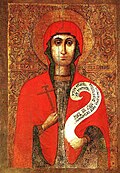 Paraskevi of IconiumGreat Martyr · Great Martyr, called FridayOct 28
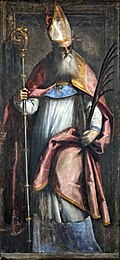 Judas CyriacusSaint · Bishop of JerusalemOct 28
- Arsenius AutorianusSaint · Patriarch of ConstantinopleOct 28
- FirmilianSaint · Bishop of Caesarea in CappadociaOct 28
 Stephen the SabaiteVenerable · Hymnographer of Mar SabaOct 28
 Neophytus of UrbnisiSaint · Bishop of UrbnisiOct 28
 Terence and NeonillaMartyrOct 28
- Abraham of EphesusSaint · Archbishop of EphesusOct 28