Saint
Firmilian
Bishop of Caesarea in Cappadocia
Bishop of Caesarea in Cappadocia from about 232, a disciple of Origen with great standing among bishops.
- Feast
- October 28old style November 10
- Reposed
- 2683rd century
- Place
- Tarsus
- Order
- Hierarchs
Life
Saint Firmilian, hierarch, was bishop of Caesarea in Cappadocia in the third century, a disciple of Origen, a man of letters and one of the most prominent episcopal figures of his time. He took part in the great disputes of the middle of the century, on the baptism of heretics, on the lapsed in the persecution of Decius and on the heresy of Paul of Samosata, and he died at Tarsus around 268 or 269. The Orthodox Church commemorates him on 28 October.
Life
It is not known where and when he was born, but he was a Cappadocian of noble family and fine secular learning. Gregory of Nyssa says that Gregory Thaumaturgus, while still a pagan, having completed his studies, met Firmilian, a Cappadocian of noble family, like him in character and gift, as was shown in his later life, when he adorned the Church of Caesarea. The two young men went to Alexandria to study with Origen, by whom Gregory at least was baptized; Firmilian was more probably brought up a Christian from childhood. It seems he was ordained priest at Caesarea.
Around 230 he became bishop of Caesarea in Cappadocia, a see which, from the way Dionysius of Alexandria mentions it ("Firmilian and all Cappadocia"), was already a metropolis. According to Eusebius, in the years 232 to 235, when Origen was at Caesarea in Palestine, because of his bishop's displeasure that he had been ordained priest there, Firmilian invited him to his own country for the benefit of the Churches. Origen stayed with him for a time, and Firmilian kept in touch with him by letter and often went to hear him. He had a reputation comparable to that of Dionysius of Alexandria and Cyprian of Carthage, and his contemporaries counted him perhaps the most conspicuous figure of the time, after forty years of influential episcopate.
Synods and disputes
Firmilian presided at synods that dealt with the questions troubling the Church: Montanism, the Novatian schism, the heresy of Paul of Samosata and the baptism of heretics. He opposed the stern line of Novatian, and Dionysius writes that in 252 the bishops of Cilicia, Cappadocia and Palestine invited him to a synod at Antioch to repudiate Novatianism; at the Antioch synod of 251 he had a part in the election of Demetrian as bishop. He also took part in the council at Iconium, with the bishops of Galatia and Cilicia, which decided to rebaptize the Montanists.
In the East it was the custom to baptize again those who had received baptism from heretics. When the dispute broke out, Cyprian, who wanted support in the East against Pope Stephen I, sent him at the end of summer 256, by the deacon Rogatian, a letter with the documents of the dispute. Pope Stephen broke communion with Helenus of Tarsus, Firmilian and all Cilicia and Cappadocia, as Dionysius recalls in a letter to Pope Sixtus II. Firmilian's reply reached Carthage around the middle of November. It is a long letter, harsher than Cyprian's, preserved in a Latin translation made under Cyprian's direction, very literal, full of Greek expressions. From it Firmilian held baptism given outside the Church to be void, since those who are outside the Church and have not the Holy Spirit cannot receive others into the Church and cannot give what they do not have: "Very many of us meeting together at Iconium examined the matter most carefully and decided that every baptism arranged outside the Church must be altogether rejected."
Firmilian told Cyprian that he had received his writings as his own and learned them by heart by repeated reading, that the custom of rebaptizing might be new at Carthage but in Cappadocia it had been from the beginning, and that he could answer Stephen by opposing tradition to tradition. The threat of excommunication only angered him; he thought it ridiculous that Stephen demanded only the use of the Trinitarian formula and saw in his leniency toward heretics an insult to the Apostles. Nor did he accept that Rome preserved the apostolic traditions unchanged, since it differed from Jerusalem over Easter, and he denied Stephen's authority to excommunicate them: "I am justly indignant at Stephen's open and manifest folly, that he so boasts of his position and claims to be the successor of Peter... You have cut yourself off; the true schismatic is he who makes himself an apostate from the communion of ecclesiastical unity. For in thinking that all can be excommunicated by you, you have cut off yourself alone from the communion of all." The style of the letter is more vehement than becomes a bishop, because Stephen had written also to Firmilian and Helenus. Dionysius of Alexandria interceded by letters and obtained a respite. The dispute also had a theological side: Stephen regarded it as a question of faith, while Cyprian and Firmilian regarded it as a matter of local discipline. The popes who followed did not keep Stephen's severe policy.
Paul of Samosata and death
In 266 Firmilian presided at a council at Antioch that examined the case of Paul of Samosata. He was persuaded that Paul would amend, but another council was needed. He was on his way to this assembly when death overtook him at Tarsus, around 269. Saint Basil the Great, his successor at Caesarea, mentions his view on heretical baptism without accepting it, and says, speaking of the doxology, that Firmilian held this faith, as the words he left behind testify.
Writings
Of his writings only the letter to Cyprian survives, in Latin translation, among Cyprian's letters. He had written, like many bishops, letters on church questions and letters to Origen. Saint Jerome does not mention him in his work on illustrious men. There is also a report by the Armenian historian Movses Khorenatsi that he wrote a history of the persecutions under Diocletian, but it is not credible, since Firmilian was not a contemporary of that emperor. The Orthodox Church commemorates him on 28 October, and in the West he is not venerated.
Commemorated the same day October 28
 Abgar of EdessaRight-Believing · King of EdessaOct 28
 Arsenije of SerbiaSaint · Archbishop of SerbiaOct 28
 Arsenios the CappadocianVenerable · Spiritual father from CappadociaOct 28
 Job of PochaevVenerable · Abbot of PochaevOct 28
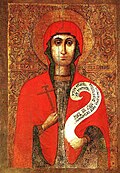 Paraskevi of IconiumGreat Martyr · Great Martyr, called FridayOct 28
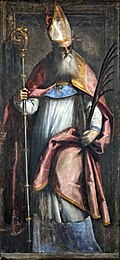 Judas CyriacusSaint · Bishop of JerusalemOct 28
- Arsenius AutorianusSaint · Patriarch of ConstantinopleOct 28
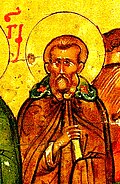 Stephen the SabaiteVenerable · Hymnographer of Mar SabaOct 28
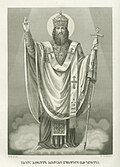 Neophytus of UrbnisiSaint · Bishop of UrbnisiOct 28
 Terence and NeonillaMartyrOct 28
- Theodora of WallachiaSaint · Tsaritsa of BulgariaOct 28
- Abraham of EphesusSaint · Archbishop of EphesusOct 28