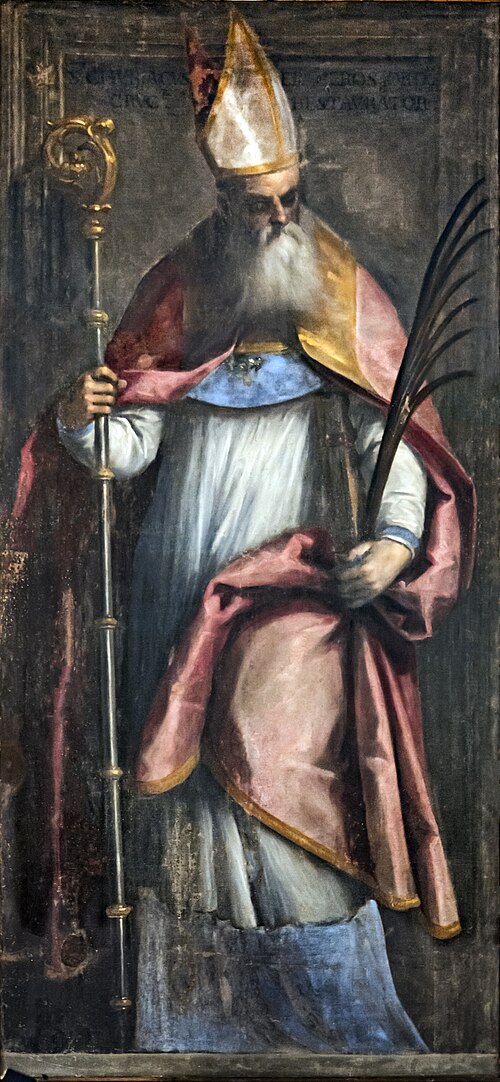
Saint
Judas Cyriacus
Bishop of Jerusalem
Venerated as bishop of Jerusalem and patron of Ancona in Italy; died around 360.
- Feast
- October 28old style November 10
- Reposed
- 3634th century
- Place
- Jerusalem
- Order
- Hierarchs
Life
The Holy Hieromartyr Judas Cyriacus (Quiriacus, Kyriakos) is mentioned in the hagiographic tradition as a Jew of Jerusalem who helped Empress Helena find the Cross of the Lord, then became bishop of Jerusalem and suffered martyrdom in the persecution of Julian the Apostate, around 360. The Orthodox Church commemorates him on 28 October, in English sources on 14 April; the Catholic Church on 4 May (according to another source 1 May). He is the patron of the city of Ancona in Italy. He is not to be confused with Judas Kyriakos, the legendary bishop of Jerusalem, killed in 133.
The story of the finding of the Cross The story of the finding of the Cross by Judas appears in the first half of the fifth century; in the Middle Ages it was much loved throughout Europe and was translated into many languages. The earliest versions are in Syriac, Greek and Latin. The oldest surviving Syriac text, from about 500, is "of great value for the history of the legend of the inventio crucis". Sozomen (about 440) mentions that it was said the place of the Holy Sepulchre was disclosed by a Hebrew who lived in the East, who got his information from documents inherited from his father, though he himself disputes the story; Gregory of Tours (573 to 591) says Helena found the Cross with the help of Judas; the Liber Pontificalis says Judas was baptized on the same day the Cross was found. After that the story was the most loved by Christians of the West. The Golden Legend of Jacobus de Voragine (thirteenth century) takes it up.
According to this story, Empress Helena came to Jerusalem to find the Cross of the Lord. She ordered the inhabitants of the city and its surroundings gathered. About three thousand Jews were found then. One of them, named Judas, whose forefather had been the Holy Protomartyr Stephen (according to the Golden Legend, among his ancestors, his father's brothers, were Stephen and Nicodemus), said: "I know, and I think that she is using us to question us about the tree on which our fathers crucified Jesus. But take care that, if any of us finds out, he does not confess. And if anyone does, all the feasts of our fathers will cease, and the law will be abolished." Judas said his father had commanded him that when they sought the Cross he should show it, and if not, to command his sons. But the Jews did not agree that Judas should show the place of the Cross, and Helena ordered them burned. Frightened, they handed Judas over, saying he knew the law best. But at Helena's request to show the place of the Cross, Judas said he knew nothing. Then Helena ordered him thrown into a dry well, for seven days, without food, until he told the truth. When the seven days passed, Judas cried from the well and said he agreed to show the place where the Cross of Christ was hidden. Coming out of the well, he went to the place and prayed for a sign to be sent. After that a loud voice was heard and a strong smell of wonderful incense rose, so that Judas was enlightened and said: "Truly You are Christ, the Saviour of the world." The Serbian source says he clapped his hands for joy. Then he dug about twenty cubits down, found three hidden crosses and brought them to the city to the empress. The Cross of the Lord was recognized thus: when a dead man on a bier was being carried past, Judas laid the three crosses on him in turn, and the dead man rose when the cross on which Jesus Christ was crucified was laid on him. Nearby was a demon-possessed man, and the demon went out of him at Judas's command. After this Judas was baptized by the local bishop. When the bishop died, Empress Helena turned to Eusebius, bishop of Rome, who was with her, and he laid hands on Judas and made him bishop in Jerusalem. She also changed his name and called him Cyriacus. Then the empress took care to seek the nails of the Cross. She called Cyriacus, asking him to show the place of the nails. Cyriacus, with many brothers and faithful, went to the place where the Cross had been found. Arriving there, he began to read a prayer and, when he finished, a sign appeared, a flash of lightning, "and the nails came out of the earth like shining pure gold, so that all who saw it believed" and said that Jesus crucified is God. Cyriacus brought the nails to Helena, who ordered bridles made of them for the horse of Emperor Constantine, that he might be invincible against all his enemies. After this she raised a great persecution against the Jewish people and commanded them expelled from Judea. This source adds that the ancient lists of the bishops of Jerusalem of the first centuries do not contain the name Cyriacus and that historians do not confirm the report that he was bishop of Jerusalem. According to the conjecture of the Bollandist Daniel Papebroch, Cyriacus may be identified with the bishop Judas (second century) mentioned in Eusebius of Caesarea's Ecclesiastical History and Chronicle. Another source says that John of Nikiu wrote, in the seventh century, that the Cross was found for Helena by a certain Ablavius, "a zealous Christian, one of the most prominent men of the empire".
Martyrdom According to his life, while preparing for war with the Persians, the emperor Julian the Apostate, hearing of Cyriacus, came to Jerusalem and summoned him to trial. The emperor ordered Cyriacus's mother Anna brought and tried to persuade her and her son to sacrifice to Zeus. Cyriacus refused and was tortured; then he was thrown into prison, where his mother came after two days. According to the Acts of his martyrdom, first written in Greek and then translated into Latin and Syriac, he conversed with the emperor and was subjected, with his mother, to horrible torments. There may have been confusion with another saint named Cyriacus, who died in the same century.
Ancona and Provins Empress Galla Placidia is said to have presented Ancona with the relics of Judas Cyriacus, brought from Jerusalem for the church she built there. The saint's head, however, is at Provins: Henry I of Champagne brought it from Jerusalem and built a church in the town to hold it. It still stands as the Collegiate Church of Saint-Quiriace, though the building work of the twelfth century was never completed, for lack of money in the reign of Philip the Fair; a dome was added in the seventeenth century, and the old families of the upper town were called "Children of the Dome". The Cathedral of San Ciriaco on Monte Guasco in Ancona is dedicated to the saint. It is said to occupy the site of a temple of Venus, mentioned by Catullus and Juvenal as the tutelary deity of the place. It was consecrated in 1128 and completed in 1189. It is a fine Romanesque building of grey stone, in the form of a Greek cross, with a dodecagonal dome over the center slightly altered by Margaritone d'Arezzo in 1270. The body of Cyriacus lies prostrate and visible in his tomb.
Commemorated the same day October 28
 Abgar of EdessaRight-Believing · King of EdessaOct 28
 Arsenije of SerbiaSaint · Archbishop of SerbiaOct 28
 Arsenios the CappadocianVenerable · Spiritual father from CappadociaOct 28
 Job of PochaevVenerable · Abbot of PochaevOct 28
 Paraskevi of IconiumGreat Martyr · Great Martyr, called FridayOct 28
- Arsenius AutorianusSaint · Patriarch of ConstantinopleOct 28
- FirmilianSaint · Bishop of Caesarea in CappadociaOct 28
 Stephen the SabaiteVenerable · Hymnographer of Mar SabaOct 28
 Neophytus of UrbnisiSaint · Bishop of UrbnisiOct 28
 Terence and NeonillaMartyrOct 28
- Theodora of WallachiaSaint · Tsaritsa of BulgariaOct 28
- Abraham of EphesusSaint · Archbishop of EphesusOct 28