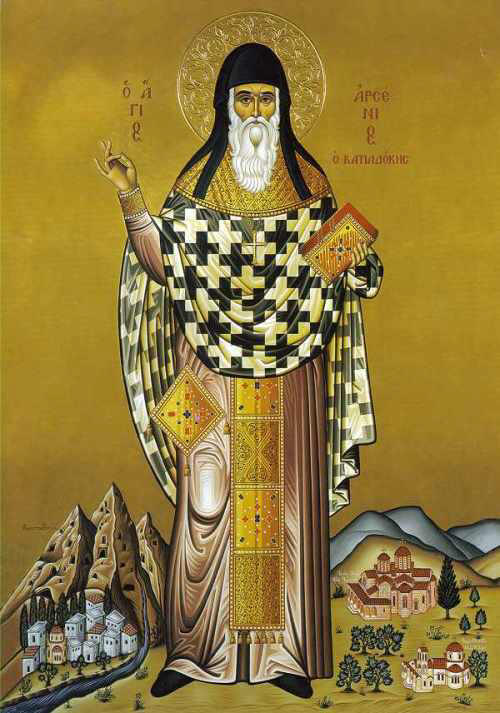
Venerable
Arsenios the Cappadocian
Spiritual father from Cappadocia
Priest born in Cappadocia who died on Corfu in 1924, the spiritual father of Paisios of Mount Athos.
- Feast
- October 28old style November 10
- Reposed
- 192420th century
- Place
- Corfu
- Order
- Venerables
Life
The Venerable Arsenios the Cappadocian, in the world Theodore Annitsalichos, born at Pharasa in Cappadocia, was a priest and archimandrite, spiritual father of Saint Paisios of Mount Athos, and fell asleep on Corfu on 10 November 1924. Ecumenical Patriarch Demetrios numbered him among the saints on 11 February 1986. The Church remembers him on 10 November.
Childhood and calling
He was born around 1840 at Kephalochori, one of the six Christian villages of the region of Pharasa in Cappadocia, an old centre of Orthodox Christianity. His father, Eleftherios, was a teacher, and his mother, Barbara, of the Frangopoulou family. Both died when he was very young, and he and his brother Vlasios were raised by his mother's sister. He studied at Niğde, where his father's sister, a teacher, housed him, then at Smyrna, with relatives. Besides Greek and church studies he learned Armenian, Turkish and some French. At about twenty-six he entered the monastery of the Holy Forerunner at Flavianai near Caesarea, where he was tonsured a monk with the name Arsenios. Metropolitan Paisios II ordained him deacon and sent him to Pharasa and neighbouring villages as priest, while he taught Greek children in secret, at a time when the Turks hindered the education of Greeks in every way. In 1870 he was ordained priest and archimandrite. Then he made a pilgrimage to the Holy Land, whence his Turkish nickname, Hadji Efendi.
Shepherd of Pharasa
A monk in the midst of the world, he led an austere life: on Wednesdays and Fridays he spent the days in seclusion and intensified prayer. This did not prevent him from taking part in the life of the villagers, for whom he was teacher, priest, caring for several churches, and guide of Christian life. He was spiritual guide of the Pharasa region for over fifty years. He helped the people much, together with the mayor of Pharasa, the father of Saint Paisios. As there was no doctor in Pharasa, many came to him also for bodily healing: it is said he healed the sick who came, Christians and Muslims. The people's immeasurable love sometimes forced him to feign folly. The patriarchs of Constantinople and Jerusalem offered him episcopal sees, but he did not accept. He did accept to be exarch of the Holy Sepulchre at Jerusalem, helping pilgrims, and exarch of his district. He baptized Paisios, giving him his own name, though the parents wished to name him after his grandfather, and remained afterward his spiritual father.
Exile and end
In 1924, under the population exchange between Greece and Turkey, the Greeks of Asia Minor were forced to leave for Greece, and Arsenios left with his flock, counselling and encouraging them on the way. He arrived in October in the Castle of Corfu, where he continued his priestly service. After about two weeks he fell ill and was taken to hospital, where he fell asleep on 10 November 1924, at eighty-four, as he had foretold already in Turkey, forty days after arrival. He was buried in the city cemetery, at the church of Saint George.
Relics
Surrounded by veneration in life, after arriving in Greece, because of the scattering of his flock, he was for a time forgotten. His spiritual son, the monk Paisios Eznepidis, found his relics in October 1958 and took them to Konitsa, where Greeks from Pharasa still lived, and in 1970 to the convent of Saint John the Theologian at Souroti near Thessalonica, where they were kept in a simple chest by the altar. Miracles from the relics drew attention to the saint. In 1971 Paisios wrote his life. He was canonized by Patriarch Demetrios and his synod on 11 February 1986 and is venerated in the Ecumenical Patriarchate and the Church of Greece. His relics are at the monastery of Saint John the Theologian at Souroti; a part is also venerated at the Greek church of the Prophet Elias in Frankfurt.
Commemorated the same day October 28
 Abgar of EdessaRight-Believing · King of EdessaOct 28
 Arsenije of SerbiaSaint · Archbishop of SerbiaOct 28
 Job of PochaevVenerable · Abbot of PochaevOct 28
 Paraskevi of IconiumGreat Martyr · Great Martyr, called FridayOct 28
 Judas CyriacusSaint · Bishop of JerusalemOct 28
- Arsenius AutorianusSaint · Patriarch of ConstantinopleOct 28
- FirmilianSaint · Bishop of Caesarea in CappadociaOct 28
 Stephen the SabaiteVenerable · Hymnographer of Mar SabaOct 28
 Neophytus of UrbnisiSaint · Bishop of UrbnisiOct 28
 Terence and NeonillaMartyrOct 28
- Theodora of WallachiaSaint · Tsaritsa of BulgariaOct 28
- Abraham of EphesusSaint · Archbishop of EphesusOct 28