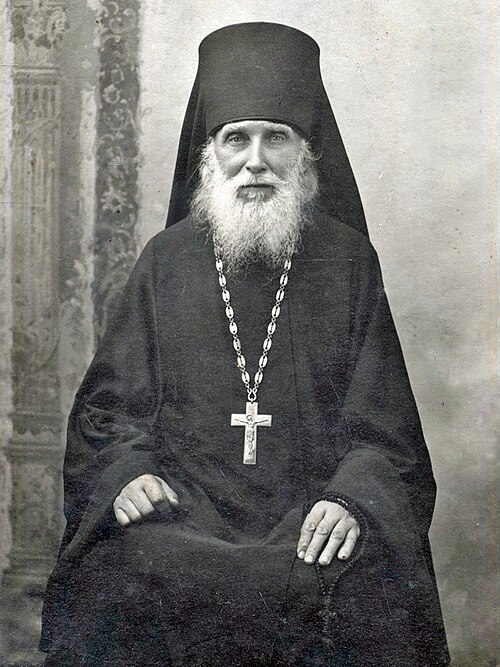
Venerable
Alexis of Goloseevo
Monk of the Kiev Caves Lavra
Monk of the Kiev Caves Lavra, born in 1840 and died in 1917, venerated as a saint.
- Feast
- March 11old style March 24
- Reposed
- 191720th century
- Place
- Kyiv
- Order
- Venerables
Life
Venerable Alexis of Goloseevo (Vladimir Ivanovich Shepelev) was a hieromonk of the Kyiv Caves Lavra and confessor-elder of the Goloseevo Hermitage, venerated for the gift of foresight, prayer and confession. Born on 14 April 1840 at Kyiv into a noble family, he fell asleep on 11 March 1917 at Goloseevo. He was entered among the locally venerated saints of the Orthodox Church in Ukraine in 1993, and in 2017 the Council of Bishops of the Russian Church decided on his veneration throughout the Church, with commemoration on 24 March.
Childhood
His father, Ioann Ivanovich Shepelev, captain at the Kyiv arsenal, died when Vladimir was three; his mother, Maria Kuzminichna, attended on 7 August 1832 the unveiling of the relics of Saint Mitrophan of Voronezh, where she met Bishop Antony, who, it is said, spoke to her of a son. After seven years Vladimir was born, mute. His mother raised him, instilling love of people, took him to prisons to distribute alms and to the Kitaevo Hermitage, where the fool for Christ Theophil then lived, whose words showed that Vladimir would be a monk. In spring 1852 a letter from Saint Petersburg ordered him to be brought to the capital for cadet training, but his mother, advised by Metropolitan Philaret of Kyiv, answered that his muteness barred him from military service.
In 1853 Maria and Vladimir were invited to Paschal vespers at Metropolitan Philaret's house church. After the Liturgy, at the kissing of the cross on Philaret's staff, the metropolitan said to him three times "Christ is risen", and the boy miraculously answered: "Truly He is risen", his first words. After this healing Philaret offered to take him to the Kyiv Caves Lavra. On 2 July 1853, at thirteen, he reached the lavra; four days later his mother died. Philaret took charge of his education, with professors from the Theological Academy and the University of Kyiv: Russian literature, church and Russian history, Scripture, medicine and probably Latin. He himself guided his moral upbringing, ordering him to give alms to the poor of Kyiv at the great feasts. Prayer he learned from Elder Parthenius. In winter he stayed at the lavra, in summer at Goloseevo, with Philaret and Parthenius. In 1855 Parthenius died, and Philaret, ill, advised him to ask the Lavra's council to receive him as a novice; on 25 February 1856 he was accepted and put in the printing workshop. Philaret, who died the next year, gave him a cassock and his blessing. On 15 April 1857 he was accepted as a permanent novice.
In the Caves Lavra
During his novitiate relatives urged him to give up monasticism and marry, but Archimandrite Barlaam stopped them. Before tonsure he made a pilgrimage to the tomb of Saint Mitrophan at Voronezh and served a memorial service at Bishop Antony's grave. In 1872 Archimandrite Barlaam chose for him the name Philaret, after his mentor, but on 13 April 1872 (Maundy Thursday), at the tonsure, he changed it to Alexis. On 12 September he was moved to the hospital monastery of Saint Nicholas, where he was a scribe. On 23 November 1873 he was ordained hierodeacon, and on 23 December 1874 sacristan; he gave the church there a silver chalice inscribed "In memory of Hierodeacon Alexis (Shepelev)". On 6 December 1875 Metropolitan Arsenius ordained him hieromonk. On 20 August 1879 he was moved to the Near Caves, to guard the shrines of the saints and help pilgrims, for over six years, and received a cross from the Holy Synod. On 7 October 1885 he became sacristan of the great church, the Dormition. An incident led to his removal: the Stepanova sisters accused him of misappropriating five thousand roubles entrusted to him; on 21 September 1887 the spiritual council removed him from office. Persistent accusations led, on 30 April 1891, after thirty-eight years at the lavra, to his transfer to the Spaso-Preobrazhenskaya Hermitage south of Kyiv, where he often thought of death.
At Goloseevo
On 15 November 1895 he was moved to the Goloseevo Hermitage, where for twenty-one years he was confessor-elder of the brethren and pilgrims. He was confessor of two metropolitans, Joannicius and Flavian; in April 1911 he was summoned to Chernigov to give last rites to the dying Archbishop Antony, and in 1915 he gave absolution to Bishop Flavian two days before his death. In 1905 he received the Order of Saint Anna, third class, and in 1913 Metropolitan Flavian gave him a pastoral staff, normally reserved for hegumens, though he was a hieromonk. He often made pilgrimages to the Nikolaevskaya Hermitage in the Chernigov governorate, visited the Lavra several times a year and honoured the icon of Saint Nicholas at Bessarabka. Toward the end of his life he declined to return to the lavra as caretaker of the Far Caves. He fell asleep in March 1917 and was buried five metres from the wall of the church of the Life-Giving Spring; in 1925 the relics were moved twenty metres lower.
The gift of foresight
The Church attributes prophetic gifts to him. On 1 March 1881, at the elevation of the particles, Alexis noticed that the particle for Tsar Alexander II was light brown, unlike the white ones, and took it as a sign of danger to the tsar, who was assassinated that very day. In 1888 he foretold to parents that their two-year-old daughter, Vassa Kovaleva, would be a holy nun persecuted for the faith; she later entered a monastery as Faina. In 1896, at the opening of the shrine of Saint Theodosius of Chernigov, he dreamt that Saint Theodosius asked for liturgies for his parents and gave their names, Nikita and Maria. In 1907 he called Nun Eufalia "abbess", and she did become abbess in 1914. In 1911 he foretold to a novice that monks would soon flee from Athos to Russia, which happened in 1912, when Greek troops occupied the monastery of Saint Panteleimon, because of the dispute over the Name of God. To a woman of Kharkov he said that her son would be a bishop like Joasaph of Belgorod; to a woman of Tambov he advised preparing a coffin for the younger daughter, which was fulfilled within two weeks.
His teaching
To monks he advised preparing for death, fleeing vainglory, obeying superiors, loving the cell, keeping spiritual purity, praying unceasingly and reading lives of saints. To laypeople: thinking of Christ, restraining oneself and anger, being strict with oneself and lenient with others, giving alms, doing good, acquiring humility and accepting suffering with joy. Among those who followed him: Alexander Gotovtsev, a monk with the name Alexis, a bishop martyred in the 1930s; Bishop Vladimir Bogoyavlensky, killed in January 1918, who had asked his prayers and whose body was found by Alexis's spiritual son, Archimandrite Anthim; and Bishop Vyacheslav Shkurko, martyred in 1937. In 1993, at the rebuilding of the hermitage, his remains were moved into its church, and on 15 July 1993, during the vigil for Saint Vladimir, in the Holy Trinity church of the Lavra, he was canonized. A portion of the relics is in the church of the Protection of the Mother of God in Sloboda Oziericka in the Smalyavichy district.
Commemorated the same day March 11
 Sophronius of JerusalemSaint · Patriarch of JerusalemMar 11
 Sophronius of VratsaSaint · Bishop of VratsaMar 11
 Theodora of ArtaRight-Believing · Consort of the ruler of EpirusMar 11
 Pionius of SmyrnaHieromartyr · Presbyter of SmyrnaMar 11
- John MoschusVenerable · Author of the Spiritual MeadowMar 11
 Benedict of MilanSaint · Archbishop of MilanMar 11
 Euthymius II of NovgorodSaint · Archbishop of NovgorodMar 11
 Constantine of StrathclydeRight-Believing · King of StrathclydeMar 11
 Basil MalakhovConfessor · ArchpriestMar 11
 SophroniusVenerableMar 11
- Agape of AntiochMartyrMar 11
- Alberta of AgenMartyrMar 11