Venerable
John Moschus
Author of the Spiritual Meadow
Byzantine monk and ascetic writer of Georgian origin, author of the Spiritual Meadow; died in 619.
- Feast
- March 11old style March 24
- Reposed
- 6197th century
- Place
- Rome
- Order
- Venerables
Life
The Venerable John Moschus was a Byzantine monk and ascetic writer of Georgian origin, known above all as author of the Spiritual Meadow. He was born around 550, probably at Damascus, and fell asleep in 619 at Rome. He is commemorated with his disciple Sophronius on 11 March.
Life He was given the epithet "Eucrates", the self-controlled. He lived in turn with the monks at the monastery of Saint Theodosius, southeast of Jerusalem, among the hermits in the Jordan valley and in the New Lavra of Saint Sabbas the Sanctified near Tekoa, east of Bethlehem. About 578 he went to Egypt with Sophronius, later patriarch of Jerusalem, and came as far as the Great Oasis of the Libyan desert. After 583 he came to Mount Sinai and spent some ten years in the Lavra of the Aeliotes, then visited the monasteries near Jerusalem and the Dead Sea. In the 580s he returned to Egypt to meet refugees, at a time when Byzantine influence was waning and several monasteries in Wadi el Natrun had been razed, and three thousand five hundred monks scattered in the Levant. In 604 he went to Antioch but returned to Egypt in 607. Later he went to Cyprus, and in 614 or 615 to Rome, where he died in 619. On his deathbed he asked Sophronius to bury him, if possible, on Sinai, or else at the monastery of Saint Theodosius near Jerusalem. Since Sinai was then invaded by the Saracens, Sophronius buried him at Saint Theodosius. The epithet comes, according to others, from the drink "eucratos" of a monastery he founded at Carthage.
The Spiritual Meadow He is the author of one of the earliest hagiographical works, called in Greek Leimon pneumatikos, in Latin Pratum spirituale, also cited as the Limonarion or the "New Paradise", which he wrote in the 610s. In it he tells his experiences with many great ascetics he met in his long travels, above all in Palestine, Sinai and Egypt, but also Cilicia and Syria, and repeats the edifying stories they told him. The work teems with miracles and ecstatic visions, shows clearly the practices of Eastern monasticism, contains important data on the worship and services of the time and makes known the heresies that threatened the Church in the East. At a time when the cities of the eastern Mediterranean were declining, his writings show the decay of the once flourishing world of the Eastern Roman Empire. In Old Russian it is known as the "Limonar" or the "Sinai Paterikon". With Sophronius he also wrote a life of Saint John the Almsgiver, of which a fragment survives in the first chapter of the life written by Leontius of Neapolis.
Commemorated the same day March 11
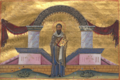 Sophronius of JerusalemSaint · Patriarch of JerusalemMar 11
 Sophronius of VratsaSaint · Bishop of VratsaMar 11
 Theodora of ArtaRight-Believing · Consort of the ruler of EpirusMar 11
 Pionius of SmyrnaHieromartyr · Presbyter of SmyrnaMar 11
 Benedict of MilanSaint · Archbishop of MilanMar 11
 Euthymius II of NovgorodSaint · Archbishop of NovgorodMar 11
 Alexis of GoloseevoVenerable · Monk of the Kiev Caves LavraMar 11
 Constantine of StrathclydeRight-Believing · King of StrathclydeMar 11
 Basil MalakhovConfessor · ArchpriestMar 11
 SophroniusVenerableMar 11
- Agape of AntiochMartyrMar 11
- Alberta of AgenMartyrMar 11