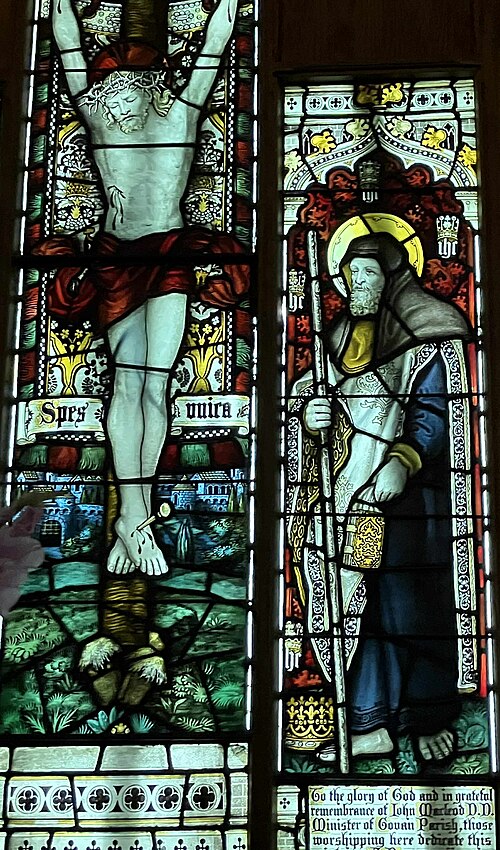
Right-Believing
Constantine of Strathclyde
King of Strathclyde
Son and successor of King Riderch Hael of Strathclyde, mentioned only in the Life of St Kentigern.
- Feast
- March 11old style March 24
- Reposed
- 6407th century
Life
Constantine of Strathclyde is named in tradition as the son and successor of King Riderch Hael of Alt Clut, the Brittonic kingdom later called Strathclyde, and then a cleric and saint. Our sources show that his historical existence cannot be proved: he appears only in the Life of Saint Kentigern written by Jocelyn of Furness, and he is thought to be a literary invention. The Great Synaxaristes, the compilation of lives of saints in the Orthodox Church, includes him on 11 March. The Greek Orthodox Church recognises him as a saint.
What tradition says
According to Jocelyn, Constantine was the son of Riderch and of Queen Languoreth. He succeeded his father, the illustrious Riderch, but later left the throne and became a cleric. No other source mentions a son of Riderch named Constantine. He is absent from the pedigrees of the kings of the North of Britain in the Harleian genealogies and in the Bonedd Gwŷr y Gogledd. A Saint Constantine was venerated in the neighbourhood of Glasgow, where much of Jocelyn's narrative is set: the early church at Govan, near the city, was dedicated to him. But in the twelfth century the biography of Saint Constantine was obscure, so King Constantine is probably a literary invention meant to give a narrative to an old and shadowy figure.
According to a Russian source, Constantine ap Riderch (570 to 636) was king of Alt Clut from 612 to 617. The Life of Saint Kentigern says he subdued without bloodshed all the barbarian peoples around and surpassed in wealth, glory, dignity and holiness all the kings of Cambria before and after him, so that many began to honour him as a saint. Soon he left the throne in favour of his kinsman Nechtan ap Guithno and withdrew to Ireland, where he lived unknown. Only after some years did the monks learn of his royal origin. About 636 he became abbot of the monastery of Rahan. Later he returned to his own country, where he built churches at Kirkconstantine, Kennoway and Dunnichen and the famous monastery at Govan, where he died.
The Great Synaxaristes says that he was guided to Christianity by Saint Columba, became a missionary in England and in Ireland and died about 640. The Greek Orthodox Church recognises a Saint Constantine of Strathclyde and Govan, of whom legend says that he gave up the throne in 612 and became a monk and then a priest.
Govan and other Constantines
Without sure historical records, the date 612 would match the time in which the churchyard at Govan was used by Christians, according to archaeological work, from the fifth and sixth centuries. But the sarcophagus believed to have held his relics belongs stylistically to the ninth and tenth centuries. This does not exclude that the sarcophagus was made later for the remains or part of the remains of the earlier saint, a common practice in the Middle Ages, in the time of the cult of relics. Three later Scottish kings were called Constantine, all reigning several centuries after the legendary figure tied to Riderch Hael. Matters grow still more confused, for there is a Cornish Saint Constantine, tied to the kingdom of Dumnonia of the Dark Ages, very like in stock and culture to the Brittonic kingdom around Strathclyde. Without original sources, scholarly opinion is divided: whether Constantine of the British kingdoms is the same as the other, or one invented on the model of the other, or whether there were several with this name.
Commemorated the same day March 11
 Sophronius of JerusalemSaint · Patriarch of JerusalemMar 11
 Sophronius of VratsaSaint · Bishop of VratsaMar 11
 Theodora of ArtaRight-Believing · Consort of the ruler of EpirusMar 11
 Pionius of SmyrnaHieromartyr · Presbyter of SmyrnaMar 11
- John MoschusVenerable · Author of the Spiritual MeadowMar 11
 Benedict of MilanSaint · Archbishop of MilanMar 11
 Euthymius II of NovgorodSaint · Archbishop of NovgorodMar 11
 Alexis of GoloseevoVenerable · Monk of the Kiev Caves LavraMar 11
 Basil MalakhovConfessor · ArchpriestMar 11
 SophroniusVenerableMar 11
- Agape of AntiochMartyrMar 11
- Alberta of AgenMartyrMar 11