Hieromartyr
Pionius of Smyrna
Presbyter of Smyrna
Presbyter of Smyrna, martyred in the persecution of Decius around 250.
Life
The Holy Hieromartyr Pionius of Smyrna was a presbyter of Smyrna, martyred most probably in the year 250, in the persecution of Decius. His feast is on 11 March in the Orthodox Church (on 1 February in the Roman Catholic Church).
The source and the time
His life is known from the Martyrdom of Pionius, a document dating from about 250 to 300, also called the Acts of Pionius, Martyrium Pionii or Passio Pionii, drawn up from the transcript of the governor's hearing. According to it, Pionius and other Christians were killed on the "birthday" (commemoration day) of Polycarp, a prominent martyr of an earlier time. The empire-wide measures under Decius in 250 required everyone to offer sacrifices and eat sacrificial meat, one of the four things forbidden to Christians by the first Apostles in Acts 21:25. The Orthodox sources say that Pionius, a presbyter known for wisdom and the gift of preaching, was seized, with Sabinus, Asclepiades and others, fifteen in number, while serving the Liturgy. Eusebius, however, places the martyrdom under Marcus Aurelius; scholars generally date it to the persecution of Decius.
The narrative
Warned by God in a dream the night before about his impending martyrdom, Pionius was arrested the next day. He was a model citizen of Smyrna admired by all. One of the three temple guardians, accompanied by police, went to find him, because he had refused to offer sacrifices. Pionius was waiting for them in his house with the Christians Sabina and Asclepiades; the three had already put shackles around their necks to show that they were ready for prison. While efforts were made to persuade them to follow the example of others who had already sacrificed, they were led through the streets to the agora. The author of the Acts says the upper galleries of the square were packed with Greeks, Jews and women, who had the day off because of the Great Sabbath. Pionius responded to the crowd's taunting by reminding the Greeks that Homer never thought it pious to rejoice at another's loss of life, and the Jews of Moses and Solomon, who teach giving aid to the enemy and not rejoicing at his fate. He reproached them for showing no compassion, either as human beings or as victims of injustice themselves. Then he put a series of questions: "To whom have we done wrong? Have we perchance murdered someone? Or do we persecute anyone? Or have we obliged anyone to venerate idols?" He was tried by the governor of Smyrna, Claudius Rufinus Sophistes (according to some, twice: first under Polemon, the temple-verger, then under Julius Proculus Quintilianus), imprisoned, tortured, repeatedly asked "Will you sacrifice?" and repeatedly refused. He was sentenced, according to the Acts, to be burned alive.
The manner of his death
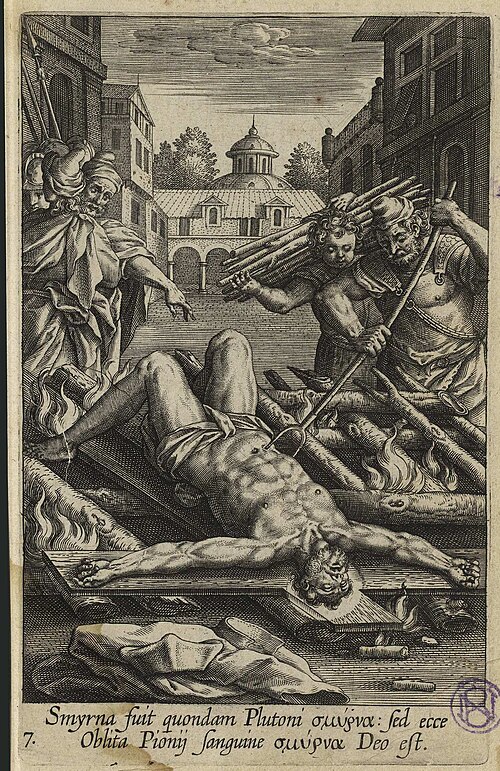
According to another account, sentenced to crucifixion, he rejoiced greatly; as soon as the soldiers had made the cross and laid it on the ground, Pionius lay down on it himself, stretched out his hands and ordered the soldiers to nail them. The cross was set in the ground upside down, and a fire was lit under the martyr's head. The gathered people were many. Pionius closed his eyes and prayed inwardly to God. The faithful believe the fire did not even singe his hair. When the fire died and all thought he was dead, Pionius opened his eyes and cried out joyfully: "God, receive my spirit." and fell asleep. It is said that he wrote the life of Saint Polycarp of Smyrna, but the Life of Polycarp attributed to him is held by scholars to be spurious, of the later part of the fourth century.
The view of historians
Daniel Boyarin describes the historical accuracy of the Martyrdom of Pionius as "highly contested." Jan Kozlowski argues that details of the text show it was written in the third century, not long after the Decian persecution. Robin Lane Fox calls it "a text of rare authority, true to its first contemporary form." Bart Ehrman sees in it traces of "literary license, if not wholesale invention" in the way it echoes the earlier story of Polycarp (155). The theologian A. C. McGiffert holds that the account bears all the marks of genuineness and may be regarded as trustworthy, at least on the main points.
Commemorated the same day March 11
 Sophronius of JerusalemSaint · Patriarch of JerusalemMar 11
 Sophronius of VratsaSaint · Bishop of VratsaMar 11
 Theodora of ArtaRight-Believing · Consort of the ruler of EpirusMar 11
- John MoschusVenerable · Author of the Spiritual MeadowMar 11
 Benedict of MilanSaint · Archbishop of MilanMar 11
 Euthymius II of NovgorodSaint · Archbishop of NovgorodMar 11
 Alexis of GoloseevoVenerable · Monk of the Kiev Caves LavraMar 11
 Constantine of StrathclydeRight-Believing · King of StrathclydeMar 11
 Basil MalakhovConfessor · ArchpriestMar 11
 SophroniusVenerableMar 11
- Agape of AntiochMartyrMar 11
- Alberta of AgenMartyrMar 11