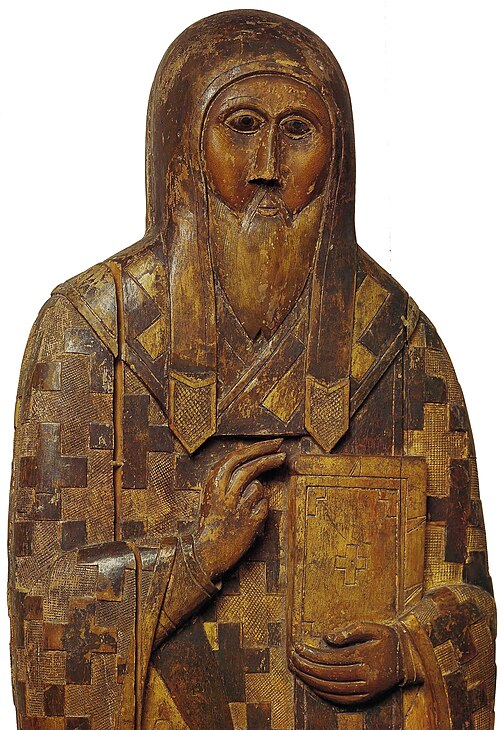
Saint
Euthymius II of Novgorod
Archbishop of Novgorod
Archbishop of Novgorod from 1429 to 1458, a great patron of the arts and architecture.
Life
Saint Euthymius II, the Hierarch (in the world John), was archbishop of Novgorod from 1429 to 1458, one of the most important builders of the city. He was a monk at Vyazhishchi, built or rebuilt more than a dozen churches, adorned the cathedral of Saint Sophia and fostered the copying of holy books and the writing of lives of saints. Through him several hierarchs of Novgorod were honoured. The Russian Church canonized him in 1549, at the second Council of Macarius, and his commemoration is on 11 March (24 March by the new calendar).
Beginnings
According to his lives, he was born at Novgorod in the family of a priest, Mikhey (in other lives, Fedor), and his wife, Anna, who had long been childless and had promised to dedicate the child to God. The year of birth is placed at the start of the 1380s, with a question mark. It is said the father was priest of the church of the Holy Great Martyr Theodore, in the market side of the city. At fifteen he received monastic tonsure, with the name Euthymius, at the monastery of Saint Nicholas at Vyazhishchi (for which he is also called Euthymius of Vyazhishchi), by another source at the monastery on Listitsa Hill. By his pure monastic life he became known to Archbishop Simeon of Novgorod, who made him steward. After Simeon's death, Euthymius moved to the Khutyn monastery, and later was chosen abbot of the monastery of the Mother of God on Fox Hill, near Novgorod.
At the end of 1429, after the death of his predecessor Euthymius I (Bradaty), he was elected archbishop of Novgorod by the city assembly. But, because there was no metropolitan of Kyiv in Russia, he was not consecrated for four years. On 4 May 1434 he was consecrated archbishop by Metropolitan Gerasim (in the English source Geronty, metropolitan of Lithuania) at Smolensk, not at Moscow, which angered the Muscovite authorities, though there was then no metropolitan at Moscow: Photius had died in 1431, and Isidore would arrive in 1437.
Builder of Novgorod
Euthymius was one of the greatest builders of culture in Novgorod's history. Much of his work looked back to the city's history: his buildings were often reconstructions of old churches on the old foundations and in the old style. According to the chronicles he built or rebuilt more than a dozen churches, several of which still stand at Novgorod today, among them the church of the Twelve Apostles, the church of Saint John the Forerunner at Opoki (first built by Prince Vsevolod Mstislavich in 1127), the church of the Dormition and the church of Saint George at the Market (both also Vsevolod Mstislavich's), all three side by side in the northern part of the Market. He also built secular buildings. The Palace of Facets, built in 1433, still stands northwest of the Saint Sophia cathedral. He also built the belfry east of the cathedral and a clock tower west of it, which collapsed and was rebuilt in 1673. He worked much for the restoration of churches after the great fires of 1431 and 1442. He richly adorned the Saint Sophia cathedral and also cared for the copying of church books.
He canonized several of his predecessors and fostered the veneration of other saints of Novgorod. In 1439 he found the relics of Archbishop Elijah (John) and commemorated him and eight other bishops and archbishops who had appeared in a vision earlier that year. Under his guidance legends were compiled about the city in general and the archbishops in particular. He brought in Pachomius the Serb, who wrote several hagiographic works on the saints of Novgorod, many of them Euthymius's predecessors in the archiepiscopal office. Pachomius arrived at Novgorod at the end of the 1430s or start of the 1440s and, under Euthymius's patronage, wrote the Life of Varlaam of Khutyn, founder of the Khutyn monastery, and the "Tale of the Journey of John (Elijah, archbishop of Novgorod 1165 to 1186) on a Devil to Jerusalem". Pachomius returned to Novgorod and, under Archbishop Jonah, also wrote the Life of Euthymius.
The end of his episcopate
His archiepiscopate was in some ways a high point of the archiepiscopal office at Novgorod. Yet, despite the flourishing of culture, Novgorod suffered a humiliating defeat at the hands of Grand Prince Vasily II in 1456 and signed at Yazhelbitsy a harsh peace that limited its foreign policy. In 1456 Euthymius, together with the mayor Fyodor Patrikeevich, took part in the reconciliation of the republics of Novgorod and Pskov with the prince of Moscow, Ivan Vasilievich. He ceased to be active around 1456; he is not mentioned in the treaty and built no churches after that. It may be that the defeat affected him personally and he withdrew.
When Dmitry Shemyaka fled to Novgorod and lived in the city (1452 to 1453), Metropolitan Jonah wrote to Euthymius that he had begun to act too lightly, receiving the one excommunicated for crimes and deeming him worthy of blessing, and urged him to repent before God. Euthymius received Jonah's forgiveness, but was already dying. He fell asleep on 11 March 1458 (other sources give 10 or 12 March), and the metropolitan's envoy with the letter of absolution arrived 16 days later. The letter was read over the coffin and put into his hand. He was buried at the Vyazhishchi monastery, where he had been a monk.
Veneration
His life was written by Pachomius the Logothete, at the order of Archbishop Jonah of Novgorod. Local veneration is known from the end of the fifteenth century (in 1500 there already existed at Vyazhishchi a church consecrated in his name, and in 1494 his life appears in a monthly collection). For veneration throughout the Church he was canonized in 1549, at the second council of Metropolitan Macarius. When his remains were disinterred, they were said to be incorrupt. His body now lies in a glass-covered coffin in the church of Saint Euthymius of the Vyazhishchi monastery, after Metropolitan Alexy of Leningrad and Novgorod (now Patriarch of Moscow) consecrated the church in his name, on 31 March 1990. A new church dedicated to Euthymius and Archbishop Gennady also stands at the Kovaleva cemetery, east of Saint Petersburg. A small silver ladle, which belonged first to Euthymius, then to Tsarevich Ivan, son of Ivan the Terrible, is today in the Armoury Chamber in Moscow.
Commemorated the same day March 11
 Sophronius of JerusalemSaint · Patriarch of JerusalemMar 11
 Sophronius of VratsaSaint · Bishop of VratsaMar 11
 Theodora of ArtaRight-Believing · Consort of the ruler of EpirusMar 11
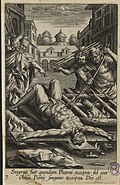 Pionius of SmyrnaHieromartyr · Presbyter of SmyrnaMar 11
- John MoschusVenerable · Author of the Spiritual MeadowMar 11
 Benedict of MilanSaint · Archbishop of MilanMar 11
 Alexis of GoloseevoVenerable · Monk of the Kiev Caves LavraMar 11
 Constantine of StrathclydeRight-Believing · King of StrathclydeMar 11
 Basil MalakhovConfessor · ArchpriestMar 11
 SophroniusVenerableMar 11
- Agape of AntiochMartyrMar 11
- Alberta of AgenMartyrMar 11