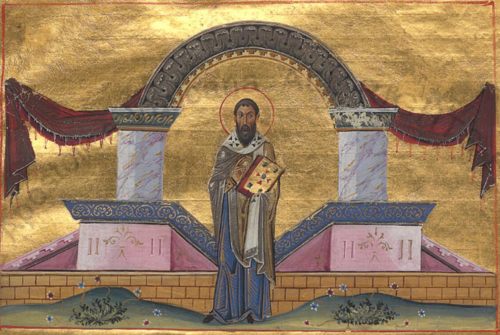
Saint
Sophronius of Jerusalem
Patriarch of Jerusalem
Patriarch of Jerusalem from 634 to 638, defender of the true faith against Monothelitism.
Life
Saint Sophronius was Patriarch of Jerusalem from 634 to 638, a theologian, poet and defender of the true faith against Monoenergism and Monothelitism. The Church commemorates him on 11 March.
Early life and travels
He was born at Damascus around 560, of a distinguished family, and received a fine education, at first working as a teacher of rhetoric, called “the Sophist”. He became a monk in Egypt around 580, then in the lavra of Saint Theodosius near Bethlehem, where he met John Moschus, who became his teacher and inseparable friend. Together they visited the monasteries of Palestine, Syria and Asia Minor. The Persian invasion under Chosroes kept them from returning to Palestine, and they went to Alexandria, where they lived for a long time with Saint Eulogius and Saint John the Almsgiver, also visiting the monasteries and holy places of Egypt. John Moschus wrote the “Spiritual Meadow” (Limonarion) and dedicated it to Sophronius; after Moschus’ death, Sophronius completed the work and published it. The friends then went by way of Cyprus to Rome, where John Moschus died around 619-620. Sophronius carried his body to the lavra of Saint Theodosius and stayed in Jerusalem, where he saw the return of the Holy Cross from Persian captivity.
Around 630-633 he went to Alexandria and Constantinople to persuade the two patriarchs, among them Cyrus of Alexandria, to abandon the false teaching that in Christ there is only one divine energy. He did not succeed, and his writings on this question are lost, apart from his synodical letter.
Patriarch of Jerusalem
In 634 he was elected Patriarch of Jerusalem. Right after his enthronement he sent his synodical letter to Pope Honorius and the Eastern patriarchs, setting out in measured words the faith in the two natures of Christ, divine and human. The letter was accepted as an exact confession of the faith at the Sixth Ecumenical Council (Constantinople, 680-681). He gathered a synod in Jerusalem that condemned Monothelitism, and compiled an anthology of some six hundred texts from the Holy Fathers in support of the teaching of two wills in Christ. In the seven homilies that remain from him, he teaches that God’s essence cannot be seen, but that His energy or power, distinct from the essence, can be beheld and shared. This teaching was later important in the disputes of Byzantium.
In his Christmas sermon of 634 he noted that Bethlehem was already in Arab hands. He saw the Muslim conquest as God’s chastisement of the weakness of Christians. When Jerusalem surrendered to Caliph Umar in 637 or 638, Sophronius negotiated civil and religious freedom for Christians in exchange for tribute, in the agreement called “Umar’s Assurance”. Umar came to the Church of the Holy Sepulchre; the patriarch invited him to pray there, but the caliph declined, so as not to endanger the status of the church. Sophronius departed to the Lord on 11 March 638, soon after the city’s fall; some tell that he died of grief for the holy places.
Writings
Sophronius wrote the Life of Saint Mary of Egypt, which is read in the Orthodox Church in the fifth week of Great Lent at the service called the Standing of Mary. He wrote a eulogy and an account of the miracles of Saints Cyrus and John, the unmercenary physicians, in thanksgiving for the healing of an eye ailment. He is credited with the rite of the Great Blessing of Water and with several hymns, among them “Bethlehem, make ready” for the Nativity, as well as twenty-three anacreontic poems on the siege of Jerusalem and on feasts. According to Symeon of Thessalonica, he had a part in spreading the typikon of Saint Sabbas through Palestine. The hymn “O Gladsome Light” is attributed to him in some Slavic books, but its authorship is disputed.
Commemorated the same day March 11
 Sophronius of VratsaSaint · Bishop of VratsaMar 11
 Theodora of ArtaRight-Believing · Consort of the ruler of EpirusMar 11
 Pionius of SmyrnaHieromartyr · Presbyter of SmyrnaMar 11
- John MoschusVenerable · Author of the Spiritual MeadowMar 11
 Benedict of MilanSaint · Archbishop of MilanMar 11
 Euthymius II of NovgorodSaint · Archbishop of NovgorodMar 11
 Alexis of GoloseevoVenerable · Monk of the Kiev Caves LavraMar 11
 Constantine of StrathclydeRight-Believing · King of StrathclydeMar 11
 Basil MalakhovConfessor · ArchpriestMar 11
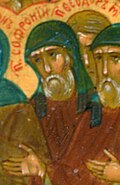 SophroniusVenerableMar 11
- Agape of AntiochMartyrMar 11
- Alberta of AgenMartyrMar 11