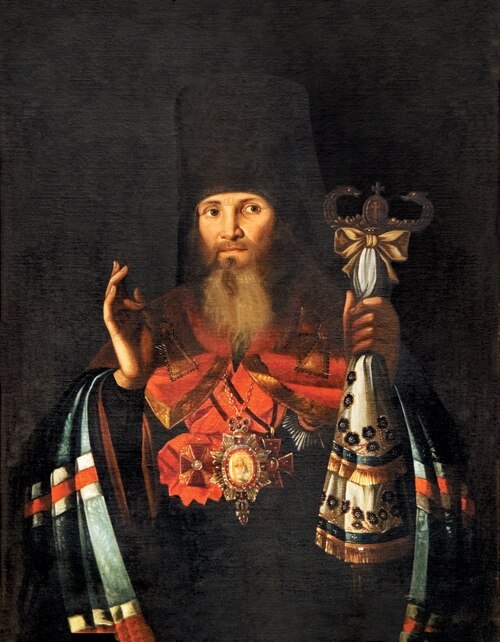
Saint
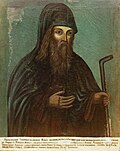
Gabriel Gorodkov
Hierarch of Ryazan
A hierarch of the Russian Church who served in the diocese of Ryazan.
Life
Holy Hierarch Gabriel Gorodkov, Archbishop of Ryazan, was a gentle and tireless shepherd, a scholar and lover of the poor, who led the Church of Ryazan through hard years of famine and cholera. He was born on 17 April 1785 and departed to the Lord on the eve of Pascha, 7 April 1862.
Childhood and studies
He was born in the village of Gorodkovichi in the Spassk district of the Ryazan province, in the family of the sacristan John Yakovlevich Gorodkov and his wife Evdokia Filippovna, and at baptism received the name George. His parents lived in poverty and were known for their gentleness, simplicity and fear of God. His father, according to the saint's memoirs, had not studied in the seminary schools, but in the school of Christ, in right faith and piety. In 1795 he was ordained priest at the Dormition church of their village.
From childhood he had no strong health, but in his weak body a mighty spirit dwelt, and gentleness and mercy were joined in him with a firm will and unusual diligence. From early on he knew hard work, helping his father in church and in the field.
In 1808 George finished the Ryazan seminary and had received a priest's place at the cathedral in Kasimov, where he was offered marriage to the daughter of Archpriest Polycarp Kistrussky. But in 1809 the Saint Petersburg Theological Academy was opened, and he, among the best, was chosen for the first course. He left in December 1808, giving his betrothed his word that he would return, but before half the course had passed the betrothed was given by her father to another, and George, who had long been thinking of monastic life, was assured once more of the way he had chosen.
At the academy he had as rector Archimandrite Philaret Drozdov and as inspector Archimandrite Philaret Amphiteatrov, with whom he formed a warm friendship, kept in letters to the end of his life. After six years he finished the academy with very good results and, on 24 August 1814, was appointed professor at the Ryazan seminary, where he lived as a perfect hermit, leading, though not a monk, a strict ascetic life.
Monk, rector and bishop
Wishing to serve the Lord in the monastic rank, he asked for tonsure, and Bishop Theophylact sent the Holy Synod within a week a petition for the tonsure of George Gorodkov and his appointment as archimandrite at the Holy Trinity Monastery in Ryazan. On 13 October 1815 he was clothed in the angelic schema with the name Gabriel, after the Archangel of the Annunciation, a name truly prophetic, because all his life he gave himself to the proclaiming of the Word of God, by word and by his whole life. On 16 October he was ordained hierodeacon, and on 22 October, on the feast of the Kazan icon of the Mother of God, hieromonk. From 27 December 1815 he began to lead the monastery. In 1816 he was raised to archimandrite, in 1817 appointed rector of the Oryol seminary and abbot of the Dormition Monastery there. His example of life helped many pupils choose their path; some became monks, rectors of academies and even bishops, among them John Alekseevich Borisov, the renowned Saint Innocent, Archbishop of Kherson and Tauris. In 1818 he was moved as rector of the Nizhny Novgorod seminary and given charge of the Makaryev monastery, then the Pechersky Monastery of Nizhny Novgorod.
On 20 May 1828, in the Kazan cathedral in Saint Petersburg, Archimandrite Gabriel was consecrated bishop of Kaluga and Borovsk. At Kaluga he received a proof of the protection of the Mother of God: in one Great Lent he was worn out by fever, and the doctors could not help him. He grieved above all that he could not serve and that in Holy Week the flock would be deprived of the washing of the feet. In a light sleep he saw an elder who told him to serve a supplicatory service with akathist before the icon of the Merciful One. After the service he could get up, and on Great Thursday he himself served in the cathedral, washing the feet, to the joy of the flock. He always counted this healing a miracle, through the icon of the Merciful One with which Bishop Theophylact had blessed him at his monastic tonsure. In his cell an unceasing lamp burned before it.
The Holy Synod moved him to the see of Mogilev, to carry through the return of the Uniates to Orthodoxy. Following the advice of Metropolitan Philaret, he accepted the obedience as from the hand of the Lord, and in his years in the Mogilev land about sixty thousand Catholics entered Orthodoxy. In speaking with people of another faith he avoided rebuke, for, he said, to rebuke is to irritate, and to irritate is to lessen the capacity to receive the truth.
Shepherd of Ryazan
After five years he was moved to the see of Ryazan and, on 21 July 1837, was met by the city clergy with cross, banners and holy icons. His fatherly heart was saddened by the calamity that had struck the city: the smoking ruins of houses burned in a dreadful fire. The archpastor strengthened the spirit of the sufferers with hope in the mercy of God, and in less than five years everything was rebuilt; new buildings were raised and nearly all the churches of Ryazan were renewed, and the saint looked over every plan himself.
He gave special attention to the Dormition cathedral, fallen into disrepair, and to the unfinished bell tower before it; in three years he consecrated the bell tower, and in 1857, on the feast of the Dormition of the Mother of God, he served the first service in the adorned cathedral.
In those years Ryazan was struck by calamities: the crop failure of 1838, the drought of 1840, the cholera of 1848, which took, among others, the lives of a hundred and fifty-five servants of the Church. Saint Gabriel strove to ease the people's life, giving generously from his own means. In time of famine bread was constantly baked at the bishop's house and distributed to the needy. Once he showed the governor a piece of black bread, black as peat, the bread of famine, and through the efforts of himself, the governor and the benefactor Ryumin the price of bread was lowered sevenfold. For the widows and children of departed clergy he ordered their allowances doubled and founded a school with full upkeep; each year at Pascha he sent his carriage to bring the girls to him, blessed them, feasted them and called them his orphans.
He loved poetry and wrote psalms and spiritual songs, appreciated by the people of Ryazan, and was interested in science; in 1837 he found in the documents of the Consistory old notes on the founding of Pereyaslavl of Ryazan, today Ryazan, in the year 1095. He greatly honoured the wonderworking Feodorovskaya icon of the Mother of God: he blessed a side chapel in its honour and, on 24 October 1852, carried it in his own arms in solemn procession to the Holy Trinity Monastery. In 1856 he was called to Moscow for the anointing to the throne of the emperor Alexander II, who gave him the diamond insignia of the order of Saint Alexander Nevsky. In 1858 he retired to the Olgov Monastery in Ryazan and chose his burial place near the right choir of the south side chapel of the Trinity church; coming to see it, he told the workmen that so ends all earthly honour and that beyond the grave only our good deeds will be met with honour.
Repose and veneration
From the beginning of 1862, at seventy-seven, he grew so weak that he could no longer rise from bed. On Palm Sunday he confessed, received communion and was anointed with oil. From then on his cell attendants read beside him now the akathist to the Sweetest Jesus, now the canon for the departure of the soul. On 7 April 1862, on the eve of the Resurrection, Saint Gabriel departed to the Lord. The burial was done, by order of his successor, Archbishop Smaragd, on the Friday of Bright Week, in the Archangel cathedral of the Ryazan Kremlin. For seven days the body lay in a stifling room, but no one noticed any smell of decay and the face did not change. Local people say that through his prayers the landslides of the bank ceased, and the monastery in which he had spent his last years was no longer endangered.
On 16 July 1999, with the blessing of Patriarch Alexy II, Archbishop Gabriel was glorified among the saints of local veneration. On 26 October 1999, on the feast of the Iveron icon of the Mother of God, his relics were found, then moved to the Holy Trinity Monastery in Ryazan and laid in a reliquary made for them. The Azbyka page gives for him the days 23 June and 23 September.
Commemorated the same day June 10
 Etheldreda of ElyVenerable · Abbess of ElyJun 10
 Olivia of PalermoMartyrJun 10
 John of TobolskSaint · Metropolitan of TobolskJun 10
 Maximus of AveiaMartyr · Deacon and martyrJun 10
 Basil of RyazanSaint · Bishop of Ryazan and MuromJun 10
 Mitrophan Chi SungHieromartyr · First Chinese Orthodox priestJun 10
 Dosifei of KyivVenerable · Rassophore at the Kiev Caves LavraJun 10
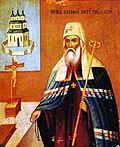 Philotheus of TobolskSaint · Metropolitan of Siberia and TobolskJun 10
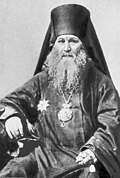 Gerasim DobroserdovSaint · Bishop of AstrakhanJun 10
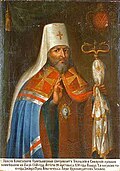 Paul of TobolskSaint · Metropolitan of TobolskJun 10
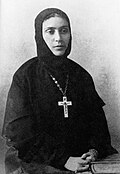 Schema-abbess Tamar MarjanishviliConfessor · Georgian schema-abbessJun 10
 Dalmat of IsetskVenerable · Founder of Dalmatov MonasteryJun 10